Classification shifting between operating and investing cash flow moves a receipt or payment from one section of the cash flow statement to the other. Putting an ordinary operating payment in investing makes cash flow from operations (CFO) look stronger by the size of the payment. A screen that uses CFO to measure how well earnings convert to cash can therefore improve even when customer collections and supplier payments are identical.
Follow the payment
A fictional manufacturer collects 180 from customers, pays 60 in wages, spends 20 on routine supplies consumed during the period, and pays 50 for machinery it recognises as property, plant and equipment. All amounts use the same currency units. There are no other cash flows or exchange rate effects. The supplies payment belongs in operating activities. The machinery purchase belongs in investing activities. IAS 7, paragraphs 14(c) and 16(a)
With the supplies payment in operating, CFO is 100 and cash flow from investing (CFI) is −50. If the company puts that payment in investing, CFO rises to 120 and CFI falls to −70. Both presentations reconcile to the same net change in cash.
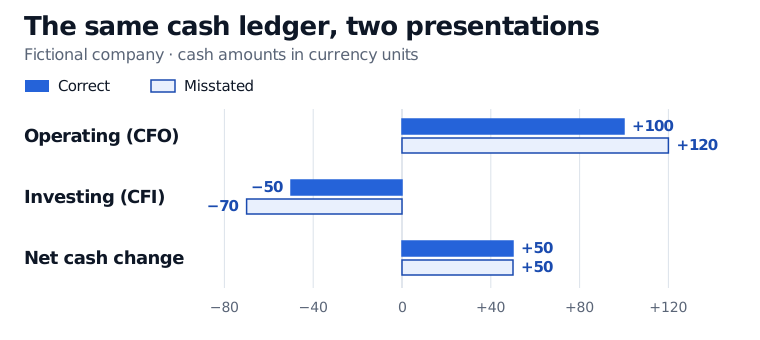
Moving the 20-unit supplies payment raises the operating subtotal and lowers the investing subtotal by equal amounts.
Moving a receipt can produce the same effect. Putting the proceeds from a sale of production machinery in operating also overstates CFO. IAS 7, paragraphs 14 and 16(b)
In a filing, an increase in CFO paired with a more negative CFI gives you two lines to investigate. Genuine equipment spending can also make CFI more negative while collections improve. Check the cash flow lines against the notes on capital spending and the operating cash reconciliation before attributing the change to a classification error.
When the section can legitimately differ
- Reporting policy. Before applying IFRS 18, a non-financial company applying IAS 7 can classify interest received in operating or investing activities, with consistent treatment across periods. Under the IAS 7 amendments that apply with IFRS 18, a company with neither investing in assets nor providing financing to customers as a main business activity classifies interest received as investing. IFRS 18 applies to annual reporting periods beginning on or after 1 January 2027, with early application permitted. Check the basis of preparation when comparing firms or years around that transition. IAS 7, paragraphs 31–34 · IFRS 18 effective date · IASB Effects Analysis, table 4
- The underlying obligation. In a supplier finance arrangement, a lender can pay the supplier before the buyer settles with the lender. The buyer's cash settlement is operating if the liability is still a trade or similar operating payable. Repayment of principal on a borrowing is financing. The terms can also change when cash actually leaves the buyer. Check where the liability sits on the balance sheet and compare the arrangement's payment dates with ordinary trade terms. IFRS Interpretations Committee, “Presentation in the statement of cash flows” · IAS 7, paragraphs 44F–44H
If you use financial statement data in a historical screen, keep reported CFO and any analyst adjustment as separate fields. Record which filing supports the adjustment and when it became usable. A subsequent correction enters the signal only once it becomes available.
The SelfMadeQuant capstone shows how a filing screen uses the gap between net income and reported CFO as an accrual ratio input. Financial Filing Change and Deterioration Monitor report (membership required)