Central bank independence is the degree to which a central bank can make monetary policy decisions free of government direction. Mandate design specifies the objectives it must pursue, who can define them more precisely, and how decision-makers answer for their choices. For a rates quant, that split matters when a headline could change the expected path of the policy rate. A committee vote, a minister’s speech and a change in the law carry different authority. Debelle and Fischer, How Independent Should a Central Bank Be?
Who sets the goals, and who sets the rate?
Suppose a legislature writes price stability and full employment into law and gives a central bank committee authority to set the overnight rate target. The legislature retains control over the statutory goals and the government has no routine power to direct rate decisions. The committee has instrument independence, also called operational independence in this context, because it chooses the rate setting it judges will best serve those goals. Goal independence is the freedom to choose the ultimate objectives. A law can fix broad goals while leaving some discretion over how to define them in practice, such as the numerical meaning of price stability. Fischer, Revisiting Goal Independence versus Instrument Independence
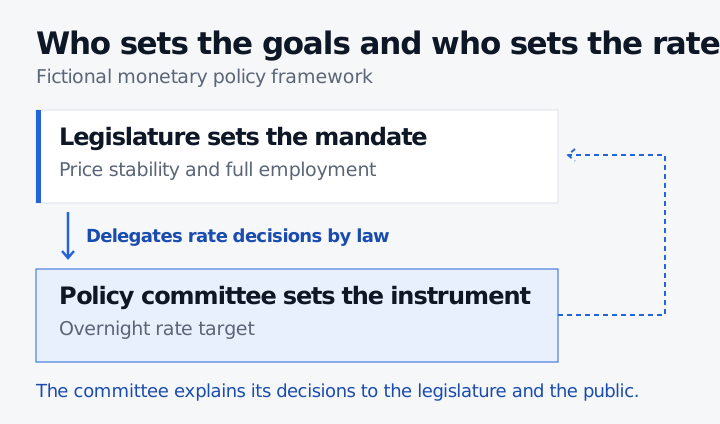
The solid arrow shows delegated authority. The dashed arrow shows who must explain the decision after the vote.
If inflation is high and employment is weakening, the committee has to weigh how quickly to bring inflation down against the effects of tighter policy on employment. A mandate can prioritise one goal or require policymakers to weigh both. Delegating rate decisions can reduce pressure to stimulate the economy ahead of an election, while reporting and hearings let elected representatives scrutinise how the mandate is being carried out. Appointment rules shape who votes over time. Day-to-day authority depends on who can direct or override those votes under the law and how the rules operate in practice. Fischer, Transparency, Accountability, and Communications, Kugler, Central Bank Independence and the Conduct of Monetary Policy
Australia separates the law, the target and the rate decision
Australia’s Reserve Bank Act 1959 sets economic prosperity and welfare as the bank’s overarching objective. It assigns the Monetary Policy Board responsibility for monetary policy in pursuit of price stability and full employment. In their July 2025 statement, the Treasurer and the Board give the price stability goal a practical meaning through flexible inflation targeting. The agreed range is 2–3% annual consumer price inflation, with an expected return to the 2.5% midpoint over a period that depends on economic conditions and the employment objective. The Board chooses the cash rate target. The Treasurer appoints external members, and the Board explains its decisions through published statements and minutes. Reserve Bank Act, sections 8AA, 9B, 25AB and 25AK, Statement on the Conduct of Monetary Policy
The Act also sets out a formal override in section 11. When the Government and a Board disagree on whether the Board’s policy serves the Australian public’s best interests, the Treasurer and Board first try to reach agreement. If they cannot, the Board gives the Treasurer a statement on the dispute. The Treasurer can then recommend that the Governor-General, acting on the Federal Executive Council’s advice, determine the policy by order. The Board gives effect to the order, the Government accepts responsibility and the Treasurer must table the prescribed documents in Parliament. Reserve Bank Act, section 11
Separately, the RBA can provide exceptional liquidity assistance to a solvent institution facing temporary liquidity pressure. That lending is a financial stability tool to contain the spread of funding stress. RBA, Contributions to Financial Stability
Reading a policy headline
A minister calling for lower rates may affect expectations through fiscal plans or future appointments. The current rate setting changes through an authorised policy decision. A change in the mandate can alter how the committee is expected to react to the same inflation and employment outlook across many meetings. When modelling either event, identify who can act, what instrument or rule could change, and when it could take effect. Reserve Bank Act, sections 9B, 11 and 25AB
An overnight indexed swap can help track repricing of the future rate path, with term premia also affecting the quote. RBA, Reassessing Australian Financial Conditions
Differences in inflation across countries can reflect different shocks or pre-existing attitudes to inflation. Those attitudes can also shape how independence is designed, making the effect of independence hard to isolate in a simple comparison. Debelle and Fischer, How Independent Should a Central Bank Be?
Sources
- Guy Debelle and Stanley Fischer, How Independent Should a Central Bank Be? (1994)
- Stanley Fischer, The Independent Bank of England (2017)
- Adriana Kugler, Central Bank Independence and the Conduct of Monetary Policy (2024)
- Reserve Bank Act 1959, compilation in force from 27 August 2026
- RBA and the Treasurer, Statement on the Conduct of Monetary Policy (10 July 2025)
- RBA, The RBA’s Contributions to Financial Stability
- RBA, Reassessing Australian Financial Conditions (26 March 2026)