Cariño logarithmic linking rescales period attribution effects to reconcile compounded arithmetic active return, including equal-return limits and numerical safeguards.
Cariño linking algorithm
The Cariño linking algorithm rescales single-period arithmetic attribution effects so that their sums explain the difference between compounded portfolio and benchmark returns. It lets a performance team turn a sequence of monthly attribution reports into a quarterly or annual report without leaving an unexplained compounding residual.
It starts after performance attribution has assigned each period's active return to effects such as allocation and selection. Linking changes how those effects aggregate through time; it does not decide which investment decisions belong in each effect.
Two correct monthly reports can produce a wrong total
Consider a fictional portfolio with two consecutive reporting periods. Returns are simple returns, measured on the same basis for portfolio and benchmark. Effects are contributions to their arithmetic return difference, expressed in percentage points (pp).
Period
Portfolio return
Benchmark return
Effect A
Effect B
Sum of effects
1
10.0%
5.0%
+3.0 pp
+2.0 pp
+5.0 pp
2
−5.0%
−2.0%
−1.0 pp
−2.0 pp
−3.0 pp
Each row reconciles. Adding the rows gives A = +2.0 pp, B = 0.0 pp and a total of +2.0 pp. However, compounding gives
The extra 0.4 pp in the raw sum is a mismatch between addition and compounding. It is not an additional investment decision. A and B can represent any exhaustive, consistently defined arithmetic effects; the numbers alone do not identify them as allocation or selection.
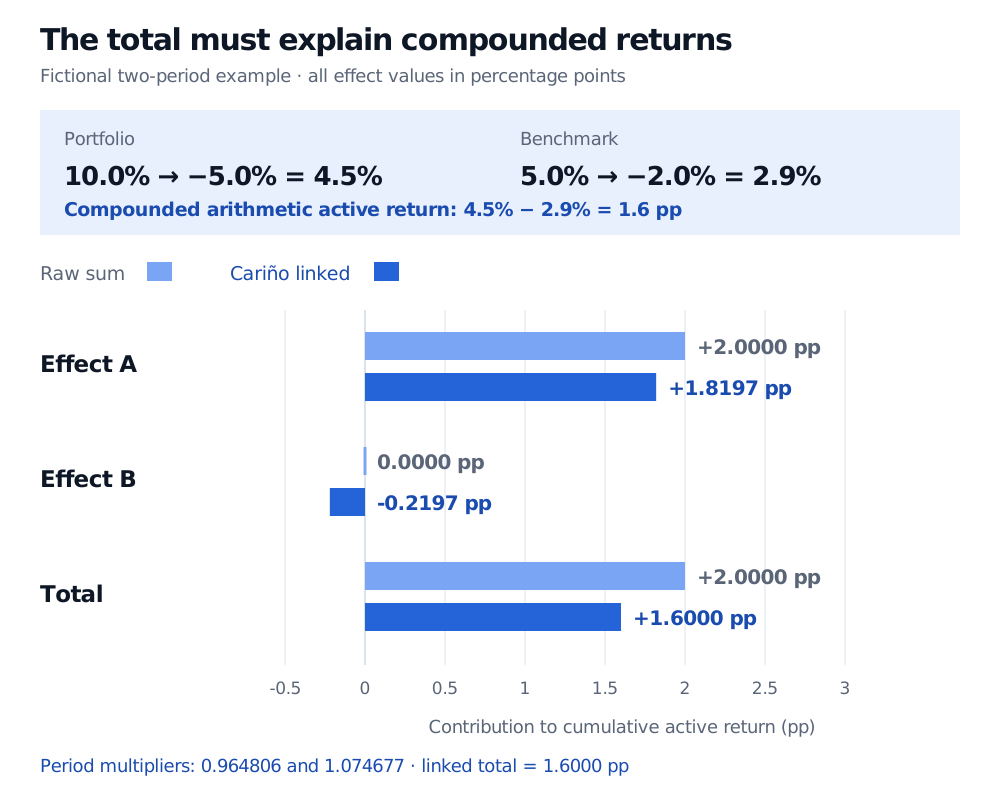
Fictional two-period attribution. Raw sums give Effect A 2.0000 percentage points, Effect B zero and total 2.0000. Cariño linking gives A 1.8197 points, B minus 0.2197 and total 1.6000, matching compounded portfolio return 4.5% less benchmark return 2.9%.
Original fictional example. The same period multiplier applies to every effect in that period; linked contributions are percentage points of cumulative arithmetic active return.
Pass through logarithms, then return to percentage points
Let aj,t be effect j in period t, in decimal return units. Require the effects to exhaust that period's active return:
j∑aj,t=rp,t−rb,t.
Write Rp=∏t(1+rp,t)−1 and define Rb similarly. Cariño's logarithmic coefficients are
These formulas, including the equal-period-return limit, are documented in the original R-Finance implementation. The mechanism can be checked directly: multiplying a period's active return by kt converts it into a difference of log wealth factors. Those log differences add across periods. Dividing by K converts the combined log difference back to the cumulative arithmetic return difference:
The linked effects are +1.81974131 pp and −0.21974131 pp, summing to +1.6 pp. Effect B no longer cancels: its negative second-period contribution receives a larger multiplier. The multipliers are scaling coefficients, not portfolio weights or probabilities; they need not sum to one.
Equal returns are a limit, not an exception to reconciliation
When rp,t=rb,t=r, differentiation of log(1+r) gives
kt=1+r1.
The same reasoning applies to the entire reporting horizon: if Rp=Rb=R, use K=1/(1+R). Equal cumulative returns do not require every individual effect to vanish. Positive and negative linked effects can offset to zero.
In numerical work, evaluate logarithms with log1p. For nearby returns x,y, an equivalent divided difference is
x−ylog(1+1+yx−y).
Computing its numerator with log1p((x-y)/(1+y)) avoids subtracting nearly equal logarithms; use 1/(1+y) at exact equality. Apply the same care to the cumulative coefficient. Every period requires 1+rp,t>0 and 1+rb,t>0: a loss of 100% or more falls outside this real-log formulation. Linking also cannot repair inconsistent valuation dates, fee bases or a single-period attribution that fails to reconcile.
What the linked report means
The target here is Rp−Rb. Geometric attribution instead concerns relative wealth growth, (1+Rp)/(1+Rb)−1; the two targets differ. Compounding the portfolio and benchmark does not by itself make this an attribution of the geometric target.
Cariño linking is one allocation convention for the compounding adjustment. Menchero optimised linking provides another approach to reconciling arithmetic effects. An exact total does not establish a unique economic explanation, validate the original effect definitions or demonstrate manager skill. Keep the linking convention consistent when comparing reports, and distinguish a mechanically linked contribution from alpha.
For a separate view of what attribution can diagnose, Performance Attribution: Selection, Sizing, and Timing examines the investment decisions behind idiosyncratic P&L (full lesson requires membership; public preview available). Its decision decomposition is a complement to choosing how return effects link over time.
Sources
David R. Cariño, Combining Attribution Effects Over Time, The Journal of Performance Measurement, Summer 1999, pp. 5–14. Publisher listing identifies the original paper; the full text is sold separately.
Andrii Babii, R-Finance PortfolioAttribution: Carino.R, documentation and implementation of the logarithmic linking coefficients. The cumulative equal-return limit above follows from differentiation; the inspected implementation explicitly handles period equality but does not guard cumulative equality.