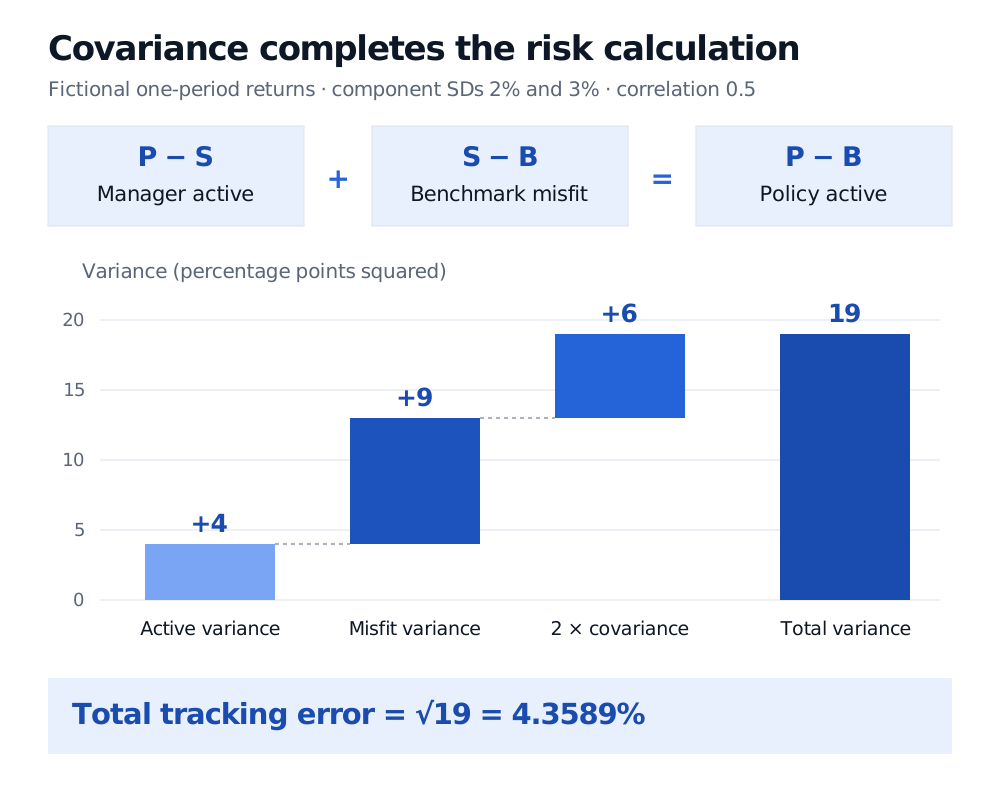
Separate manager-active risk from policy-benchmark mismatch, and see why covariance turns 2% and 3% component risks into 4.358899% total tracking error.
Benchmark misfit risk
Benchmark misfit risk is the variability of returns arising because a manager’s benchmark differs from the investor’s policy benchmark. A manager can stay close to its mandate while the investor receives exposures that depart from the intended allocation. Measuring only the manager’s tracking error can therefore miss a separate source of benchmark-relative risk.
The distinction starts with the benchmark portfolio: which reference answers which question? A broad equity index might represent the investor’s policy allocation, while a value index represents a deliberately chosen manager mandate. Differences between the two are not necessarily a manager error. They can reflect the investor’s decision to hire a specialist.
Two comparisons inside one active return
Let RP be the managed portfolio’s simple total return, RS the manager benchmark’s return and RB the policy benchmark’s return. Use the same period, currency and consistent return conventions. Then the exact arithmetic identity is
The first component asks how the manager performed against its assigned reference; the second records what that reference delivered relative to policy. MSCI’s historical manager-risk framework explicitly separates these comparisons. Its multi-manager treatment also incorporates allocation weights; the identity here isolates one mandate, without a separate regional allocation decision. Miller and Rao, 2014, pp. 2–5.
Neither component is automatically alpha. A value mandate’s outperformance of a broad policy index may be a style payoff, while the manager’s own active return can include systematic exposures, fees and noise. Calling the residual “selection” does not establish skill.
Here, standalone misfit risk means σM=SD(M). Its contribution to the investor’s total tracking error is a different question: it depends on co-movement with the other component.
A 2% manager can sit inside a 4.36% policy-relative risk
Consider fictional, one-period, zero-mean return components with
σA=2%,σM=3%,ρAM=0.5.
These are stipulated population moments, not forecasts estimated from market data. The covariance is 0.5(0.02)(0.03)=0.0003 in squared decimal-return units. Therefore
Variance waterfall for fictional one-period components: manager active variance is 4 percentage-points squared, misfit variance is 9, and twice covariance adds 6. Total variance is 19, giving tracking error of 4.3589%.
Original fictional one-period variance ledger. The bars add squared percentage-point units; the final square root restores return units.
Adding the standalone standard deviations gives 5%, which would require correlation +1 here. Taking the square root of 22+32 gives about 3.6056%, which would require zero covariance. Neither convention matches the stated correlation. Holding these two component standard deviations fixed, changing correlation across its full feasible range changes total tracking error from 1% to 5%.
The moments can be reproduced without simulation. Each row below has probability 1/4; entries are return differences in percentage points, rounded to four decimals.
Fictional state
Manager active A
Misfit M
Policy active A+M
1
−2.0000
−4.0981
−6.0981
2
−2.0000
+1.0981
−0.9019
3
+2.0000
−1.0981
+0.9019
4
+2.0000
+4.0981
+6.0981
All three means are zero. Averaging the squared total returns gives 19 percentage-points squared, using the unrounded values. Divide by four: these rows specify an entire probability distribution. Dividing by three would instead apply the usual sample-variance correction to four observations, answering a different question. The zero means make the arithmetic transparent; the variance identity also holds with nonzero means after centring.
What the diagnosis changes
A useful oversight report keeps three return series: portfolio versus manager benchmark, manager benchmark versus policy, and portfolio versus policy. Their covariance explains how the components combine. Reporting only two standalone volatilities leaves the total unresolved.
The benchmark choice must be explicit. A mandate benchmark fixed in advance and an effective benchmark fitted from observed returns answer different questions. Campisi’s historical analysis uses regression-based effective exposures to distinguish structural allocation effects from selection; its results depend on the chosen segments and estimation period. A fitted reference is not automatically the manager’s agreed mandate. Campisi, 2022, “Determining Each Fund’s Effective Exposures” and “Incorporating Misfit Risk into Active Return Attribution Analysis”.
Misfit volatility is nonnegative, but its contribution to total risk can be reduced by offsetting co-movement. With multiple managers, cross-manager covariances and mandate weights matter too. A large standalone misfit number is therefore a prompt to examine the intended exposures and aggregation, rather than proof that the manager violated the mandate.
To build the underlying calculations, Expectation, Variance and Covariance works through probability-weighted moments and portfolio variance; the full lesson requires a free signed-in account. Mean-Variance Optimisation, §2.3, develops active weights and benchmark-relative risk; the full lesson requires membership, with a public preview.