Distinguish auction participation from imbalance-only offsets, check a fixed-price share ledger, and understand Nasdaq opening OIO restrictions and fill risk.
Auction-only and imbalance-only orders
An auction-only order restricts execution to a specified auction. An imbalance-only order adds a narrower purpose: it supplies eligible interest to offset an auction's excess buying or selling, subject to the venue's matching restrictions. For an execution model, these qualifiers determine whether an order may trade at all; a recorded auction price alone cannot establish a fill.
The distinction is between participating in the event and being eligible to offset particular interest within it. An imbalance-only instruction can itself be auction-only. The two labels therefore describe overlapping restrictions, rather than two mutually exclusive trading venues.
Three questions behind one order ticket
A call auction collects orders before matching them. Its participation instructions answer different questions:
Question
Instruction dimension
What it does not establish
Which event may execute the order?
Auction-only: for example, a specified opening or closing auction
A fill outside that event
Which auction interest may it match?
Imbalance-only: an offset restriction defined by that venue
Permission to trade against every opposing order
Which prices are acceptable?
A limit or a permitted market instruction
Guaranteed execution of the requested quantity
For example, a market-on-close order seeks a closing-auction execution without an investor-selected limit price. A limit order adds a price boundary. Neither description by itself says that the order is imbalance-only. Conversely, calling an order imbalance-only does not specify its complete entry, repricing or cancellation rules.
A seller can reduce excess buying
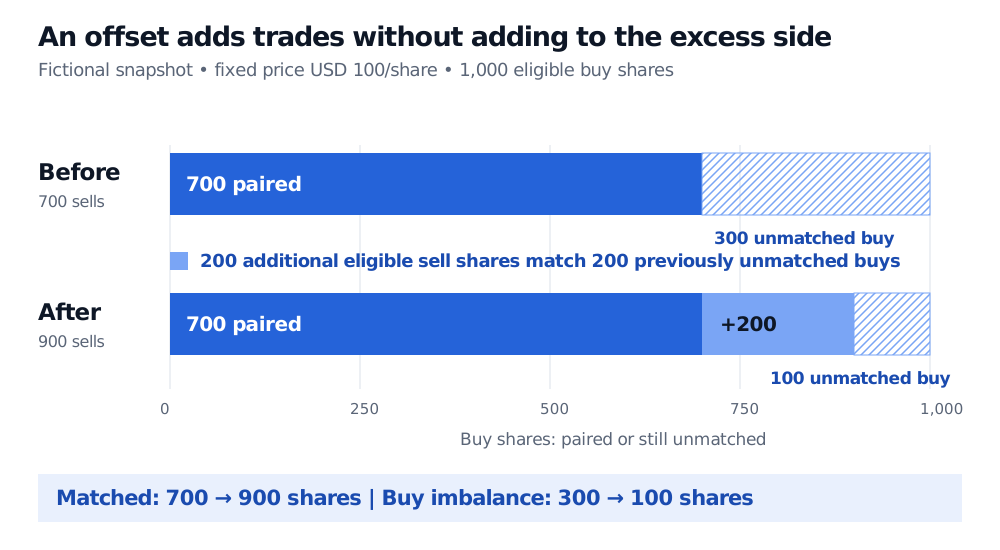
Consider a fictional auction with a fixed illustrative price of USD 100 per share. At that price there are 1,000 eligible buy shares and 700 eligible sell shares. Assume these shares can match without other restrictions. The matched quantity is 700 shares, leaving a 300-share buy imbalance. Each trade has a buyer and seller; it is still counted once.
Now introduce an imbalance-only sell order for 200 shares. Stipulate that its limit permits execution at 100, its counterparties are eligible, and all 200 receive an allocation. Hold the price and all other interest fixed to isolate the quantity arithmetic:
The new seller adds 200 traded shares and removes 200 shares of excess buying. It does not add 400 trades by counting both sides. At the stipulated price, traded notional rises from USD 70,000 to USD 90,000, before fees.
Fictional auction at fixed USD 100 per share: 1,000 eligible buy shares and 700 sell shares pair 700, leaving 300 buys unmatched. Adding 200 eligible sell shares raises paired quantity to 900 and reduces unmatched buys to 100.
Original fixed-price teaching ledger, with quantities in shares. Blue bars show paired buy shares; hatching shows unmatched buys. The lighter 200-share segment is the additional match supplied by the new seller. This is not a venue price-discovery or priority algorithm.
This calculation holds the price fixed; it does not discover a clearing price. In an actual auction, new interest can change indicative prices, eligibility and competing allocations. Nor does the initial 300-share imbalance reserve a personal allocation for this seller. A competing offset, a price restriction or the disappearance of executable excess interest can leave the order partly or wholly unfilled.
One implementation: Nasdaq's opening OIO
Nasdaq's current rulebook, checked 31 October 2026, defines an Opening Imbalance Only order (OIO) as a priced order executable only in the Opening Cross and only against Market On Open, Limit On Open or Early Market Hours orders. It is not a general continuous-book sell or buy. Entry is allowed from 04:00 ET until cross execution, but cancellation or modification is prohibited at or after 09:25 ET; orders arriving after the cross are rejected. For an aggressively priced OIO, the rule repeatedly adjusts a buy toward the Nasdaq Book's highest bid, or a sell toward its lowest offer, without moving beyond the stated limit. These are Nasdaq opening-order rules, not universal auction conventions. Equity 4, Rule 4702(b)(10).
Nasdaq's explanatory FAQ also distinguishes on-open participation from imbalance-only liquidity and explains that indicative information precedes the cross. Its summary material supports the purpose of the orders; the rulebook supplies the precise order conditions above. Opening and Closing Crosses FAQ, order types and questions 11–13.
The practical trap is that new-order entry can remain open after an existing order becomes non-cancellable. An algorithm must not infer an ability to withdraw from an ability to submit. Broker deadlines can also precede an exchange's acceptance window.
Model the restriction before crediting the trade
An auction backtest needs more than the final opening-auction or closing-auction print. Record the intended auction, permitted counterparties, side and limit, arrival and acknowledgement times, allowed amendments, final allocated quantity and treatment of any remainder. Use the imbalance information actually available at the decision; the final imbalance and final price become known later. Selecting an earlier order with those later observations creates look-ahead bias.
A useful separation is accepted → eligible → allocated → confirmed. An accepted imbalance-only order may receive no allocation. An auction-only remainder cannot simply be assumed to continue trading after the event; that requires a separately specified instruction.
Market, Limit and Conditional Orders develops price protection, partial fills and cancellation acknowledgements, which help keep requested auction quantity separate from confirmed positions. The preview is public; the full lesson requires membership.
Sources
Nasdaq, Equity 4: Equity Trading Rules, Rule 4702(b)(10), read 31 October 2026: OIO scope, eligible counterparties, entry and cancellation restrictions, repricing and post-cross rejection. The article uses the current codified rule, rather than a proposed rule change.
Nasdaq, The Nasdaq Opening and Closing Crosses: Frequently Asked Questions, copyright 2025, order-type discussion and questions 11–13: cross-only participation and imbalance-offset purpose. This explanatory document contains historical/pending footnotes; exact OIO conditions here follow the current rulebook.