Appraisal rights let eligible shareholders in certain mergers seek a court determination of their shares’ fair value in place of the merger consideration. Appraisal arbitrage is buying shares in order to pursue that claim, often after a deal is announced. In ordinary cash merger arbitrage, the deal terms set the payout if the transaction closes as agreed. In appraisal, closing starts the clock on a claim whose value and payment date are still uncertain. Delaware General Corporation Law § 262 · Wei v. Zoox, Inc., p. 22
Which shares can reach appraisal in Delaware?
- Eligibility depends on the shares and the deal terms. Delaware’s market-out rule generally excludes exchange-listed shares or classes with more than 2,000 holders of record. In covered transactions, holders regain appraisal rights if they must take consideration other than qualifying shares or depository receipts, cash for fractional interests, or a mix of those. Certain short-form mergers also qualify. The market-out provision separately excludes surviving-company shares when § 251(f) dispenses with their holders’ vote. § 262(b)
- Shareholders must preserve the claim. For a merger submitted to a stockholder meeting, this means making a separate written demand before the vote, holding the shares continuously from demand through effectiveness and neither voting for the merger nor consenting to it in writing. A vote against the deal by itself leaves the demand requirement unsatisfied. Approval by written consent or a § 251(h) tender-offer merger follows different demand deadlines, and beneficial owners demanding in their own names have additional documentation requirements. § 262(a), (d)
- A timely demand is only the first step. A qualifying claimant or the surviving entity must file a petition within 120 days of effectiveness. For a class listed on a national securities exchange immediately before the merger, the court dismisses unless the aggregate shares entitled to appraisal exceed 1% of the eligible class or series, their aggregate deal consideration exceeds USD 1 million, or the merger qualifies under § 253 or § 267. § 262(e), (g), (k)
Fair value can come in below the offer
The Delaware Court of Chancery values the shares as of the merger’s effective date. It considers all relevant factors while excluding value created by or anticipated from the merger itself. That matters when a buyer shares some of the expected merger synergies with the target’s shareholders through the offer price. In Aruba, HP agreed to pay USD 24.67 per share. The Delaware Supreme Court reversed the trial valuation and directed entry of judgment at USD 19.10 per share plus any interest due, using a deal-price-less-synergies estimate supported by the record. § 262(h) · Verition Partners Master Fund Ltd. v. Aruba Networks, Inc., pp. 2–3, 24–26
Suppose a fictional cash merger pays USD 40 per share at closing and the court later sets fair value at USD 37 per share. The appraisal principal is USD 3 below the merger consideration, before separately applicable interest and costs.
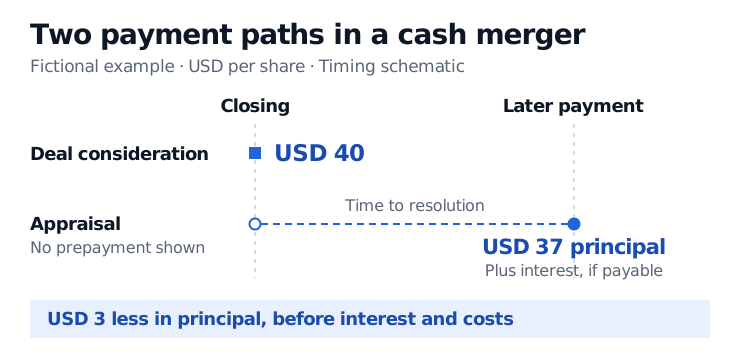
Appraisal changes both the amount and the timing of the payment. The timeline is schematic.
Delaware’s default interest rule runs from the merger’s effective date to payment of the judgment. Interest compounds quarterly at five percentage points above the Federal Reserve discount rate, including any surcharge. The court may vary that rule for good cause. If the survivor prepays, subsequent interest runs on any unpaid fair value and accrued interest still outstanding. § 262(h)–(j)
For a comparison as of closing, take the present value of any prepayment and final recovery, deduct the present value of expected legal and expert costs, and compare the result with USD 40 in hand. With a delayed payment and no prepayment, even USD 3 of interest would only match the deal in nominal dollars before costs. The purchase price is a separate benchmark for the investor’s total profit or loss. Before closing, the investor also bears the risk of being left with target stock if the deal falls through.