Anchoring bias lets a starting number exert undue influence on a judgment. Separate a stock’s purchase price from its forward payoff forecast and distinguish an anchor from a useful prior.
Anchoring bias
Anchoring bias is the undue influence of a starting number on a later judgment: an irrelevant reference can pull an estimate toward itself, or a once-useful estimate can receive too little adjustment when evidence changes. In trading, an entry price can become a target that feels justified simply because it is where the investor bought. The quant consequence is a forecast contaminated by personal trading history rather than supported by the forward opportunity set.
“I will sell when it gets back to 100”
Consider a fictional stock bought for USD 100 and now trading at USD 80. A decision maker treats 100 as the natural destination for the stock, although the purchase itself supplies no new information about future cash flows.
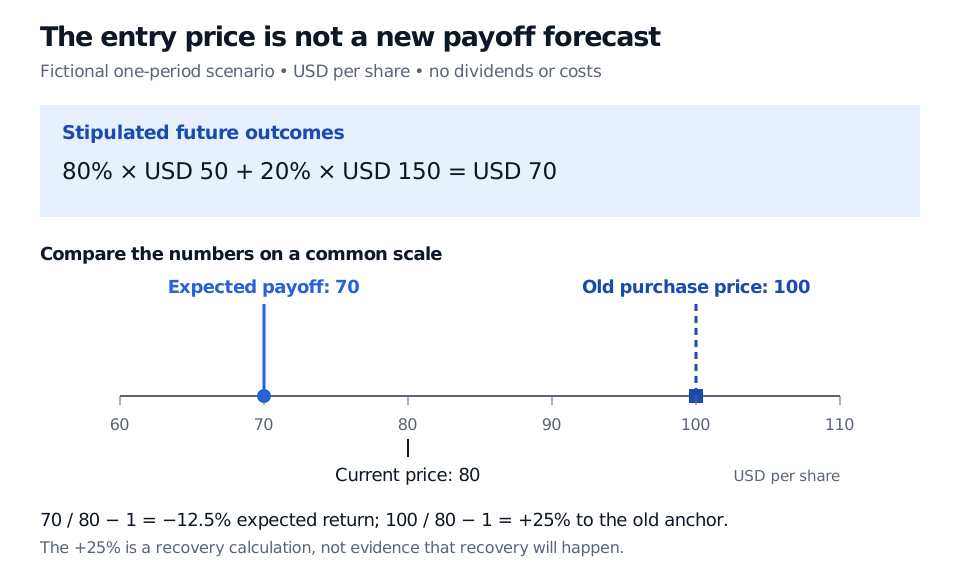
To isolate that mistake, stipulate that the stock's value at the end of one period will be USD 50 with probability 80%, or USD 150 with probability 20%. These are invented, exhaustive scenarios, not market estimates. Ignore dividends, taxes, transaction costs and discounting. The expected payoff is
E[S1]=0.8(50)+0.2(150)=70.
Measured from today's price, the expected simple return is
E[R]=8070−1=−12.5%.
By contrast, a return to the entry price would produce
80100−1=25%.
That 25% is the gain required to recover the old price, not an expected return. It contains no probability assessment. Under the stated probabilities, 70 is an expected future payoff; it is neither a risk-adjusted fair value nor a recommendation about a real position. A full decision would also specify alternatives, risk preferences, financing and relevant constraints.
Fictional future payoffs of USD 50 with 80% probability and USD 150 with 20% probability imply USD 70 expected payoff. Current price is USD 80 and old purchase price USD 100. Expected return is minus 12.5%; recovery to the old price would be plus 25%.
Original fictional scenario. The solid marker is the stipulated expected payoff; the dashed marker is the historical purchase price. Neither the purchase price nor a desired recovery supplies a probability forecast.
Even a partial revision can preserve the mistake. Suppose, purely for illustration, someone averages the unsupported 100 target and the scenario mean of 70 with equal weights. The resulting forecast is 85, implying a positive expected return of 85/80−1=6.25%. The invented weighting flips the sign compared with the stipulated forecast. The 50% anchor weight is fictional: it is not an estimated psychological parameter, an empirical causal effect or a rule for modelling investors.
A prior earns its weight through information
Using a starting estimate is not automatically biased. A prior probability can encode relevant historical information; an update may rationally be small when new evidence is noisy. The question is whether the starting value's influence is justified by what it tells us about the quantity being estimated.
An earlier market price may contain useful information about the issuer. A purchase price can also matter for taxes, accounting or a contract tied to that price. Those channels must be modelled explicitly. They do not make “I paid 100” independent evidence that the future price will be 100. In the fictional example, the stipulated distribution already supplies the entire forward outlook, and those additional channels are excluded.
A useful diagnostic is to ask whether two otherwise identical decision makers, facing the same current price, information, taxes and constraints, would produce different payoff forecasts solely because they bought at different prices. Such a difference calls for an explanation. A difference in trading actions alone is less informative: positions, hedging needs or preferences may differ.
The effect and the mechanism are different claims
Tversky and Kahneman's original account, in “Adjustment and Anchoring,” describes estimates drawn toward their starting values, including an experiment in which arbitrary numbers from a wheel influenced numerical judgments. This supports the possibility that a reference need not be informative to affect an estimate; it does not calibrate an entry-price effect in stock trading.
Epley and Gilovich's experiments distinguish self-generated anchors from externally supplied comparisons. They find evidence of insufficient adjustment from self-generated starting values, while discussing accessibility of anchor-consistent information as an explanation for effects in the standard externally supplied-anchor task. An estimate near an anchor does not, by itself, prove a conscious sequence of small adjustments.
Anchoring also differs from loss aversion: one concerns the formation of a judgment, the other the relative subjective weight of losses and gains. The disposition effect describes a selling pattern. Holding a losing stock does not establish which mechanism, if any, caused the choice.
Make the forecast inspectable
A research or trading review can record the forward scenarios, their probabilities and the information supporting each before comparing them with a proposed target. Keep the entry price available for performance and tax calculations, while requiring an explicit information-based reason for its inclusion in a forecast. This is a process check, not a guaranteed cure: forecasts remain uncertain even when the irrelevant anchor is removed.