Trade receivables are amounts customers owe for goods or services already sold. The allowance for doubtful accounts is a balance-sheet account that reduces those receivables by the amount the company expects to lose to nonpayment. Under US GAAP’s current expected credit losses model (CECL), a seller estimates losses when it recognises an in-scope trade receivable and updates the estimate at each reporting date. A credit sale can therefore enter earnings under accrual accounting while the seller already expects to collect less than the full invoice. FASB, ASC 326-20 as introduced in ASU 2016-13, Summary and paragraph 15-2
Estimate losses on unpaid invoices
An aging schedule groups open invoices by how far past their due dates they are. For invoices that share similar credit risk, the company can estimate losses using historical loss rates by age, adjusted for current conditions and reasonable, supportable forecasts. An invoice still within its payment terms can carry an expected loss. If a customer’s bankruptcy makes its risk unlike that of the rest of its group, the company evaluates that balance separately. A lender can use the same CECL framework for in-scope loans, but its estimates reflect the loans’ own contractual lives, payment profiles and recovery prospects. FASB, ASU 2016-13, ASC 326-20-30-2, 30-8–30-9 and Examples 1, 4 and 5
A fictional wholesaler ends the period with 100 currency units of gross trade receivables after write-offs and collections. The company uses the following assumed loss rates for the remaining lives of the invoices, with no further recoveries expected on balances it has already written off.
| Invoice status | Gross receivables | Expected loss rate | Estimated loss |
|---|---|---|---|
| Within terms | 70 | 2% | 1.4 |
| 1–60 days past due | 20 | 13% | 2.6 |
| More than 60 days past due | 10 | 60% | 6.0 |
| Total | 100 | 10.0 |
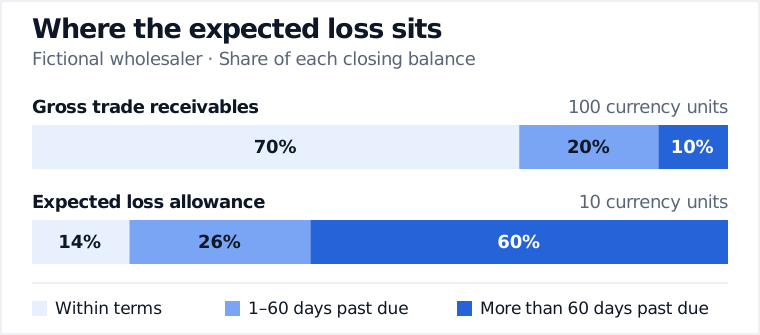
The oldest invoices are 10% of the gross balance and 60% of the estimated loss. A change in the age mix can move the allowance even if total receivables hold steady.
For eligible current receivables and contract assets arising from revenue transactions under Topic 606, ASU 2025-05 lets entities assume that balance-sheet-date conditions persist for the assets’ remaining life. An entity other than a public business entity that elects this option can also elect to consider collections after the balance sheet date, through the date the statements are available to issue or a specified earlier cutoff. The update applies to annual periods beginning after 15 December 2025 and their interim periods, with early adoption permitted. The wholesaler example uses the standard forecast-based approach. FASB, ASU 2025-05, ASC 326-20-30-10A–10H and 326-10-65-6
Reconcile the allowance to the provision
The wholesaler starts the period with an allowance of 8. It writes off 5 of invoices it deems uncollectible, reducing gross receivables and the allowance by the same amount. The write-off leaves net receivables and current-period expense unchanged at that point. The company also collects 1 in cash on an invoice written off earlier and credits it to the allowance. An actual recovery is recorded when received. The allowance estimate also includes expected recoveries, up to the total of amounts previously written off and those expected to be written off. FASB, ASU 2019-04, ASC 326-20-30-1 and 35-8
With no other movements, the allowance sits at 4 after the write-offs and recovery. The aging schedule calls for a closing allowance of 10, so the company records a provision of 6 as credit loss expense for the period. The provision adjusts the estimate without moving cash.
Read the note alongside the balance sheet
In its 2025 Form 10-K, Rollins reports a trade allowance of USD 23.528 million on net trade receivables of USD 202.518 million. In the trade column of its allowance note, the company adds a USD 23.777 million provision, deducts USD 27.141 million of write-offs and adds USD 7.122 million of recoveries to the USD 19.770 million opening balance. Adding the trade allowance back to the net amount gives USD 226.046 million of gross trade receivables. The financed-receivables column covers a separate asset balance. Rollins, 2025 Form 10-K, Consolidated Statements of Financial Position and Note 4
When comparing periods, divide the allowance by gross receivables of the same scope and date. A falling allowance ratio could reflect better collections on overdue accounts, a younger invoice mix or the removal of heavily reserved invoices through write-offs. The movement table helps distinguish those explanations. Pair it with any disclosed aging, customer concentrations and changes to the estimate when assessing earnings quality.
Sources
- FASB, ASU 2016-13, Measurement of Credit Losses on Financial Instruments
- FASB, ASU 2019-04, Topic 326 amendments on write-offs and recoveries
- FASB, ASU 2025-05, Measurement of Credit Losses for Accounts Receivable and Contract Assets
- Rollins, Inc., Form 10-K for the fiscal year ended 31 December 2025