Eligibility comes before the spin
Consider a desk that wants to compare three brokers' VWAP algorithms for a defined segment of equity orders. The wheel first needs to establish which orders belong in that segment and which broker–algorithm combinations are permitted for each one. Region, instrument coverage, order size relative to available liquidity, price limits and urgency can change that eligible set.
This is a different decision from the execution algorithm's scheduling and venue choices. In the example here, the wheel assigns a parent order to a broker algorithm; that algorithm then manages its execution. Smart order routing may determine where individual child orders seek liquidity. A wheel need not replace those downstream decisions.
Ten assignments, one realised cost
| Broker algorithm | Target assignment probability | Realised parent count | Realised notional | Observed average cost |
|---|---|---|---|---|
| A | 50% | 5 | USD 5m | 5 bp |
| B | 30% | 3 | USD 3m | 4 bp |
| C | 20% | 2 | USD 2m | 6 bp |
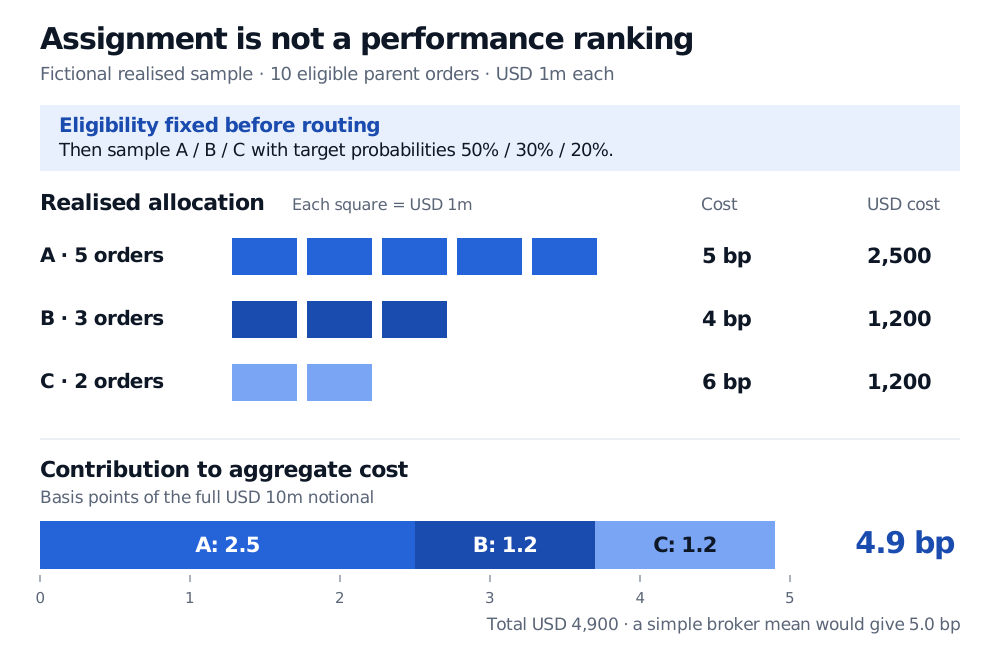
The simple average across the three algorithms, bp, gives each algorithm equal weight. It does not measure cost per dollar of this realised flow. With unequal parent notionals, even weighting by parent counts would be insufficient. For intended notional and consistently defined parent cost in bp, use
Why B's 4 bp is not a verdict
B has the lowest observed cost in the example. Yet it received only three parents, and nothing in the table establishes their difficulty or the uncertainty of the result. Perhaps they were liquid stocks traded during quiet periods, whereas A received urgent orders in wider spreads. That is confounding: the cost difference could reflect the flow rather than the broker algorithm.
Random assignment within a suitable eligible population can support a causal comparison by making assignment independent of potential execution outcomes. It balances difficulty in expectation, not exactly in every small sample. Predefined strata for liquidity, size and urgency can improve comparability; they do not remove sampling uncertainty. Restrictions that leave a broker eligible only for easy orders limit the comparison to conditions in which alternatives could actually have been assigned.
The benchmark can also change the ranking. Arrival-price slippage asks a different question from interval-VWAP slippage, and a favourable filled-price measure may hide poor completion. Complete-parent implementation shortfall can include the opportunity cost of unfilled quantity under a stated evaluation horizon. Choose the benchmark, fee treatment, completion measure and review window before seeing which algorithm looks cheapest.
Reweighting changes the experiment
A desk may change future allocation weights after reviewing transaction-cost analysis. The Robeco paper studies the resulting exploration–exploitation problem: allocating to apparently stronger brokers while retaining information about alternatives. It also notes that changing market conditions and broker improvements can distort pooled comparisons over time.
An operational review therefore needs dated policy versions, the eligible panel and probabilities at each assignment, pretrade characteristics, algorithm parameters, completion records and consistent benchmarks. A reweighting decision must use outcomes available at that time; tomorrow's completed trade cannot inform today's route. If weights adapt, the analysis must account for that assignment history rather than treating the entire sample as a fixed equal-probability trial.
A wheel makes allocation explicit and testable. Whether it improves execution still depends on its eligibility rules, evaluation design and subsequent evidence. A low average cost alone does not establish best execution.
Sources
- SEC staff, Staff Report on Algorithmic Trading in U.S. Capital Markets (5 August 2020), pp. 35–36 — historical description of wheel allocation, constraints and performance measurement; not a statement of current adoption or a compliance safe harbour.
- Jian Yang and Brett Jiu, Algorithm Selection: A Quantitative Approach (25 April 2006), pp. 4–6 — broker researchers' framework for suitability, benchmarks and conditional algorithm evaluation.
- Lars ter Braak and Martin van der Schans, Optimal Order Routing with Reinforcement Learning, author-uploaded manuscript dated 16 November 2023, “Evaluating brokers” and “Discussion and conclusion” — buy-side study of weighted assignment, metrics and adaptive allocation. Its simulation findings are conditional on the studied setup, not performance guarantees.