How public bearish research differs from ordinary short selling and ownership activism, with a checked short-position ledger, borrow risk and report-event interpretation.
Activist short selling
Activist short selling combines a short position with a public negative investment thesis intended to change other investors' assessment of a company. The thesis may challenge its valuation, business model, accounting or disclosures. For a quant, the public report is an information event; the position's profit still depends on borrow, financing and executable purchase and sale prices.
The distinguishing feature is public advocacy of the bearish thesis. Ordinary short selling can remain private. Shareholder activism generally uses an ownership position to press for changes, potentially through voting or board representation. An activist short seller usually seeks repricing through information rather than voting control. A negative report is not automatically a fraud allegation: a company can be real, accurately reported and simply valued too highly in the author's model.
Three layers in a report
A useful reading separates what the author observed, what the author infers and what the author believes the shares are worth.
Layer
Fictional example
What still needs checking
Observation
A published filing reports receivables growing faster than revenue
Definitions, consolidation scope, period alignment and the original filing
Interpretation
The report argues that collections are deteriorating
Customer terms, seasonality, acquisitions and the issuer's evidence in response
Valuation
The author lowers forecast cash flows and estimates a lower equity value
Forecast assumptions, discount rate, financing needs and alternative scenarios
The observation can be correct while the inference is wrong. Even a sound inference does not establish a unique fair price. Allegations of misconduct remain allegations unless independently established; an issuer's denial is also a claim to assess against evidence.
The authors' 2018 account of research on public short campaigns describes disclosures made through conferences, media and investor letters, with theses ranging from overvaluation to business-model concerns and fraud. Their historical evidence associates campaigns with negative abnormal returns and changes in other stakeholders' behaviour. An association in that selected sample does not prove each report correct, establish a causal effect for a new campaign or provide an attainable trading return.
The report does not pay the stock-loan bill
Consider a fictional cash-equity short, unrelated to any actual issuer. An investor borrows and sells 100 shares at USD 50, then buys them back 30 days later at USD 30 and returns them. The price gain is
100(50−30)=USD 2,000.
Stipulate a 5% annual simple borrow fee, ACT/360, on the constant initial USD 5,000 notional. This is an example convention; an actual loan can use a changing charge base and rate. The fee is
B=5,000×0.05×36030=USD 20.833333….
Profit after this fee is USD 1,979.17, rounded to cents. Assume no dividend compensation, commissions, taxes, research costs, cash interest, short rebate or other financing charges. Assume both fills are executable, the share loan continues and the account can meet every interim collateral requirement. The SEC's explanation of short sales explains the share-return obligation, margin, fees and dividend compensation that a full ledger must consider.
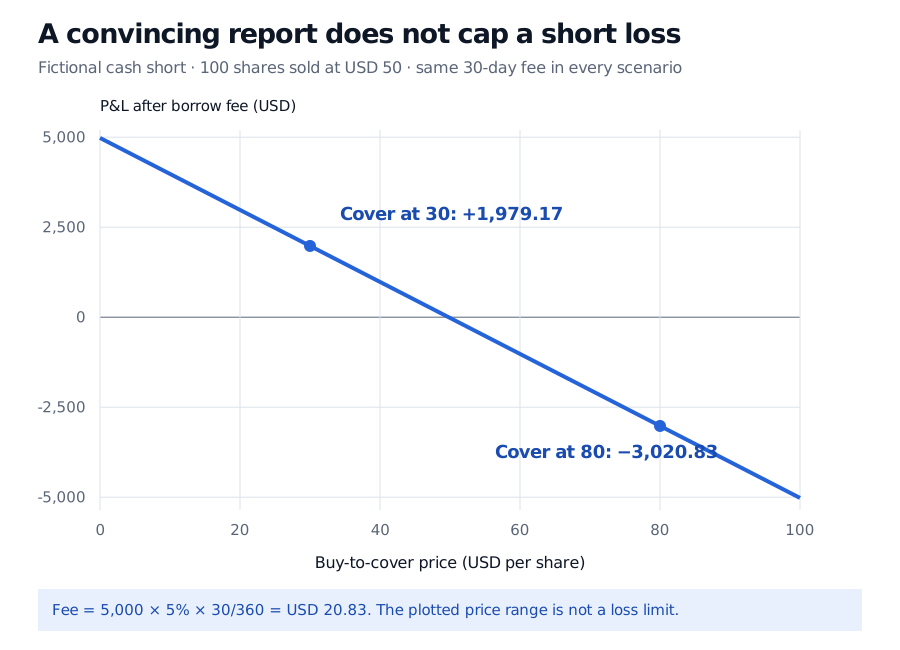
If the same position instead closes at USD 80 after 30 days, the gross price result is −USD 3,000, or −USD 3,020.83 after the same fee. Publishing persuasive research does not cap this loss.
Fictional 100-share short sold at USD 50. With a fixed USD 20.833333 borrow fee, cover at USD 30 gives USD 1,979.17 profit, and cover at USD 80 gives a USD 3,020.83 loss. Higher cover prices keep increasing losses.
Original fictional close-out sensitivity. Every scenario holds the 30-day borrow fee fixed to isolate price exposure; the chart is not a forecast, a simulated trading path or a guaranteed executable outcome.
The USD 5,000 sale proceeds are not free capital: they accompany an obligation to return shares and may be restricted as collateral. No percentage investment return is calculated here because the investor's own equity, collateral and funding arrangements have not been specified. A margin call can force closure before the eventual price decline; endpoint profit alone misses that path dependence.
Borrowing securities introduces a second deadline. A lender can recall shares; if replacement borrow is unavailable, the short may need to close. Fees can change, and an adverse price move can trigger buying to cover, contributing to a short squeeze. Glover and Hulley's short-selling model treats margin and recall risk as separate constraints on the ability to wait. It does not calibrate this fictional trade or guarantee a particular close-out policy. The owned Short Selling lesson develops these cash-flow and stock-loan mechanics; its public preview is open, and the full lesson requires membership.
The timestamp is part of the strategy
A researcher measuring a report's impact must distinguish the author's entry, the first public release, issuer responses and subsequent verification. These dates answer different questions. An after-close report cannot be acted on at an earlier regular-session closing price. The first executable opportunity depends on the venue, session rules, investor access and any halt. The release price may be unavailable to anyone who learns the thesis from the report.
The author also chooses whether and when to publish. An event study around that chosen date measures a selected disclosure event, not an experiment that randomly assigned bearish research to companies. Earnings, financing news or an issuer response can share the window. An abnormal return depends on its expected-return benchmark and does not identify how much money the report's author made.
For a dataset, preserve the original report version and first public timestamp, separate allegations from later findings, and retain campaigns that were rebutted or had no price impact. Starting with well-known successful campaigns builds selection into the result. Borrow availability and costs need contemporaneous observations; a later observation is not evidence that the same position could have been opened earlier. Event Definition develops release dating, sample screens and confounding-news checks. A public preview is available; full teaching requires membership.
Market integrity and the financial conflict
Useful negative research can challenge an optimistic consensus. False or misleading claims can instead distort price formation. The label “activist” establishes neither information quality nor misconduct.
Australian guidance, checked 30 October 2026: ASIC's INFO 255, issued in May 2021 and still linked from its current short-selling resource page, recommends objective, verifiable analysis, attention to contrary evidence, fact checking and clear conflict disclosures, including short positions and relevant payments. These are ASIC's stated better practices, not a universal legal safe harbour. Applicable law also depends on jurisdiction and conduct; disclosing a position does not make a misleading claim accurate.