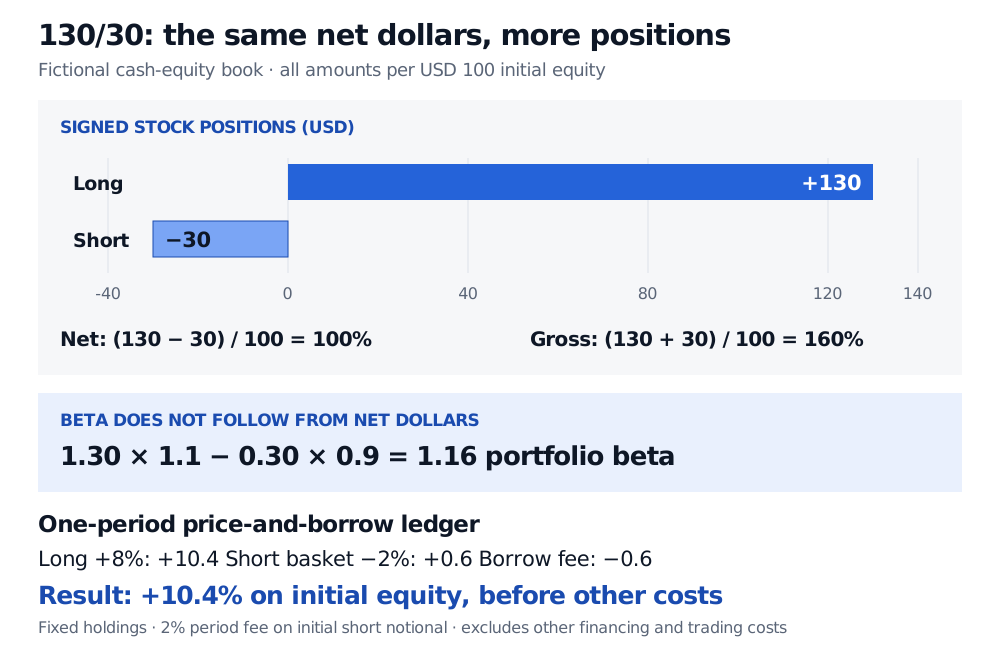
How a 130/30 active extension relaxes long-only constraints: a capital ledger, 100% net and 160% gross exposure, costs and beta risk.
Active extension strategy
An active extension strategy is a benchmark-relative equity strategy that permits limited short selling and uses the resulting financing capacity to extend the long book, while keeping a specified net long exposure. A 130/30 portfolio, for example, holds long positions worth 130% of equity capital and short positions worth 30%, giving 100% net exposure. The practical purpose is to express negative stock-selection views more strongly than a long-only portfolio permits. It also increases the size of the positions that must be financed, traded and risk-managed. AQR's relaxed-constraint framework places these portfolios within benchmark-relative equity management.
It is a particular use of a long–short portfolio, rather than a synonym for every strategy with both long and short positions. In particular, 130/30 does not mean market neutrality.
Why extend a long-only book?
Suppose a stock has a 0.1% weight in the benchmark portfolio. A long-only manager who dislikes it can hold zero, producing an active weight of only −0.1 percentage points. A desired active weight of −0.5 percentage points would require an actual holding of −0.4% of capital: a short position.
That is the constraint an active extension relaxes. It lets the manager increase selected underweights beyond “do not own it,” and balance them with additional longs. The extension can be constructed jointly with the rest of the portfolio; it need not consist of an untouched index plus a separately managed overlay. AQR's original 2016 discussion, Section 2 explains the zero-holding floor and the extra flexibility created by shorting.
More faithful implementation helps only if the forecasts are useful. A bad ranking can be expressed more faithfully too.
Read 130/30 as a position ledger
Use USD 100 of initial equity capital. Let L be the positive dollar value of long stocks and S the positive magnitude of the short-stock obligation. At entry, L=130 and S=30:
Net exposure=EL−S=100%,Gross exposure=EL+S=160%.
Net exposure describes the signed stock position; gross exposure counts both sides. More generally, with long exposure 1+s and short exposure s, net exposure is one and gross exposure is 1+2s, measured relative to equity. Mandates may specify targets or maximum exposures; the product label alone does not tell you the permitted deviations or rebalancing rules.
Short-sale proceeds are paired with a liability. They do not turn USD 100 into USD 130 of wealth. For example, suppose the broker retains the USD 30 short-sale proceeds as restricted cash and finances the extra USD 30 of longs through a debit balance. One simplified opening balance sheet is:
Opening item
USD
Long stocks owned
130
Restricted short-sale proceeds
30
Obligation to return shorted stocks
−30
Financing debit
−30
Equity capital
100
This illustration assumes sufficient eligible collateral and borrowing capacity. It does not prescribe an actual broker's margin or haircut rules. The short proceeds may be restricted even though the overall financing arrangement supports the extended long book. Financing interest, collateral income and stock-loan charges must be accounted for separately. The SEC's margin-interest bulletin illustrates why cash and debit balances cannot simply be assumed to offset on identical terms.
Follow the money through one period
Keep the entry share quantities fixed for a fictional period. Assume no dividends, and let the long basket's price return be +8% and the shorted basket's own price return be −2%. These are basket returns, so the short position earns the negative of the shorted basket's dollar price change:
Πprice=LRL−SRS=130(0.08)−30(−0.02)=11.
Contribution
USD per USD 100 initial equity
Long-stock price gain
+10.4
Short-stock price gain
+0.6
Price P&L before costs
+11.0
Stipulated stock borrow charge
−0.6
P&L after this charge, before other costs
+10.4
The borrow charge is a hypothetical 2% for the whole period, applied to the constant initial short notional of USD 30. It is not an annual rate or a market quote. Thus the return after this charge is 10.4/100=10.4%, using initial equity as the denominator.
The long stocks finish at USD 140.4 and the short obligation at USD 29.4. With the illustrated restricted cash and financing debit unchanged, equity is 140.4+30−29.4−30−0.6=110.4 before other costs. The opening 130/30 proportions drift; keeping them at their targets would require trading.
This partial ledger leaves out financing interest, collateral rebates or interest, trading costs, management fees and taxes. Dividends, if present, require both long receipts and compensation on the borrowed shares. The SEC's short-sale bulletin, updated September 9, 2026, describes the stock-loan obligation, charges and dividend payments. A real stock borrow fee can vary over time and use a different charging base. The 10.4% result is therefore neither a fully costed fund return nor evidence of alpha.
Fictional USD 100 equity book: USD 130 long and USD 30 short give 100% net and 160% gross exposure. Basket betas 1.1 and 0.9 give portfolio beta 1.16. Price gains of USD 11 less a stipulated USD 0.6 borrow charge leave USD 10.4 before other costs.
Original fictional fixed-holdings illustration. Dollar values are per USD 100 initial equity. The 2% period borrow charge uses initial short notional; other financing and trading costs and distributions are excluded.
A net-long budget is not a risk budget
The position sizes alone do not determine market beta. If the long basket's estimated beta is 1.1 and the shorted basket's beta is 0.9, the equity-normalised linear-model beta is
βp=1.30(1.1)−0.30(0.9)=1.16.
Net dollar exposure is 100%, but estimated beta is 1.16. It would equal one only under additional conditions on the baskets. Beta estimates also change. Sector, style, concentration and liquidity exposures need their own limits; the “30” is not a limit on total losses.
Performance evaluation consequently needs a specified benchmark and tracking error, alongside costs and absolute risk. A positive portfolio return can come from a rising equity market, unintended factor tilts or stock selection. Merely subtracting a benchmark return does not establish risk-adjusted alpha.
Finally, the intended short portfolio must be borrowable and affordable. Recall of borrowed shares, changing fees, collateral calls and insufficient liquidity can force a position change before the forecast plays out. Glover and Hulley's short-selling model treats margin and recall risk as separate frictions. Increasing the long and short books creates implementation demands even when net exposure stays fixed.
For the optimisation mechanism behind the extension, SelfMadeQuant's Portfolio Constraints lesson develops the long-only active-weight floor and its interaction with risk targets. The public page previews the lesson; the full teaching requires membership.