Universal consistency means that a learning rule approaches the best attainable prediction risk for every fixed data distribution within a stated setting as its training sample grows. For a quant using historical analogues, this answers an asymptotic question about learning a stable relationship; it does not establish that today's dataset is large enough or that tomorrow's market follows the same law.
The destination is Bayes risk
Consider binary classification. Training data contain independent, identically distributed pairs from a fixed distribution , where , is fixed and finite, and . A fresh test pair follows the same law independently of training. For the fitted classifier , define
The infimum runs over measurable classifiers using these features. is Bayes risk under zero–one loss: the lowest possible error probability, which can remain positive when labels are noisy. Universal describes which distributions the guarantee covers, not perfect prediction. Collins, Kumari and Pestov, §1.
Here, weak universal consistency means
The expectation also averages over training samples. Because zero–one risk is bounded, this is equivalent to convergence of the conditional risk in probability. Strong consistency instead requires almost-sure convergence along the growing training sequence. We use the weak statement below. Biau and Devroye, §17.2.
Two requirements that pull in different directions
For unweighted k-nearest neighbors, use ordinary Euclidean distance, break equal distances by the smaller original training index, and predict class 1 only when its vote exceeds one half; a class-vote tie predicts 0. With this convention, a deterministic integer schedule is weakly universally consistent if
This is the sufficient direction of Biau and Devroye's Corollary 19.1, with the distance-tie convention in §8.3. The first condition supplies increasing averaging; the second prevents averaging a permanently positive fraction of the sample.
Take the illustrative schedule :
| Training records | Neighbors | Fraction |
|---|---|---|
| 100 | 10 | 0.10 |
| 10,000 | 100 | 0.01 |
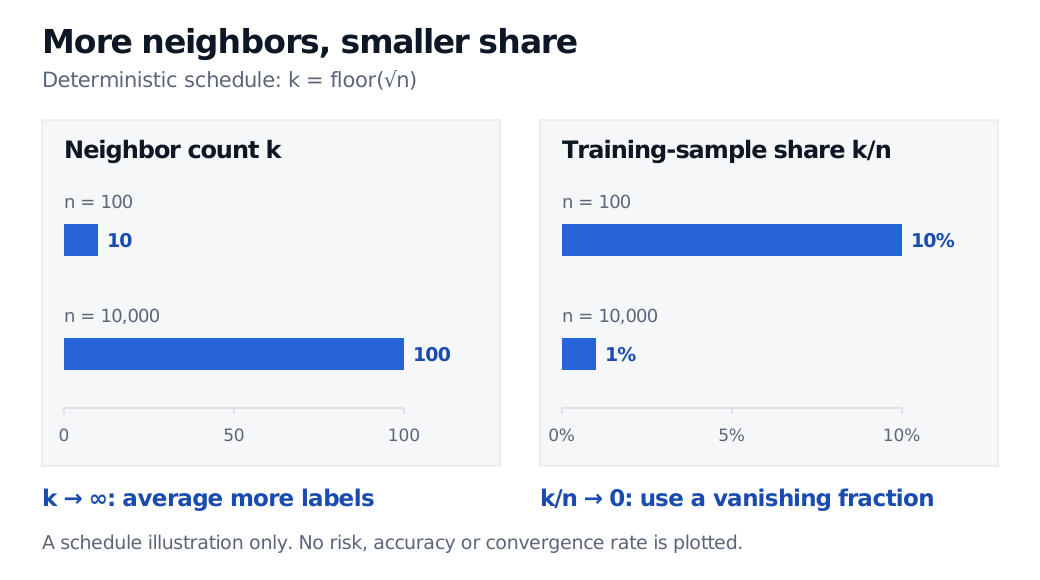
More labels enter each vote, while the selected fraction of the training sample shrinks. These are schedule values, not measured prediction results.
The two rows illustrate the schedule; the limit claim follows from , so grows without bound while . Neither row specifies an accuracy. Nor is this schedule a practical tuning recommendation. The curse of dimensionality still matters at finite sample sizes; the theorem holds dimension fixed.
Why keeping one neighbor differs. Suppose all features equal zero and independent labels equal 1 with probability 0.8. Under the index tie rule, 1NN always copies the first training label. Its expected test error is for every sample size. Always predicting 1 attains Bayes risk . Collecting more records does not close this gap when the rule still copies one noisy label. This exact example separates fixed-1NN behavior from consistency with growing ; a bound on fixed-1NN risk is not a claim of convergence to Bayes risk.
For the voting rule and finite-data geometry, see k-Nearest Neighbours and the Curse of Dimensionality (membership; public preview).
“Every distribution” has no common deadline
For weak consistency, the sample size needed to make excess risk small with high probability may depend on . The statement does not supply one distribution-independent accuracy deadline. By comparison, agnostic PAC learning specifies a hypothesis class and a sample threshold depending on the class, error tolerance and confidence, valid across distributions. Its benchmark is the best risk within that class, which can exceed Bayes risk. The quantifiers and benchmarks differ. Shalev-Shwartz and Ben-David, Definition 3.3 and §7.4.
For market prediction, serial dependence and concept drift need separate analysis. Merely calling a process stationary does not make its observations IID. Adding older observations from a changing regime does not reproduce the fixed-distribution experiment above. Even in that experiment, minimum classification error is a different objective from trading profit after costs.
Sources
- Collins, Kumari and Pestov (2020), Universal consistency of the k-NN rule in metric spaces and Nagata dimension, §1: classification risk, Bayes error, weak and strong consistency, and tie distinctions.
- Biau and Devroye (2015), Lectures on the Nearest Neighbor Method, §8.3: index-based distance ties; §17.2: consistency definitions; §19.1, Corollary 19.1: growing-neighborhood classification consistency.
- Shalev-Shwartz and Ben-David (2014), Understanding Machine Learning: From Theory to Algorithms, Definition 3.3: agnostic PAC learnability; §7.4: distribution-dependent consistency.