The U.S. Department of Agriculture’s World Agricultural Supply and Demand Estimates (WASDE) is a monthly report that projects annual supply and use for major agricultural commodities. The Crop Progress report from USDA’s National Agricultural Statistics Service (NASS) estimates how far selected U.S. crops have progressed and how their condition is rated during the growing season. Analysts use the field survey to update their expectations for the harvest and the WASDE balance to see how production, demand and trade together change the inventory outlook. USDA outlook process · NASS survey guide
Read the balance for one marketing year
The World Agricultural Outlook Board issues WASDE and chairs the interagency committees that prepare it. The committees combine data, analysis and expert judgment. NASS supplies most U.S. crop production forecasts used in the process. In a grain balance, ending stocks, also called carryout, are the inventory expected to remain at the end of the commodity’s marketing year. The marketing year is the accounting period for that crop. For U.S. corn it begins on September 1. USDA outlook process · February 2026 WASDE, p. 12
Take a fictional U.S. corn marketing year, with every entry in million bushels. Begin with 100 in inventory, add 500 produced and 10 imported, then subtract 450 of domestic use and 50 of exports.
The 110 is the projected year-end balance under those inputs. During the year, an updated production or usage forecast can move carryout even though the inventory at the end of the year has yet to be measured.
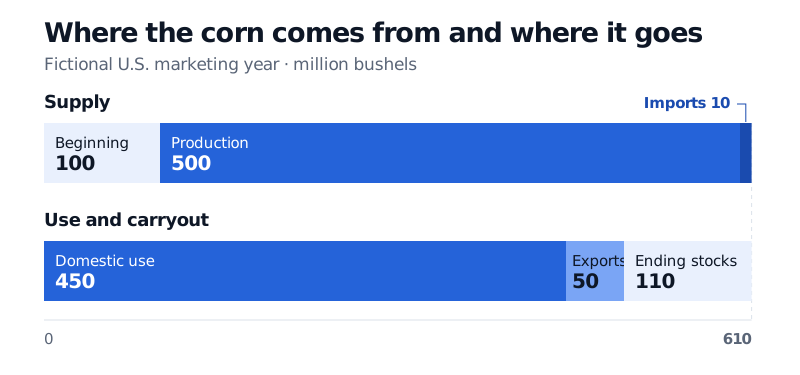
In the fictional balance, domestic use and exports account for 500 million bushels of the 610 available. The remaining 110 carry into the next marketing year.
An actual revision shows why it pays to look past production. The February 2026 WASDE raised projected U.S. corn exports for 2025/26 from 3,200 to 3,300 million bushels compared with the January projection. Projected supply and domestic use held steady, so projected ending stocks fell from 2,227 to 2,127 million bushels. Both columns refer to the same marketing year. February 2026 WASDE, p. 12
Read progress and condition separately
Progress measures the estimated share of acreage at or beyond a specified stage, such as emerged, or where an activity such as harvest is complete. Condition divides the crop into five qualitative grades from very poor to excellent. The estimates come from a non-probability survey of field observers, and NASS weights the summaries by acreage. A fall in the share rated good or excellent can prompt a closer look at yield prospects, but the grades provide no fixed conversion to bushels per acre. Compare the same crop, stage and geography, since fast development and high condition ratings describe different things. NASS survey guide · NASS terms and definitions · Crop Progress methodology
Keep the release vintage
A WASDE revision measures the change since the previous projection. A surprise in commodity futures research instead compares the released figure with what was expected just before publication. An export increase that traders already anticipated can produce a revision without much surprise.
To avoid look-ahead bias, record both the period the number describes and the time that particular version became public. A NASS estimate refers to a week ending before release and can be revised in the following issue. A WASDE file can also be corrected after release. USDA reposted its May 2026 issue the next day to correct a wheat-by-class table. If a backtest assigns the corrected values to the original publication time, it gives the model information that was unavailable at that time. Crop Progress revision policy · May 2026 WASDE archive and correction notice
Sources
- USDA Economic Research Service — USDA Outlook Process
- USDA World Agricultural Outlook Board — February 2026 WASDE, U.S. Feed Grain and Corn Supply and Use, p. 12
- USDA National Agricultural Statistics Service — Crop Progress and Conditions survey guide
- USDA National Agricultural Statistics Service — National Crop Progress terms and definitions
- USDA National Agricultural Statistics Service — May 11, 2026 Crop Progress, Statistical Methodology, p. 12
- USDA National Agricultural Library — May 2026 WASDE release and correction notice