Symbolic alpha search discovers explicit trading-signal formulas. Follow one expression from operator grammar and input timing to a losing trade and an auditable research search.
Symbolic alpha search
Symbolic alpha search automatically constructs and evaluates mathematical expressions as candidate alpha signals. It searches over formula structure—inputs, operators and their arrangement—rather than merely tuning parameters inside one fixed formula. The practical attraction is an inspectable forecasting rule. The practical danger is that automation can search historical noise just as efficiently as it searches useful relationships.
A formula is symbolic because its operations remain explicit. For example, a tree can have prices and constants at its leaves, division and subtraction above them, and negation at its root. Searching those trees is genetic programming when proposals evolve through selection, subtree crossover and mutation; a genetic algorithm is the broader evolutionary-search family. AutoAlpha, Sections 2–3, develops an evolutionary method for formulaic factors. Symbolic search need not be evolutionary: Yu and colleagues' AlphaGen learns a policy for assembling expressions and evaluates their contribution to a combined factor model.
Specify a language before searching it
The grammar defines which expressions the search may propose. Its terminals might be point-in-time prices, volume and a finite set of constants. Its operators might include arithmetic, positive integer lags, trailing-window means and ranks. Depth or expression-length limits control complexity. These choices define the candidate universe; they are research decisions, not neutral plumbing.
The name of an operator is insufficient. Kakushadze's operator appendix distinguishes a cross-sectional rank from a rank over trailing observations. The former compares assets at one formation time; the latter compares one asset's values through time. Neither requires future data. Ranking an observation against its entire eventual history does.
Operator or input
Contract the researcher must fix
Add or subtract
Compatible units: a price plus a share count has no ordinary financial interpretation.
Divide
Nonzero denominator and a policy for near-zero values, missing values and infinities. A price divided by its own lagged price is dimensionless.
Logarithm
Strictly positive, dimensionless argument under the chosen definition; a log price ratio satisfies that unit requirement.
Lag or rolling window
Positive lag, instrument-specific session indexing, trailing endpoints and minimum history. No centred window.
Cross-sectional rank
An eligible point-in-time universe, contemporaneously available values, and declared tie/missing-value treatment.
These are proposed research contracts, not claims that every published package enforces them. The AlphaGen authors' expression code implements explicit operator classes, but its ordinary division and logarithm delegate directly to tensor operations. A syntactically valid tree can still produce invalid numerical values. “Protected division” is also a different operator: replacing a zero denominator with a fallback changes the formula and must be documented.
Input availability travels through the tree. A trailing mean that includes the final close is not known before that close becomes available. A formula using it must wait for receipt and computation, then trade at a feasible later time. Shifting rows cannot repair future-aware source data or scaling fitted using the full history. Any estimated preprocessing must use only the eligible training data at each fit. The lesson Observation, Event and Availability Timestamps develops the signal-to-fill clock; its public page is a preview and the full lesson requires membership.
A transparent expression, followed by a losing trade
Consider this fictional candidate for stock i:
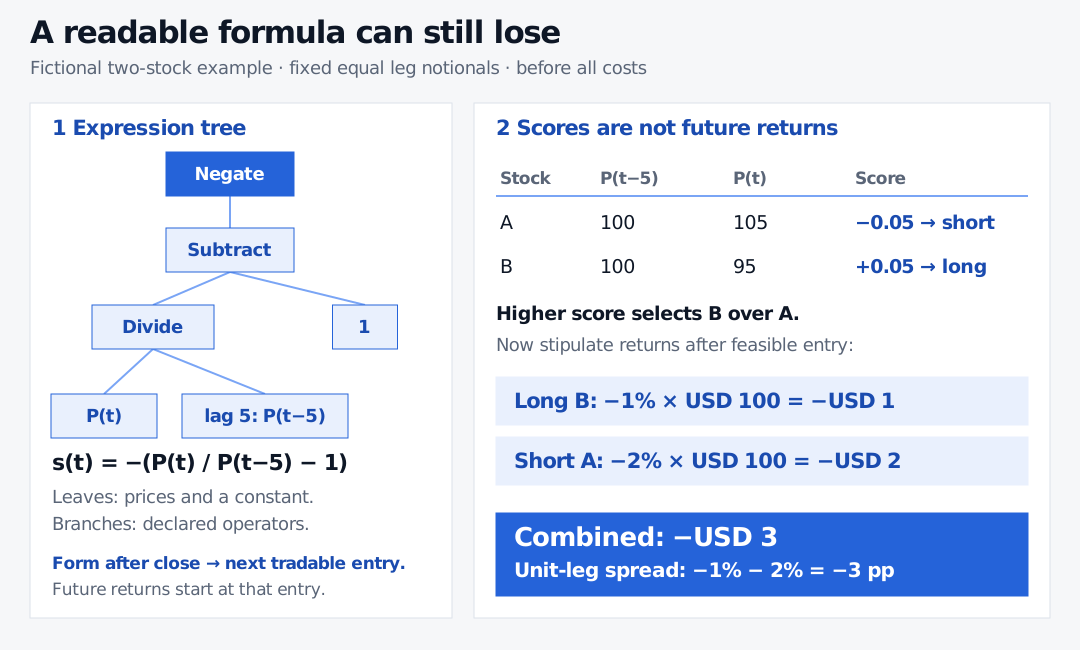
si,t=−(Pi,t−5Pi,t−1).
Here P is a strictly positive closing-price series on a consistent adjustment basis; five means five trading sessions for that stock. Assume no corporate actions in the example. All formation inputs become available after session t closes. The policy computes the score then enters at the next tradable opportunity. The future returns stipulated below begin at that feasible entry, not at the already observed close.
Stock
Price five sessions earlier
Formation close
Score
Stipulated subsequent simple return
A
100
105
−0.05
+2%
B
100
95
+0.05
−1%
The score reverses the recent price move: B, the recent loser, ranks above A. It is a mean-reversion hypothesis. A score of 0.05 is not a calibrated forecast of a 5% future return. Here it is just the output used for ordering stocks.
Suppose the portfolio buys B and shorts A, with equal fixed initial notionals. Assume both trades fill and the short is borrowable. On the convention “one unit long minus one unit short,” the subsequent payoff is
RB−RA=−1%−2%=−3 percentage points.
For USD 100 on each leg, the long loses USD 1 and the short loses USD 2: total P&L is −USD 3 before costs. Dividing by USD 200 of gross notional gives −1.5%; a return on equity needs a separate equity denominator. The −3 percentage-point spread is not automatically a −3% return on account capital. Borrow charges, financing and trading costs are excluded here.
Fictional expression tree negates the five-session price return. A moves from 100 to 105 and scores minus 0.05; B moves from 100 to 95 and scores plus 0.05. Long B then loses USD 1 and short A loses USD 2 on USD 100 each, for minus USD 3 before costs.
Figure: An explicit expression makes its inputs and reversal hypothesis visible. It still loses in this stipulated future: the unit-leg spread is −3 percentage points, before costs.
This is an arithmetic counterexample to equating readability with profitability. It is not an empirical test of short-term reversal, and the two-stock outcome supplies no statistical evidence about the candidate's expected performance.
The search history belongs with the winning formula
A search needs a declared fitness criterion. Average information coefficient measures an association between scores and later returns; it does not directly measure investable net P&L. A portfolio-based objective adds weighting, rebalancing and cost assumptions. An objective based on improvement to a factor combination also asks a different question from selecting the strongest standalone factor—the distinction motivating AlphaGen.
Thousands of candidates using similar prices, lookbacks and transformations create correlated trials. Different trees can even describe equivalent rankings: multiplying every score in the example by two preserves the stock order. Neither counting every formula as independent nor counting only the final winner is defensible. A trial count alone supplies no valid p-value, probability of skill or effective number of independent tests. Bailey and colleagues' backtest-overfitting paper, Introduction, explains why selection across configurations changes the evidence and why a holdout label alone is insufficient.
Make the search reviewable by fixing the grammar, data versions, universe, target horizon, fitness rule and evaluation budget before running it. Log rejected candidates, seeds for stochastic searches, changes of objective and manual interventions. Compare the selected formula against simple baselines under the same timing and cost conventions. Budget limits make this history explicit; they do not eliminate backtest overfitting.
Use chronological development data to choose candidates, then freeze the complete procedure before opening a reserved final period. Overlapping target intervals require a split design that prevents outcome leakage. Repeatedly inspecting the final period to revise the grammar turns that period into development evidence. Even a properly reserved period can be short or unrepresentative; later observations remain valuable.
Finally, translate scores into positions and examine turnover, costs, borrow, exposure concentration and sensitivity to plausible execution delays. A smooth score can produce unstable holdings near a rank cutoff. Symbolic alpha search produces a research candidate; a readable tree and a high development score leave those trading and confirmation questions open. For a worked treatment of the research register and candidate freeze, see Multiple Testing and Researcher Degrees of Freedom (public preview; full lesson requires membership).