A sunk cost describes the expenditure. The fallacy describes how it influences the decision. Neither a disappointing project nor persistence by itself establishes the bias.
The research bill and the next test
A fictional team has already spent USD 10,000 developing a signal. That payment is irrecoverable. A further test would cost USD 2,000 and deliver an estimated USD 1,500 of incremental gross benefit. Treat the benefit as an expected money value that includes any useful future learning or option value. Suppose stopping has no further cost or benefit, and there are no refunds, saleable assets, taxes or exit costs that differ between the choices. All future amounts are expressed at today's value.
Under this deliberately risk-neutral comparison,
Stopping has incremental value zero. Continuing is therefore USD 500 worse in expected-money terms under the stated assumptions. The USD 10,000 does not make another USD 2,000 attractive merely because stopping would feel like wasting the original research.
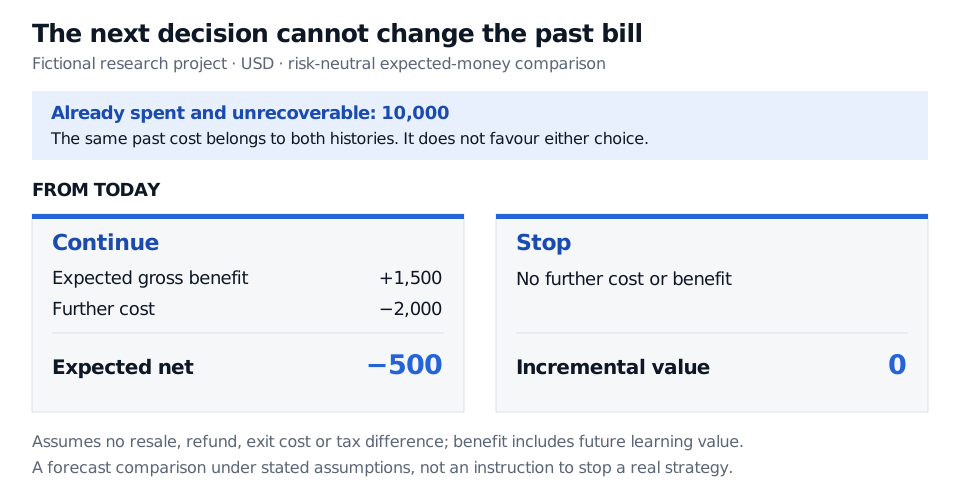
Including the historical bill in both histories gives expected cumulative net amounts of minus USD 10,500 for continuing and minus USD 10,000 for stopping. Their difference is still minus USD 500. Removing a common past cost from the comparison does not erase the accounting loss; it identifies what this decision can change.
The conclusion depends on the forecast. If revised evidence instead supports USD 2,500 of incremental benefit with the same further cost, continuation has positive expected incremental value of USD 500. Continuing can be sensible after a large sunk expenditure. Its justification must come from what continuation offers now.
What belongs on the forward side
“Exclude sunk costs” is narrower than “ignore history.” Before excluding a number, ask whether today's alternatives can change its consequences.
| Item | Treatment in today's comparison |
|---|---|
| An expired, non-refundable data licence | Its past fee is sunk. Evidence learned from its data can still change the forecast. |
| A refundable deposit or saleable server | The amount recoverable now is relevant. Giving it up to continue creates an opportunity cost. |
| A researcher's next week | Already completed hours are sunk; the value of the best alternative use of next week's time is not. |
| Closing a live strategy | Future liquidation costs, remaining obligations and risk during exit belong in the comparison. |
| Tax consequences of a sale | Include applicable future differences. A historical cost basis may determine them; it cannot simply be discarded. |
The same care applies to a losing position. Its current resale value remains available capital, and holding it forgoes an alternative use of that capital. Original purchase price alone does not establish today's expected payoff. But transaction costs, portfolio exposures, constraints, taxes and new information may legitimately affect a hold-versus-exit comparison. Labelling a position a “loser” supplies none of those inputs and does not imply a trade instruction.
Evidence about the bias, and limits on the label
A review that keeps the learning
A useful project review records the alternatives available now, their remaining costs and benefits, the evidence behind the estimates, and what would change the decision. Asking “would this next test be worth buying today, with the knowledge and assets we actually have?” removes the emotional claim on yesterday's budget without pretending the project started from nothing.
Sources
- Arkes, H. R. and Blumer, C. (1985). The Psychology of Sunk Cost, Organizational Behavior and Human Decision Processes 35(1), 124–140. Introduction and Experiments 1–4, pp. 124–130: definition, ticket choices, field evidence, project continuation and beliefs. The research-budget example and decision ledger above are original fictional constructions.