A Strategic Petroleum Reserve (SPR) release moves crude oil out of the U.S. government's emergency stockpile and makes it available to buyers or borrowers. For an oil-market analyst, the headline volume describes how many barrels may move. The delivery schedule determines when those barrels can help cover a physical shortfall. U.S. Department of Energy (DOE) — SPR Sales and Exchanges
From authorization to delivery
The reserve stock is the amount held at a point in time, measured in barrels. Authorization permits a drawdown. For a competitive sale, DOE then issues a Notice of Sale specifying what is offered and when it is scheduled for delivery. A contract award commits a volume to a buyer. Record the actual physical delivery against the dates on which the oil moves. DOE — SPR Sales and Exchanges
In 2022, a release announced on March 31 led to several sales. For one tranche, DOE issued a Notice of Sale on July 26, announced contract awards on August 11 and scheduled deliveries from September 16 through October 21. The award notice establishes the planned window. Actual daily volumes would require delivery records. DOE — July 26 notice and August 11 awards
Put the barrels on the calendar
Suppose a fictional release physically delivers 1 million barrels evenly over 10 days. The gross delivery rate during the window is
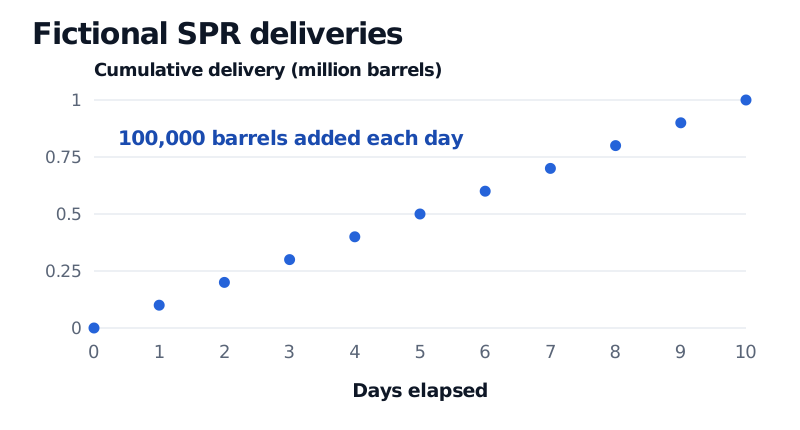
In this fictional schedule, the increase between consecutive day-end points is the flow on that day.
Real shipments can bunch around pipeline schedules or tanker loadings. To compare a release with a disruption, match the delivery window, reachable market and usable grade. Oil moves through specific pipelines and marine terminals, and a refinery that needs low-sulfur sweet crude may be unable to use a higher-sulfur sour stream as a substitute. DOE — SPR distribution systems and SPR FAQs on crude grades
Sales and exchanges have different later flows
In a sale, the buyer pays for the crude. In a short-term exchange, a recipient borrows crude and later returns the volume plus a premium in additional barrels under the contract. Both transactions can supply oil during a disruption. An exchange also calls for barrels to flow back into the reserve later. DOE — SPR Sales and Exchanges
Keep SPR stocks separate from commercial crude stocks when reading the EIA's Weekly Petroleum Status Report. Moving a barrel out of the reserve puts existing oil into circulation. If the recipient processes or exports it before the weekly reporting cutoff, the same barrel may never appear in a week-end commercial stock count. EIA — Weekly U.S. crude oil and petroleum product stocks
When studying oil forward curves, separate the announcement date from the delivery dates. Prices can respond as soon as news changes expectations. How much the curve moves depends on what the market already expected and how closely the delivered oil matches the shortage in timing, location and grade.
SelfMadeQuant’s Commodities lesson explains how grade, location and timing enter physical commodity prices and hedges. The preview is public and the full lesson requires a free account.