A self-regulatory organisation (SRO) is a non-governmental body with legally recognised authority to make and enforce rules within its remit, subject to public oversight. For a trading or surveillance team, that means the same order sequence can come under an exchange rule, a broker-dealer membership rule and federal securities law. The rulebook, the firm's status and the date of the orders all matter. Exchange Act section 19.
Where the authority comes from
A voluntary industry group can write standards that firms choose to adopt. An SRO has a regulatory mandate. In the US, the Securities Exchange Act of 1934 classifies national securities exchanges, registered securities associations and registered clearing agencies as SROs. It also includes the Municipal Securities Rulemaking Board for specified statutory purposes. The enforcement remit varies by type of organisation. For example, the Act also requires exchanges and registered securities associations to enforce applicable federal requirements among their members, subject to specified exceptions. Exchange Act section 3(a)(26), section 19(g).
The Financial Industry Regulatory Authority (FINRA) is a registered securities association funded by member firms and other sources. It sets rules for its members, examines firms, monitors markets and can discipline members within its remit. Its industry ties give it access to member firms' expertise. The US Securities and Exchange Commission (SEC) is the federal agency that oversees and examines FINRA and can bring its own enforcement actions under federal securities law. FINRA’s functions and oversight, SEC Division of Enforcement.
One order sequence, three rule checks
Suppose a fictional broker-dealer belongs to both Cboe BZX and FINRA. On BZX it repeatedly posts sell limit orders at several prices, increasing displayed supply in the order book. The firm then enters a buy order that fills and cancels the earlier sell orders.
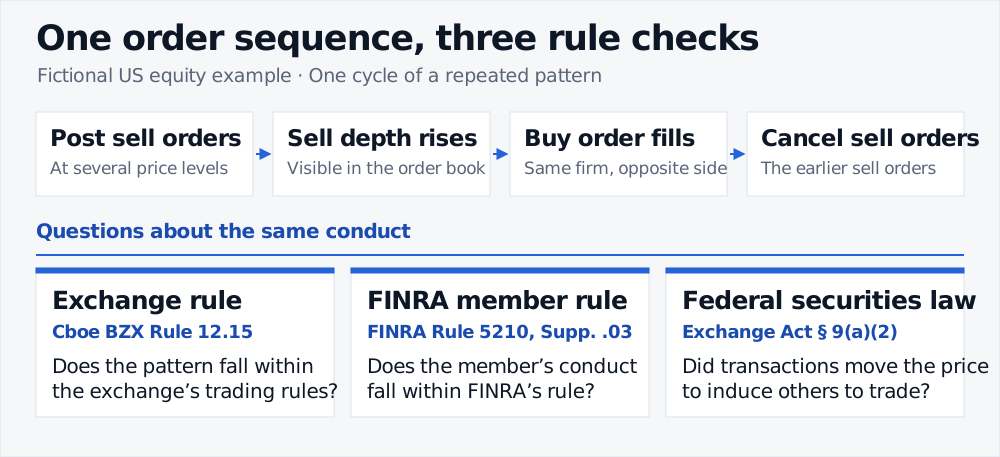
One cycle of a repeated fictional pattern. The order record is shared across the three checks, while the relevant rule and its scope differ.
- Exchange rule. BZX can examine whether the member's repeated sequence falls within its rule on disruptive quoting and trading. Cboe BZX Rule 12.15.
- Broker membership rule. FINRA can examine the member's conduct under its own disruptive quoting rule, which covers patterns on a single venue or across venues. FINRA Rule 5210, Supplementary Material .03.
- Federal securities law. The SEC can investigate the same conduct for potential manipulation. One question under section 9(a)(2) is whether a series of transactions moved the price with the purpose of inducing others to trade. The order and fill sequence can flag activity for review. Establishing a violation requires evidence of the elements of the provision being applied. Exchange Act section 9(a)(2).
Which version applied on the trade date?
Under Exchange Act section 19(b), SROs file proposed rule changes with the SEC. The Act provides for notice and public comment. Some filings go through the SEC approval process, while qualifying changes such as certain fee amendments can take effect upon filing and remain subject to SEC suspension. An immediately effective filing can also specify a later operative date. For a historical surveillance replay, match the order date to the rule version that was operative and check the member and venue scope before coding the alert. Exchange Act section 19(b), SEC Rule 19b-4.