Skip to content

Performance Fee Crystallisation and Equalisation

How an accrued fund performance fee becomes payable and how series accounting or equalisation credits allocate it across entry dates.

Performance fee crystallisation is the point at which an accrued performance fee becomes payable to the fund manager. Equalisation adjusts how investors bear that fee when they subscribe at different times. For a hedge fund investor, the headline fee rate and the latest net asset value (NAV) alone can leave out the information needed to reconcile their net return.

When the fee becomes payable

  • Accrual. At a valuation, the administrator estimates the fee under the fund's terms and reflects the provision in NAV. If eligible performance falls before crystallisation, the provisional fee can shrink or reverse.
  • Crystallisation. On the event date, the eligible amount becomes payable. Cash can settle later. When the fund pays a fee already included in NAV, the payment reduces assets and clears the liability by the same amount.
  • Redemption. If the terms provide for crystallisation on exit, the fee attributable to the redeemed units becomes payable even between scheduled crystallisation dates. The provision for units still held follows their own schedule. The Kinsale Compass Fund's 2021 supplement, for instance, treated a repurchase date as the end of the calculation period for the shares being repurchased. Kinsale supplement, §9.2
For funds in its scope, ESMA's 2020 guidelines call for fee computation at the NAV calculation frequency. They generally limit scheduled crystallisation to once a year, identify exceptions for specified models, and call for proportionate crystallisation on redemption. Their scope covers UCITS and certain alternative investment funds. ESMA guidelines, scope and Guidelines 1 and 3
The high-water mark answers a separate question about fee eligibility. In a model with a fixed mark carried forward after a loss, gains below that mark go towards recovery. The terms define the observations used for the mark, any reset or loss-recovery period, and whether the relevant level is tracked by class, series or investor. A benchmark or minimum return hurdle can also affect the fee base. ESMA guidelines, definitions and Guidelines 1 and 4

Two entry prices, one crystallisation date

Suppose a fictional fund charges 20% of each lot's positive gain above its own reference value. Each investor buys one unit, and its reference is the pre-performance-fee NAV per unit at entry. Ignore other charges, distributions and hurdles. Both investors stay until the scheduled crystallisation.

If VV is the pre-fee NAV per unit and BiB_i is lot ii's reference, the per-unit fee under these terms is

fi=0.20max⁡(V−Bi,0).f_i = 0.20 \max(V-B_i,0).
LotEntry reference (USD)Pre-fee NAV at crystallisation (USD)Fee per unit (USD)Closing value per original unit (USD)
A, early1001204116
B, late1101202118

The gain from 100 to 110 belongs to A. Charging both lots on gains above 100 would assign B an extra USD 2 for performance before it entered. The chart also shows what happens before the fee becomes payable. When NAV dips from 110 to 105, A's provision falls from USD 2 to USD 1. B's stays at zero because it is still below its reference.
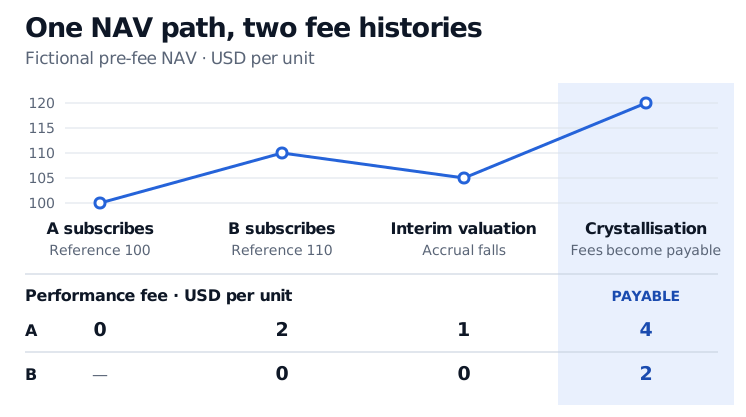
Fictional pre-fee NAV per unit moves from USD 100 to 110, falls to 105 and ends at 120. Lot A enters at 100 and its fee moves from 0 to 2, then 1, then crystallises at 4. Lot B enters at 110, has zero provisional fee at 110 and 105, and crystallises at 2.
The same pre-fee NAV path produces two fee histories. The fees shown before the final valuation are provisional.

The USD 116 and USD 118 are economic values per original unit under the example's lot-level rule. How those values appear in an investor statement depends on whether the fund tracks separate series or adjusts the holdings of individual subscribers.

Where the adjustment sits in the books

Series accounting groups subscriptions into separate series, each with its own NAV and fee calculation. The SproutBridge Equity Fund's May 2025 memorandum tracked performance fees and high-water marks by series. Investors in the same class could hold different series based on when they joined. SproutBridge memorandum, §13.1
Equalisation credits can preserve a common NAV per share within a class while recording a separate adjustment for the subscribing investor. In Kinsale's 2021 terms, a subscriber paid the pre-fee price. The difference between that price and the NAV after accrual was recorded as a credit. The fund applied the available credit against the fee by issuing additional shares, recognising that some of the accrued gain preceded the subscription. The supplement used a different adjustment for subscriptions below the mark. It specified repurchasing some of the investor's shares to collect a fee on eligible gains between their entry and the class mark. Kinsale supplement, §9.2

To reconcile a charge, identify the class and series or subscription lot, the fee base that applies to it, and the event that makes the fee payable. Then match the amount against the accrued NAV provision and any credit or unit adjustment. A single class NAV may require an investor-level record to explain what an individual investor actually paid.

Sources

Last updated
  • fund accounting
  • performance fees
  • high water mark
  • hedge funds
← Back to the glossaryBack to top ↑