Momentum ignition seeks to induce others to extend a price trend. Separate that manipulative purpose from lawful execution, observed price moves and actual trading profit.
Momentum ignition
Momentum ignition is manipulative trading intended to start or intensify a price trend, induce other participants to extend it, and create a favourable opportunity to open or close a position. For a quant, the key distinction is between responding to a price signal and deliberately generating a misleading signal to influence others. The EU's Delegated Regulation 2016/522, Annex II, Section 1, point 4(f) identifies the practice through orders or executed transactions; it is not limited to unfilled orders.
A momentum strategy may legitimately seek to profit from an existing trend. An urgent purchase may legitimately consume liquidity and move prices. Neither price movement nor aggressive execution alone establishes momentum ignition. The distinguishing concern is the manipulative inducement and intended trading benefit, assessed with the surrounding evidence.
A 1% rally can accompany a trading loss
Consider fictional observations in USD per share. A stock was at 100 and then reached 101: an observed rise of
100101−100=1%.
One participant held no initial position, then actually bought 1,000 shares at 101 and later sold all 1,000 at 100.80. Assume no other trades, distributions, fees or financing. Their complete cash ledger is:
Cash flow
Calculation
USD
Purchase payment
1,000 × 101
−101,000
Sale receipt
1,000 × 100.80
+100,800
Realised P&L before costs
100,800 − 101,000
−200
Equivalently,
P&L=1,000(100.80−101)=−200 USD.
The participant earned nothing from the earlier move from 100 to 101 because they did not hold the shares during it. Their sale is an actual stipulated execution, not an assumption that a displayed price was available for the entire position. Positive fees and financing charges would deepen this loss.
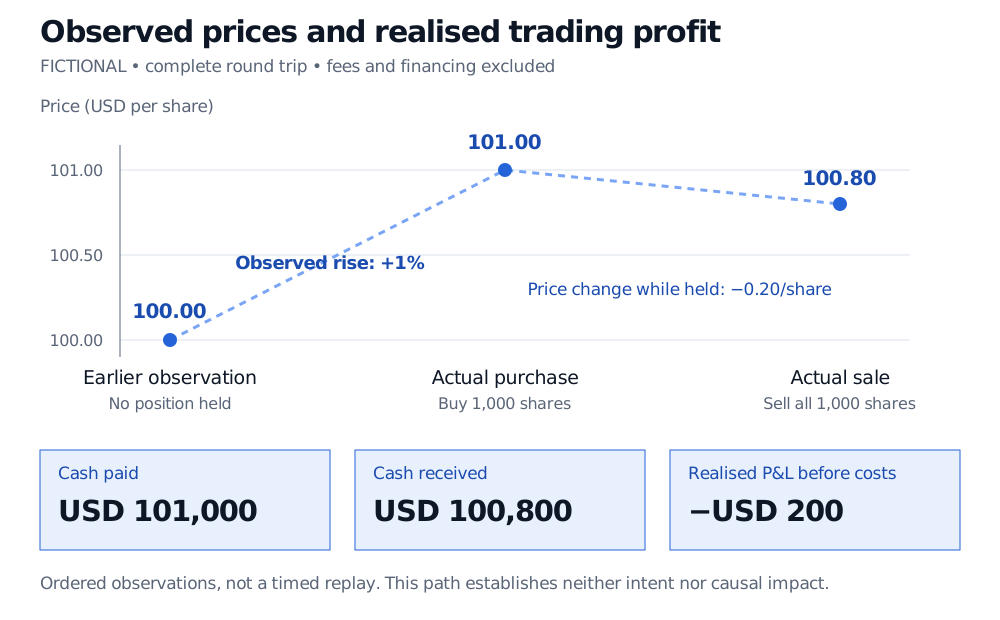
Fictional prices rise from USD 100 to 101 before a participant buys 1,000 shares at 101 and sells all at 100.80. Cash paid is USD 101,000, cash received is USD 100,800, and realised P&L is minus USD 200 before costs. The path does not identify intent.
Original fictional observations and complete cash ledger. The participant has no initial position; dashed segments connect observations rather than specify a timed market replay.
This example establishes a cash result only. It supplies no evidence that this participant caused the rally or intended to induce others. Equally, a loss would not, by itself, exonerate conduct shown by other evidence to be manipulative. A scheme can fail economically.
Evidence beyond a price chart
A sharp rise followed by a reversal could reflect news being reassessed, a large genuine order, or thin liquidity recovering. An investigator needs to reconstruct the participant's orders and fills alongside positions, contemporaneous market conditions and relevant communications. Price observations alone leave both motivation and the no-order counterfactual unresolved. A profitable round trip would not fill those evidential gaps either.
Market impact concerns the price effect attributable to trading. It does not automatically establish manipulation. The Market Impact lesson develops the difference between an observed response and a causal effect, including news and urgency as confounders. It has a public preview; the full lesson requires membership.
The related term quote stuffing concerns message activity intended to create uncertainty, slow others or conceal a strategy. Momentum ignition instead centres on inducing extension of a trend for a favourable position opportunity. These concepts can overlap, but a large message count is not their definition or proof. Annex II, Section 1, points 4(e)–(f) treats them separately.
The EU legal boundary
Under the EU Market Abuse Regulation (MAR), Article 12 covers conduct giving or likely to give false or misleading signals, artificial price levels and deceptive devices. Article 12(2)(c)(iii) specifically addresses misleading signals from orders initiating or exacerbating a trend; Article 15 prohibits manipulation and attempted manipulation. These provisions are broader than a requirement to prove a successful profitable round trip. MAR, Articles 12 and 15.
MAR Annex I expressly treats its indicators as non-exhaustive and insufficient, by themselves, to establish manipulation. A rapid price reversal is therefore a reason to examine context, rather than a verdict. The intended-inducement description of momentum ignition should not be turned into a universal statement about the mental element of every MAR infringement. Legal classification depends on the applicable provision and facts. This discussion uses EU law, not a rule assumed identical across jurisdictions.
Sources
Commission Delegated Regulation (EU) 2016/522, consolidated 5 August 2026, Article 4 and Annex II, Section 1, points 4(e)–(f): quote stuffing and momentum ignition. Current consolidation checked 31 October 2026.
Regulation (EU) No 596/2014 (MAR), consolidated 5 June 2026, Articles 12, 15 and Annex I, Section A: manipulation, attempts and the limits of indicators. Current consolidation checked 31 October 2026. Consolidated texts document the law; the Official Journal acts are authoritative.