A microwave trading network carries market data or other trading messages between distant sites over point-to-point radio links. Earlier delivery can let a strategy in one market react sooner to a quote or trade in another. Radio signals travel faster through air than optical signals through conventional glass fibre, and a chain of radio links can sometimes take a shorter route than buried cable. Laughlin, Aguirre and Grundfest, Appendix A.
How the route works
Directional antennas send the signal along a series of hops. A relay receives it from one site and forwards it to the next. Each hop needs line of sight and enough clearance around the direct path, in a region engineers call the first Fresnel zone. A ridge can intrude into that zone and cause diffraction loss even when the antennas can see each other. Rain can weaken the signal, and reflections can interfere with it. A long-haul chain depends on every hop in use, so the speed of the route and its availability are separate questions. ITU-R P.530-19, §§2.2–2.4 and 7.
How much time does the route itself save?
Consider two fictional routes from the same send site to the same receive site. Add up the radio hop lengths to get 900 km. The alternative has 1,200 km of fibre. Approximate the signal speed in air by the vacuum speed of light, , and assume a fibre speed of . For the one-way propagation stage, divide each route length by its signal speed. BIPM, SI base unit metre.
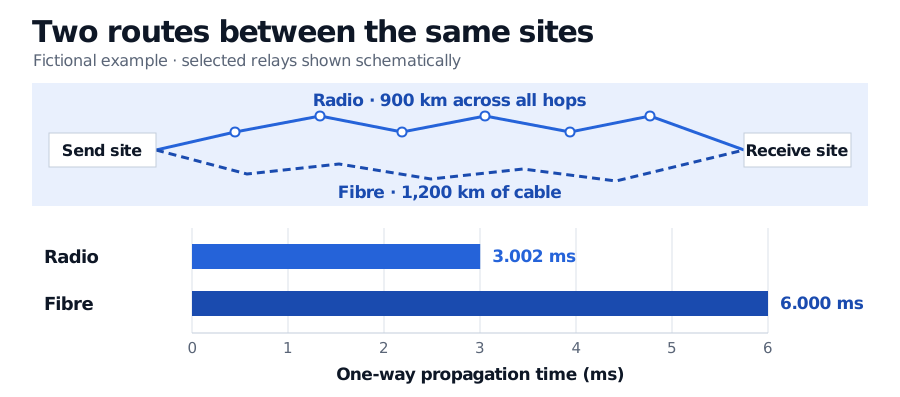
The fictional radio route is shorter and the signal travels faster through air. The bars exclude equipment, queueing and failover delays.
The propagation difference gives radio about 2.998 ms of headroom. If the radio path adds more than that in extra delay relative to fibre, its end-to-end advantage disappears. A full comparison for a low-latency trading system includes radio processing at relays, waiting to transmit and any local connections between the long-haul endpoints and the trading hosts. A cross-connect can form part of that local handoff. Laughlin, Aguirre and Grundfest, Appendix A.
What the strategy actually receives
If a hop fades and the feed switches to a fibre backup, the next update can arrive later, and a gap during the switch can leave the strategy working with stale quotes. A backtest that assumes the fastest route on every event can make a signal available before the live system would have seen it. Use receipt times and sequence information to reconstruct the state available at the decision. The SelfMadeQuant lesson works through this distinction in a quote-and-trade timeline. Trades, Quotes and Market State (public preview, full lesson for members).
Sources
- Laughlin, Aguirre and Grundfest, Information Transmission Between Financial Markets in Chicago and New York, Appendix A.
- ITU-R P.530-19, Propagation Data and Prediction Methods Required for the Design of Terrestrial Line-of-Sight Systems.
- Bureau International des Poids et Mesures, SI base unit metre.