A cross-connect is a dedicated physical point-to-point link, usually fibre in a trading data centre, between two specified network handoffs. A trading firm can use one to reach an exchange access switch for market data and order entry. The installed cable length and the active equipment on the rest of the route affect how soon a quote can arrive or an order can reach the venue. Equinix Cross Connect documentation.
Where the cable ends
Colocation puts a firm's hardware in a facility near venue infrastructure. A cross-connect joins two physical handoffs. A handoff can be a designated port on a patch panel, so the dedicated link may cover only part of the path from the firm's server to the venue's order gateway and matching engine. Equinix demarcation documentation.
Use the installed fibre length in a delay estimate. A direct physical connection can pass through passive patch panels and follow cable trays, so the distance between two racks can be a poor proxy. A venue can also standardise the handoff lengths. For example, CME Group specifies an equidistant cross-connect between a customer's licensed space and the CME GLink access switch to make that segment location-neutral. CME Group production connectivity options.
A one-way transit budget
Consider two fictional paths between equivalent handoff points. Assume light travels at in both paths. The direct cross-connect uses 200 m of fibre. The alternative uses 600 m of fibre in total and two switches, each with an assumed processing delay of 1.5 µs. Adding the propagation and switch times gives
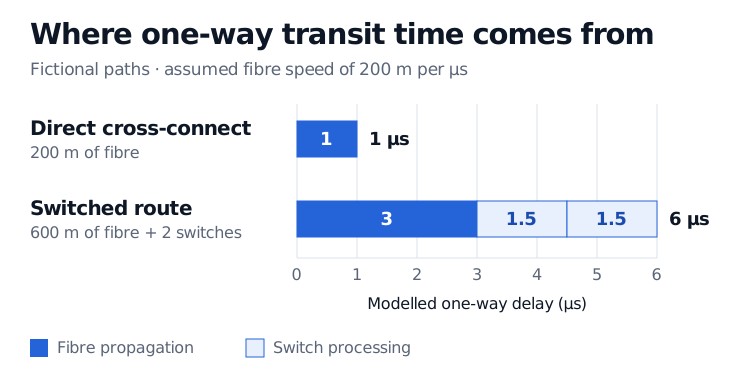
The switched route adds 2 µs of propagation and 3 µs of switch processing in this model. The bars exclude endpoint processing, frame serialisation and queueing.
Put timestamps around the part you want to measure
A one-way network test times the same packet at both ends. Specify the timestamp points and account for clock offset and uncertainty. For example, RFC 7679 defines the wire interval from the first bit sent to the last bit received. IETF RFC 7679, §§3.4 and 3.6–3.7.
An order-to-acknowledgement measurement spans the outbound route, venue processing and the return route. A low-latency trading system can measure its own application time separately, from accepting a market-data update to handing an order to transport.
The Trades, Quotes and Market State lesson shows how local receipt time determines whether a quote was available to the strategy when it made a decision. The preview is public and the full lesson requires membership.