The term covers several mechanisms. A content classifier, a JSON validator, a permission check and a human approval gate answer different questions. Calling all of them “guardrails” does not make them interchangeable.
Four questions that must stay separate
| Check | What it establishes | What it leaves open |
|---|---|---|
| Schema | The proposed action has the required fields and types | Whether its claims are true or its action is allowed |
| Factuality | A claim agrees with an identified source or independent calculation | Whether the agent may access that source or act on the claim |
| Permission | This authenticated session may perform this action on this resource | Whether capacity remains or additional approval is required |
| Quota | The action fits the remaining enforced allowance | Whether it is accurate, useful or authorized |
A research-only session, walked through
read_report, with a text report identifier, and place_order, with a text symbol and positive integer quantity. Both action types can be schema-valid.| Proposal, in order | Schema | Permission | Decision before execution | Read tickets left |
|---|---|---|---|---|
| Read report A | Valid | Allowed | Execute | 1 |
| Place an order | Valid | Denied | Block; no order tool call | 1 |
| Read report B | Valid | Allowed | Execute | 0 |
| Read report C | Valid | Allowed | Block; quota exhausted | 0 |
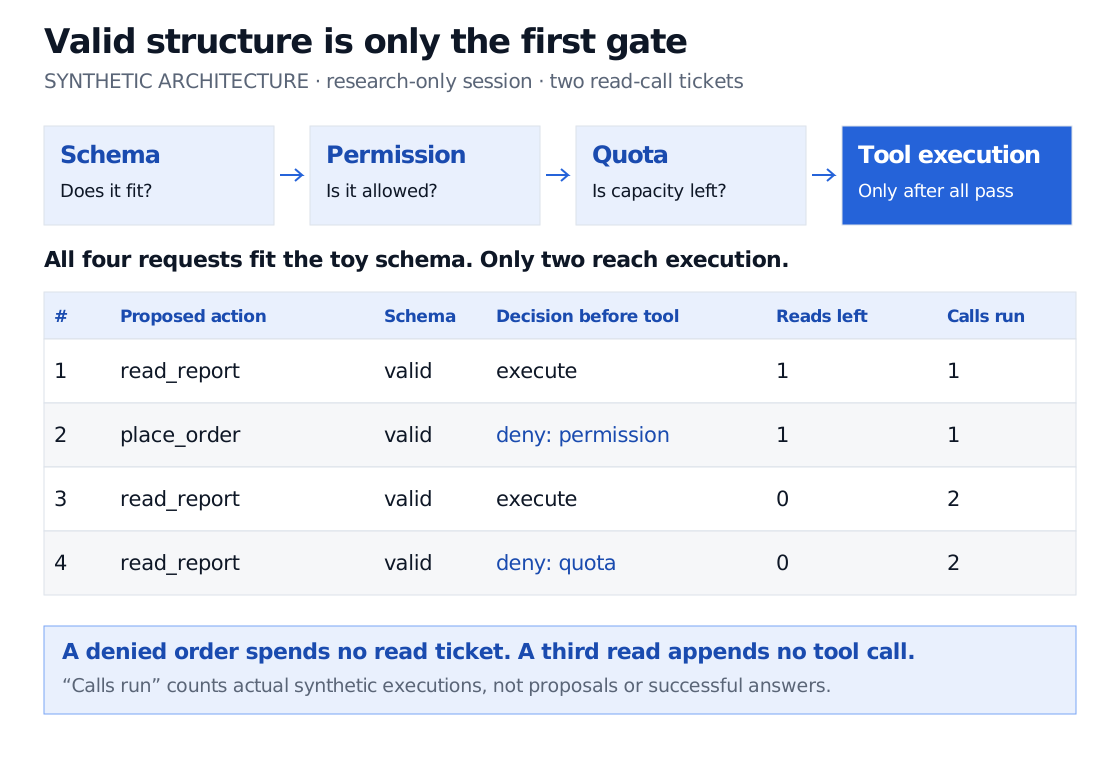
In this design, the model proposes an action; a trusted execution layer validates its arguments, checks the authenticated user's resource permissions, reserves any quota and dispatches only an allowed request. The model cannot edit the policy or replenish its tickets. With parallel requests, checking and reserving capacity must be atomic: two requests must not both consume the same last ticket. Retries count under the stated policy too.
Approval is another gate
For an order-capable system, a meaningful review would expose the exact instrument, side, quantity and destination being authorized. Changing those arguments requires applying the policy again. In the research-only example, an order remains denied: adding an approval dialog does not itself grant trading permission. A person would need a separate, authorized change of session capability before the action could become eligible.
What guardrails cannot promise
The research-only permission boundary limits one possible consequence—an order through the denied tool. It does not prove that the summary is accurate, prevent every information leak or make all report access harmless. Resource authorization and restrictions on where data may be sent still matter. Logging supports investigation and monitoring; it does not substitute for a check that runs before an action.
Sources
- OWASP — LLM06:2025 Excessive Agency: excessive functionality, permissions and autonomy; least privilege, complete mediation and approval before high-impact actions.
- LangChain — Guardrails: deterministic and model-based checks, execution positions, and input/output filtering.
- LangChain — Human-in-the-loop: pausing tool execution for a policy-driven review decision.
- OWASP — LLM01:2025 Prompt Injection: indirect injection and the limits of prevention.