An LLM agent is a system in which a large language model selects actions toward a task, receives observations from tools or its environment, and uses those observations to choose what to do next. In quant research, that can mean finding a filing passage, requesting a calculation and deciding whether the evidence is sufficient to answer an analyst’s question.
The useful distinction is who chooses the next action. A model that writes “I will check the filing” has produced text. An agent’s surrounding system can turn a permitted request into an actual retrieval and return the result for another decision.
A workflow can use tools without being an agent
Suppose a programme always retrieves a report, extracts two fields, computes a ratio and fills a template. The sequence is fixed even if an LLM performs the extraction. Under the architectural distinction used here, that is a workflow. An agent can decide, after inspecting the first result, to search again, calculate, ask for clarification or stop. The same tools can support either design. Anthropic’s 2024 architectural guidance draws this distinction; its tooling discussion now carries an update notice.
ReAct, introduced by Yao and colleagues, is an influential example of interleaving model reasoning, actions and observations. Its research tasks include retrieving evidence before answering. ReAct is one approach to agent behaviour, not a requirement that every agent expose a written reasoning transcript or learn a new policy during the task.
A bounded research trace
Consider a fictional request: “Using the supplied report, calculate revenue less the stated cost as a share of revenue.” The task permits report retrieval and arithmetic only, with at most three tool calls. The quoted revenue is 120 and the stated cost is 90, both in the same currency units and reporting period. Here “margin” means only that specified ratio; it is not automatically an issuer’s gross or operating margin.
| Step | Decision or observation | Tool calls used |
|---|---|---|
| Read the question | Identify the requested ratio and permitted source | 0 |
| Retrieve the passage | A report tool returns revenue 120, cost 90 and a passage locator | 1 |
| Request the calculation | A calculator returns 0.25 | 2 |
| Answer and stop | Report 25%, identify the passage and state the ratio’s definition | 2 |
Three calls is a ceiling, not a quota. This successful trace uses two. If the passage omits the reporting period, the model might use the remaining call to clarify the source. If the evidence remains inadequate, it should return that limitation. A fourth tool call must be blocked by the surrounding system, even if the model requests one.
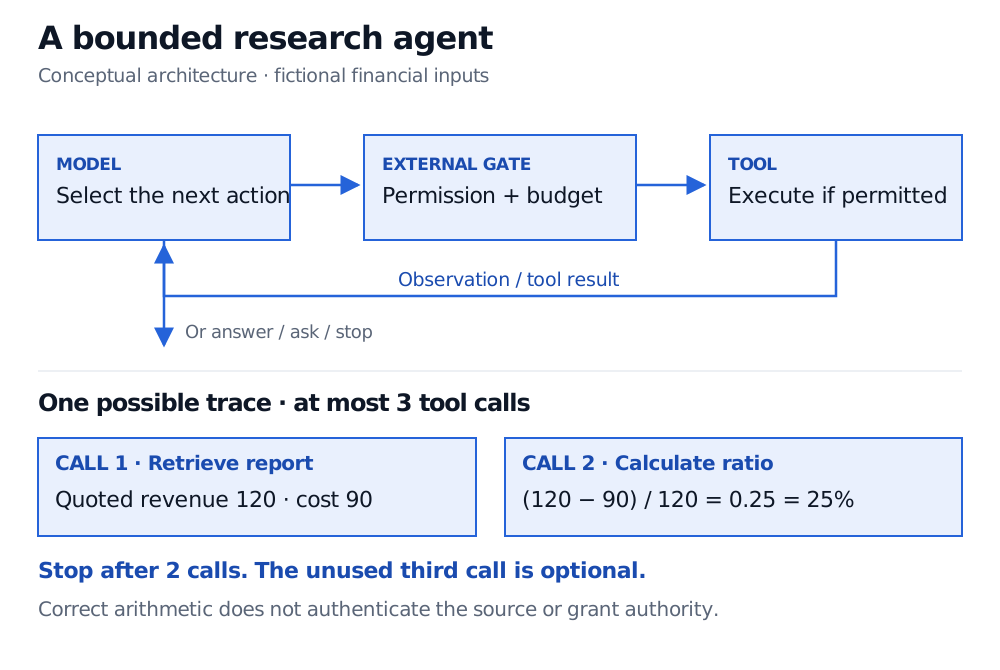
The model chooses the next step; the surrounding system controls whether it can execute. Two calls suffice in this fictional trace, leaving the third unused.
A matching trace could also arise from a fixed workflow. The visible sequence alone does not establish an agent architecture; the distinction is whether the model was allowed to select and revise its next step.
A valid request is not permission, and a correct ratio is not verified evidence
Tool descriptions tell the model what an operation accepts and returns. Structured LLM output can constrain the request’s format. Neither grants authority. Credentials, tool permissions and budgets need enforcement outside generation, as part of agent guardrails. A research session’s access to a calculator does not authorise sending an order. Anthropic’s 2026 architecture discussion separates the model’s control loop, execution tools and durable event log, and discusses keeping credentials outside untrusted execution.
Retrieval, including hybrid retrieval, supplies candidate evidence. It does not establish that a passage is authentic, current or relevant. Retrieved instructions can also be prompt injection: source text must not become permission to change the task.
In the example, a calculator establishes the arithmetic conditional on the inputs. It does not establish that 120 and 90 came from the correct issuer, period or accounting definition. Preserve the document identity, passage, extracted units, calculation inputs and tool results so a reviewer can check those separate claims. An LLM judge can help assess answers against a rubric, but its approval is another model judgment, not independent verification of a filing.
For the wider research problem, Measurement Validity explains why a reproducible extraction still needs a defensible link to the intended financial construct (public preview; full lesson requires membership).
Sources
- Yao et al., ReAct: Synergizing Reasoning and Acting in Language Models, §§2–3: action–observation interaction and knowledge-intensive tasks. Original research, not a financial-research accuracy guarantee.
- Anthropic, Building effective agents, 19 December 2024: workflow/agent distinction and stopping conditions. Used for architecture; the page flags changes to its tooling landscape.
- Anthropic, Scaling Managed Agents, 8 April 2026: separation of session, harness and execution; security boundary. Checked as the newer guidance linked from the earlier article.