The Job Openings and Labour Turnover Survey (JOLTS) is a monthly survey in which the US Bureau of Labor Statistics (BLS) estimates vacancies, hires and separations at nonfarm business and government establishments. It helps macro analysts distinguish a drop in demand for new workers from an increase in layoffs. Both can signal a cooling labour market, but they show up in different parts of the release. BLS JOLTS Technical Note
The vacancy count is a snapshot
A position counts as a job opening on the last business day of the month if there is a specific unfilled job with work available, the job could start within 30 days, and the employer is actively recruiting outside the establishment. An internal-only posting is excluded. Employers can recruit by word of mouth, so a qualifying vacancy can exist without an online ad. BLS JOLTS FAQ, question 1
The openings rate divides openings by payroll employment plus openings. In a fictional release, payroll employment is 950 filled jobs and employers have 50 qualifying openings. The employment reference is the pay period that includes the 12th of the month. The vacancies come from the later snapshot. BLS JOLTS Technical Note
That is 50 vacancies per 1,000 positions under the JOLTS convention. The unemployment rate divides unemployed people by the labour force and comes from a household survey. The Beveridge curve plots unemployment on the horizontal axis and the JOLTS openings rate on the vertical axis to compare unused labour supply with unmet labour demand. BLS CPS definitions
Hires and quits accumulate over the month
Hires count additions to establishment payrolls over the full calendar month, including rehires and people who switch from another employer. Separations count departures from payrolls over the same period. They split into quits (voluntary departures), layoffs and discharges (employer-initiated departures), and other separations such as retirements and transfers to another location of the same firm. Each flow rate divides its own monthly count by payroll employment alone. With 38 hires and 19 quits in the fictional release, the hires rate is and the quits rate is . BLS JOLTS Technical Note
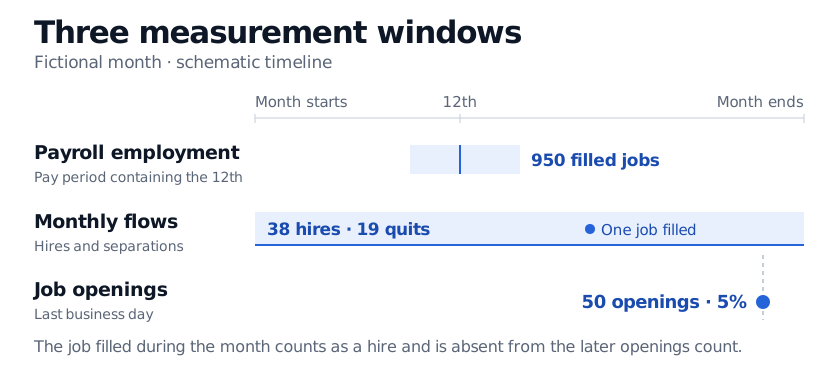
Fictional JOLTS data. A job filled before the snapshot contributes to the monthly hires flow and is already out of the vacancy stock.
A drop in openings alongside steady hires and low layoffs is consistent with firms filling or withdrawing vacancies without widespread cuts to existing jobs. A drop in openings alongside rising layoffs points to a different kind of cooling. Quits add a read on workers' willingness or ability to leave, though the quits count does not tell you where they went. Dividing the month's hires by the final snapshot of openings does not give a vacancy fill probability. A hire can fill a vacancy before the snapshot, and a vacancy that is still open may have appeared only near the end of the month. BLS JOLTS FAQ, questions 2–8 · BLS JOLTS release, Separations
Reading the release in real time
Use the seasonally adjusted series for consecutive-month comparisons to account for recurring calendar patterns. Keep the adjustment basis consistent across observations. The first estimate is preliminary. The next release can revise it as more establishments report and seasonal factors change. Annual updates use new Current Employment Statistics employment benchmarks and can revise both adjusted and unadjusted figures across five years. A backtest that uses JOLTS as a signal should use the release and data vintage available on each decision date, since today's revised history can include information unavailable then. BLS JOLTS FAQ, question 9 · BLS JOLTS Technical Note