Expected credit loss provisioning recognises a loss allowance on in-scope exposures using an estimate of future credit losses. IFRS 9 generally starts an ordinary newly originated loan at 12-month expected credit losses (ECL). Current expected credit losses (CECL), the US GAAP model in ASC Subtopic 326-20, generally starts an equivalent loan at expected losses over its remaining contractual term. The same loan can therefore produce different allowances at origination even when the lenders agree about default risk and recoveries. IFRS 9, paragraphs 5.5.3–5.5.5 and Interagency Policy Statement, Overview and Contractual Term
The 12 months refer to default events
Under IFRS 9, a default that occurs within 12 months can cause a cash shortfall much later. The 12-month measure includes the lifetime shortfall attributable to that default, weighted by its probability and discounted to the reporting date. If the instrument has less than a year of expected life left, use that shorter default window. IFRS 9 requires a probability-weighted estimate using reasonable and supportable information available without undue cost or effort. For an ordinary fixed-rate loan, discount using the original effective interest rate or an approximation. IFRS 9, paragraphs 5.5.17 and B5.5.43–B5.5.44
Take a fictional two-year bullet loan with USD 100 of exposure at default in either year. Set the discount rate to zero and assume no prepayments. At maturity the lender collects USD 100 if there is no default and USD 50 if there is a default in either year, so loss given default (LGD) is 50%. The probabilities of first default, measured from today's reporting date, are 1% in year one and 2% in year two. The second probability already accounts for surviving year one.
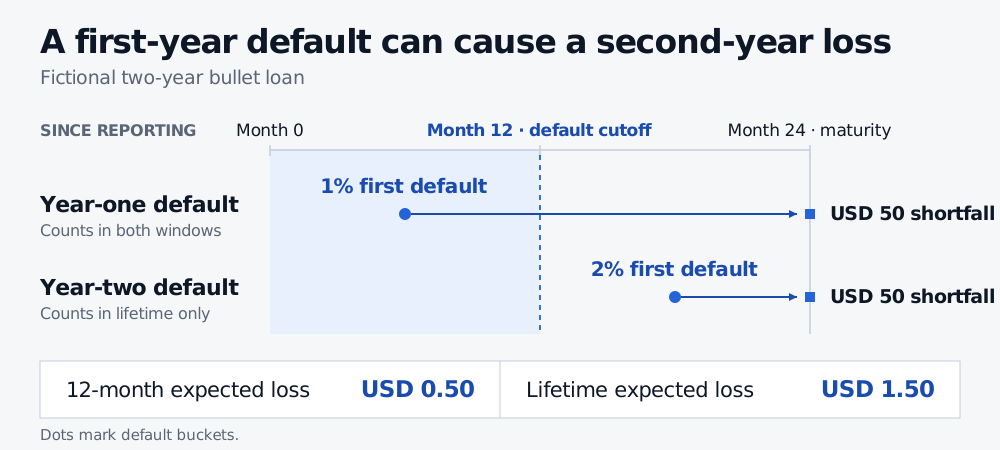
The first-year default counts in the 12-month estimate even though the missed principal is due in month 24.
With those inputs, IFRS 9 Stage 1 uses USD 0.50 and CECL uses USD 1.50. The USD 1.00 difference comes from year-two first defaults. The two measures use the same loss severity. In a loan model that starts with year-two default probability conditional on surviving year one, multiply that conditional probability by year-one survival before using it in the sum.
When the horizon changes
Under IFRS 9's general approach, Stage 1 uses 12-month ECL while credit risk has not increased significantly since initial recognition. A significant increase in lifetime default risk since initial recognition moves the loan to Stage 2, which uses lifetime ECL. A change in LGD affects the loss estimate. Stage assignment turns on default risk. If the loan becomes credit-impaired (Stage 3), lifetime ECL still applies, and interest revenue generally uses the carrying amount after the loss allowance. The 12-month measure can resume if the lifetime recognition criterion is no longer met. IFRS 9, paragraphs 5.4.1–5.4.2 and 5.5.3–5.5.9 and BIS Financial Stability Institute, the three stages
CECL uses the contractual-life horizon from the outset and updates the estimate each reporting period. The term reflects expected prepayments and, where applicable, renewal or extension options that are part of the contract and that the lender cannot unconditionally cancel, taking expected exercise into account. If the reasonable and supportable forecast ends before the contractual term does, the estimate reverts to historical loss information or an appropriate proxy for the remaining period. CECL permits methods such as loss rates and discounted cash flow. The example holds the model fixed to isolate the effect of the horizon. Interagency Policy Statement, Methods, Contractual Term, Forecasts and Reversion
Check which assets are being compared
CECL covers assets such as loans held for investment and held-to-maturity debt securities. US available-for-sale debt securities use the separate ASC 326-30 model, which generally limits the credit allowance to the amount by which amortised cost exceeds fair value. IFRS 9 applies its impairment requirements to qualifying debt assets measured at fair value through other comprehensive income. The allowance goes in other comprehensive income, and the balance sheet continues to show the asset at fair value. Interagency Policy Statement, Scope and Available-for-Sale Debt Securities and IFRS 9, paragraphs 5.5.1–5.5.2 and 5.5.8
Under the IFRS 9 simplified approach, qualifying trade receivables without a significant financing component use lifetime ECL from initial recognition. For assets purchased or originated credit-impaired, the allowance reflects cumulative changes in lifetime ECL since initial recognition. Under US GAAP, the initial allowance on purchased credit-deteriorated assets in ASC 326-20 is added to the purchase price in setting the amortised cost basis. ASU 2025-08 extends that treatment to qualifying purchased seasoned loans for annual periods beginning after 15 December 2026, with early adoption permitted. IFRS 9, paragraphs 5.5.13–5.5.16, Interagency Policy Statement, Purchased Credit-Deteriorated Assets and FASB ASU 2025-08
For an amortised-cost loan, the allowance reduces the gross carrying amount at the reporting date. The provision is the period's charge or reversal in earnings. When comparing banks, read the allowance rollforward to separate provisioning from write-offs and recoveries, then check the portfolio's maturity mix and, for IFRS reporters, its stage mix. IFRS 9, paragraph 5.5.8 and Interagency Policy Statement, Overview of ACLs
The SelfMadeQuant lesson Credit Instruments, PD/LGD/EAD, and Rating Migration builds the probability and severity inputs behind the example. The preview is public and the full lesson is for members.
Sources
- IFRS Foundation, IFRS 9 Financial Instruments, 2026 issued edition, paragraphs 5.4.1–5.4.2, 5.5.1–5.5.17 and B5.5.43–B5.5.45.
- BIS Financial Stability Institute, IFRS 9 and expected loss provisioning, the three stages.
- FASB, ASC Topic 326 credit losses overview and original ASU 2016-13, ASC 326-20-30-1 through 30-5 and 326-20-35-1.
- US banking agencies, Interagency Policy Statement on Allowances for Credit Losses, revised April 2023.
- FASB, ASU 2025-08, Purchased Loans, ASC 326-10-65-7 and ASC 326-20-30-13 and 30-16 through 30-19.