Partition persistent order signs into same-agent and different-agent contributions, with exact pair weights, mean corrections and identity limits.
Herding versus splitting decomposition
The herding versus splitting decomposition partitions order-sign autocorrelation into contributions from pairs attributed to the same agent and pairs attributed to different agents. It helps a quant investigate whether persistent order flow is concentrated within identities or across them. The attribution is statistical; identifying the economic mechanism needs additional assumptions.
Start with the pairs
Take twelve fictional aggressive orders in arrival order. A plus sign means buyer-initiated and a minus sign means seller-initiated. Assume the true investor identity and aggressor sign are known; each event receives equal weight, regardless of size.
Order event
1
2
3
4
5
6
7
8
9
10
11
12
Sign
+
+
+
−
−
−
+
+
+
−
−
−
Investor
A
A
A
B
B
B
B
B
B
A
A
A
Both investors have three buys and three sells. Their full-sample sign means, and the global mean, are zero; global sign variance is one.
For lag τ, let M=N−τ, It be identity and ϵt∈{−1,+1} be sign. Define the globally centered product
The denominator uses all lag pairs in both components. Do not recenter or renormalize each identity subset and then add its correlations: that changes the statistic. This estimator also differs from conventions dividing the lag-product sum by N.
At lag one there are eleven overlapping pairs: (1,2),(2,3),…,(11,12). Pair products in order are
+1,+1,−1,+1,+1,−1,+1,+1,−1,+1,+1.
The identity changes only at (3,4) and (9,10), both with product −1. The middle sign reversal, (6,7), belongs to B on both sides.
Pair class
Pair count
Product sum
Contribution using all 11 pairs
Same investor
9
7
7/11≈0.636
Different investors
2
−2
−2/11≈−0.182
All pairs
11
5
5/11≈0.455
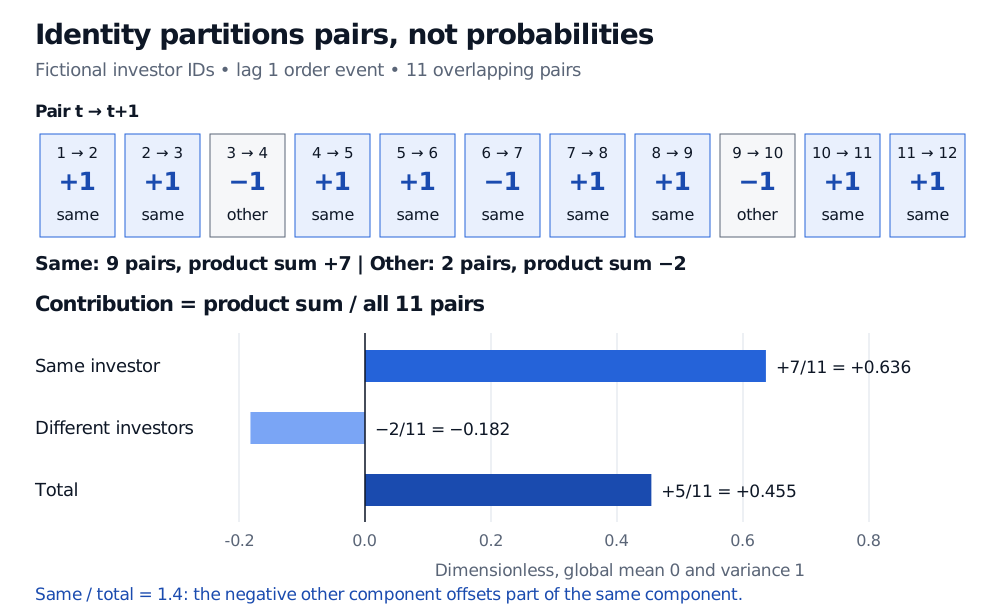
Eleven fictional lag-one pairs contain nine same-investor pairs with product sum seven and two different-investor pairs with product sum minus two. Contributions are seven elevenths and minus two elevenths, summing to five elevenths.
Original fictional lag-one decomposition. Every component uses the same eleven-pair denominator; bars are dimensionless contributions, not conditional probabilities.
Here C^same/C^=7/5=1.4. A contribution can exceed the total because another contribution offsets it. “140% same” is an attribution ratio, not a probability; if the total is zero this ratio is undefined, and near zero it is unstable.
The conditional product average among same-investor pairs is 7/9, not 7/11. Its pair-occurrence weight is 9/11, giving (9/11)(7/9)=7/11. The different-investor term is (2/11)(−1)=−2/11. Omitting these weights overrepresents rare pair types.
Nonzero means need another term
Tóth, Palit, Lillo and Farmer, §3, retain both sign dependence and activity dependence. In stationary population notation, let pi=P(It=i), pij(τ)=P(It=i,It+τ=j) and μi=E[ϵt∣It=i]. Define
Split both sums into i=j and i=j; divide by global sign variance for normalized contributions. The second sum is the activity/mean correction. Zero global mean alone does not remove it. Also, kij is not a Pearson correlation; its centering uses agent means, which need not equal means conditional on that particular pair occurrence.
Our finite example avoids this complication because every μi is zero. Its endpoint convention is explicit; the stationary identity should not be substituted into a short sample without treating boundary counts consistently.
What the identity does—and does not—identify
Same-investor persistence is consistent with splitting a large intended trade into child orders. Autocorrelated information received by one investor can produce it too. Positive cross-investor dependence may reflect shared news rather than imitation. The paper discusses these identification limits in §§4.1 and 4.4.
A broker code is not an investor code: a broker pools clients, and an investor may use several brokers. Consequently, same-broker pairs can contain different investors; cross-broker pairs can contain one investor's split order. §5's brokerage mapping makes this observation problem explicit.
For a reproducible study, record the identity level, event unit, lag, sign-classification method, centering, pair denominator and treatment of session boundaries. This twelve-event illustration establishes arithmetic, not a population estimate or statistical significance. Overlapping pair observations should not be treated as independent evidence.
Order Flow and Adverse Selection develops aggressor-sign estimation and explains why persistent flow does not establish informed trading. Its preview is public; the full lesson requires membership.