See how a principal VWAP guarantee transfers benchmark-tracking risk, while the benchmark price stays unknown, using a fictional client and provider ledger.
Guaranteed VWAP
Guaranteed VWAP is a contractual execution arrangement in which a broker acting as principal commits to transact an agreed quantity at a price tied to a specified realised volume-weighted average price, with any agreed charge or adjustment. It transfers the risk of the provider’s execution deviating from that benchmark to the provider within the contract’s scope. It does not fix the future benchmark’s numerical value.
That distinction changes what a quant should compare. A VWAP-targeting algorithm attempts to track a benchmark; a guaranteed contract establishes what the client pays or receives relative to it. Wells Fargo Securities’ “Guaranteed Orders” disclosure explicitly describes principal execution at an agreed benchmark or pricing formula, including VWAP. A label on an algorithm ticket alone does not establish such a commitment.
A known rule, an unknown price
For eligible trades indexed by i, with prices pi and positive share volumes vi, the benchmark is
B=∑ivi∑ipivi.
The trade set includes the agreed observation window and inclusion rules. Until that window finishes and the relevant data are determined, B is generally unknown. Agreeing today to buy at tomorrow’s VWAP plus a charge therefore does not reveal today how much cash the purchase will require.
Consider a fictional USD contract for a client to buy all 10,000 shares at a later-determined benchmark plus a fee of 2 basis points of benchmark notional. Assume the contract is accepted, its conditions are satisfied and the full quantity is delivered. This fee convention is invented for the example; it is not a broker quote. Ignore taxes, funding and other charges.
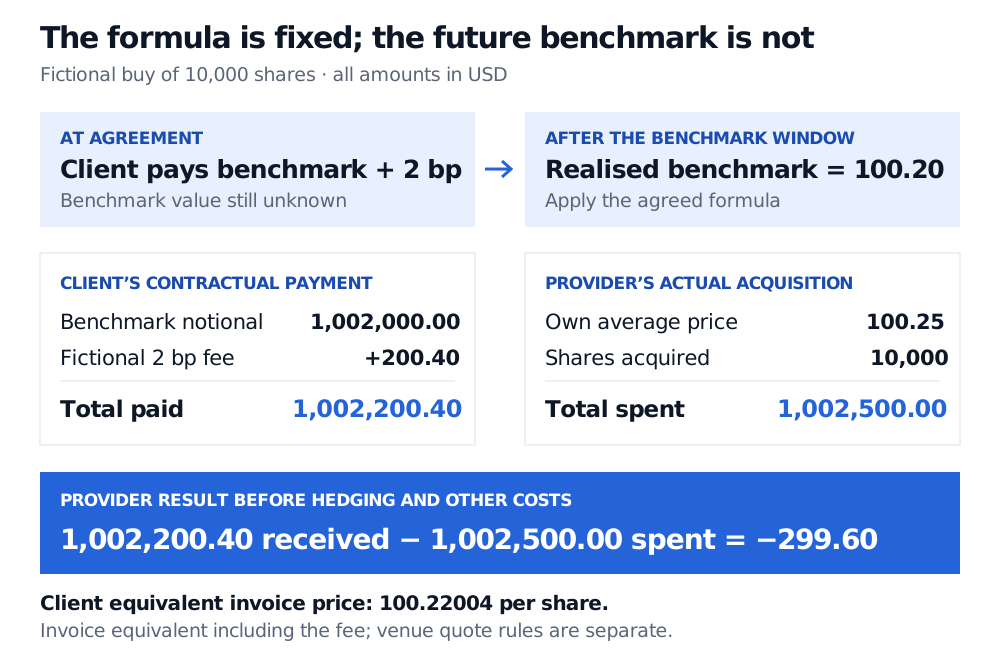
Suppose the final benchmark is USD 100.20 per share. With Q=10,000 and f=0.0002,
Dividing the total payment by the quantity gives USD 100.22004 per share. This is an equivalent invoice price including the fee, not a displayed venue quote or an assertion that a venue accepts that price increment. Actual confirmations and rounding follow the agreed conventions.
Fictional buy of 10,000 shares: realised benchmark USD 100.20, benchmark notional USD 1,002,000, fee USD 200.40 and client payment USD 1,002,200.40. Provider acquisition at USD 100.25 costs USD 1,002,500 and produces a USD 299.60 loss before hedging and other costs.
Original fictional USD ledger. The benchmark value is learned after the window; only the pricing formula is fixed at agreement. The 2 bp fee is hypothetical. Provider P&L excludes hedging and other costs.
Now suppose the provider actually acquires the 10,000 shares at an average USD 100.25. Under this simplified, fully matched purchase-and-delivery ledger, it spends USD 1,002,500 but receives USD 1,002,200.40:
where A is its actual acquisition average. The USD 500 adverse execution difference exceeds the USD 200.40 fee. The client’s stipulated payment does not rise to cover this loss. Conversely, favourable provider execution can benefit the provider rather than passing through to the client. The fee is revenue before the provider’s trading outcome and expenses, not guaranteed profit.
This ledger assumes newly acquired shares exactly offset delivery. Inventory supplied from an existing position, derivatives used to hedge, financing and other trading flows need their own accounting. GTS’s “Guaranteed and Benchmark Orders” disclosure describes principal risk management and states that principal-position profits or losses accrue to GTS unless otherwise stated.
Tracking VWAP and guaranteeing it are different services
In ordinary agency execution, an algorithm may use a predicted volume profile to schedule child orders. Its realised average can differ from VWAP because market volumes surprise, limits prevent fills or liquidity changes. The word “VWAP” identifies its target, not a promise to make up the difference.
For a concrete distinction, Interactive Brokers’ VWAP (Best-Efforts) description explicitly says that benchmark-price execution is not guaranteed, deviations can have either sign and part of an order may remain unfilled. This best-efforts product illustrates why a target must be distinguished from a guarantee; capacity and contractual commitments still need to be checked for the particular service.
The TWAP, VWAP and Participation Algorithms lesson develops volume-profile schedules, participation conventions and residual-order policies (public preview; full lesson requires membership). It helps separate the algorithm’s allocation rule from a contractual transfer of benchmark risk.
What remains exposed
A guarantee is only as clear as its benchmark and covered obligation. Establish the instrument, side and quantity; window boundaries and time zone; eligible venues, trade types and auctions; corrections and cancelled prints; and the price source. Establish the treatment of halts, shortened sessions, order changes or cancellation, and any exceptional-event or delivery provisions. Do not assume an accepted quantity or window survives a later amendment on identical terms. These are matters to resolve in the actual agreement, rather than uniform features of every service.
The client still bears movement in the benchmark itself. Buying at the agreed VWAP relationship can be expensive relative to an earlier decision price, and the acquired position can subsequently lose value. A guarantee of benchmark-relative execution is neither a known future price nor a positive portfolio return. Implementation shortfall answers a different question by comparing implementation with the original investment decision.
Nor does the guarantee remove market impact. GTS warns that its hedging and other trading can influence the benchmark and client execution price. The contract allocates the provider’s tracking outcome; it does not make the benchmark independent of trading. Benchmark definition, contractual coverage, provider obligations and total charges belong alongside any reported VWAP comparison.