How pressure for agreement can suppress objections in quant teams, and why three approvals may contain only one independent source of information.
Groupthink
Groupthink is a failure of group deliberation in which the desire to maintain agreement and cohesion suppresses realistic examination of alternatives. On a quant team, it can let a strategy pass review because challenging the desk's preferred story becomes socially costly. The key issue is whether objections can change the decision, rather than how many people approve it.
Irving Janis developed this account through historical case studies of policy decisions. He described group pressures that make members soften criticism of colleagues and leaders, allowing loyalty to displace critical appraisal. This is a proposed explanation of a decision process, not a diagnosis established by observing a loss. Janis's original 1971 essay supplies the historical definition.
The objection that disappears
Consider a fictional strategy-review meeting. A researcher finds that a promising signal depends on an optimistic execution assumption. Before the meeting, the desk head describes the launch as a collective achievement. When the researcher raises the issue, colleagues treat further challenge as disloyalty. The final memo records unanimous support and omits the unresolved objection.
The concern is the social suppression of a relevant alternative: delay the launch and test execution costs. A unanimous decision after openly comparing that alternative with proceeding could be entirely reasonable. A profitable launch would not establish that suppressing the objection was sound; a losing launch would not establish why the committee agreed.
This overlaps with confirmation bias in research, but the concepts have different targets. A lone analyst can selectively seek supportive evidence. Groupthink concerns the pressures within a group that obstruct serious challenge.
Three approvals need not be three independent checks
A small probability model shows why counting endorsements can be misleading. It illustrates information dependence, not a numerical model of groupthink.
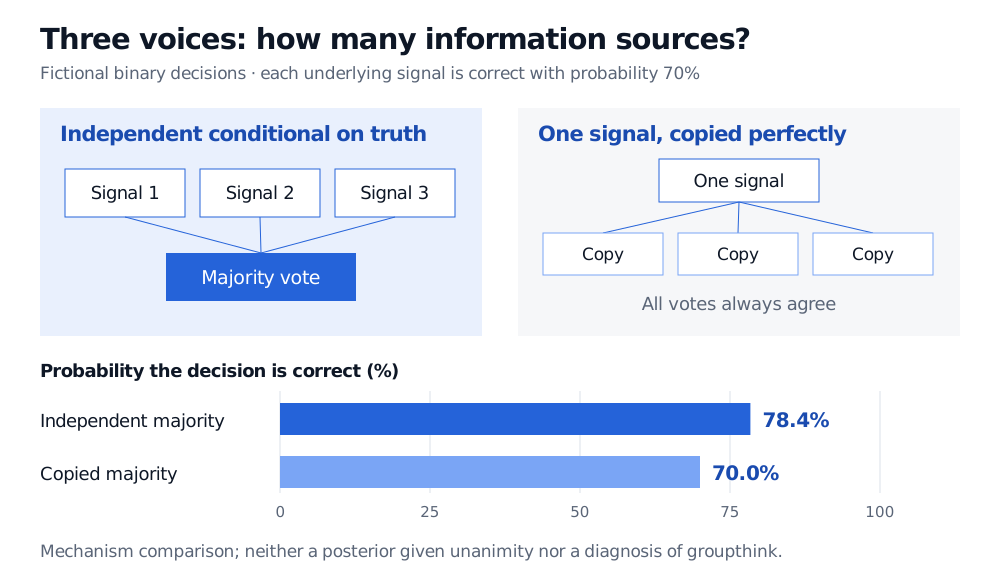
Suppose a fictional review concerns a binary proposition with a true or false answer. For either true state, each of three signals gives the correct answer with probability p=0.7. First stipulate that the signals are conditionally independent given that state, and that the committee uses their majority. It is correct when exactly two signals are correct, or when all three are:
Now change the mechanism. Everyone reports an exact copy of one signal whose correctness probability is 70%. There are three votes, but the majority is simply that original signal. Its correctness probability is 70%, rather than 78.4%: an 8.4 percentage point difference between the stipulated mechanisms.
Two fictional mechanisms with 70% accurate underlying signals: three conditionally independent signals yield a majority correct probability of 78.4%; three exact copies of one signal yield 70%.
Original stipulated-mechanism comparison. Accuracy is the probability that the decision is correct, not the probability of correctness after observing unanimous votes.
These calculations do not condition on an observed unanimous outcome. Nor does copied information establish groupthink: people might sensibly rely on the same authoritative measurement without any pressure against dissent. Conversely, reviewers can use different datasets while still avoiding uncomfortable objections. Independence of evidence and freedom to challenge are separate questions. Writing opinions separately does not, by itself, make their errors independent.
What group research can establish
In Stasser and Titus's original experiment, university students discussed hypothetical candidates for student-body president. When relevant information was distributed across members, discussion often failed to overcome their initially biased preferences. The authors' definition of the best candidate meant the one supported by the available attributes, not an objectively correct real-world politician. Their methods, results and discussion demonstrate an information-pooling problem in that task. They do not measure its prevalence on trading desks or validate every part of Janis's theory.
The broader theory also needs care. In their 1993 reappraisal, Aldag and Fuller found little support for the full groupthink model and questioned generalising from selected fiascoes. Treating cohesion, consensus and poor outcomes as an automatic causal chain goes beyond that evidence.
For the fictional review, the useful repair is concrete: keep the execution objection in the decision record, assign a test that could resolve it, and compare proceeding with delaying. Recording a disagreement matters only if the group considers its evidence. A ritual dissent slot followed by an unchanged, unexplained decision offers little protection.
Communicating to traders, risk managers and investment committees develops a complementary discipline: preserve limitations and rejection criteria when briefing a committee. The full lesson requires membership; its preview is public. It helps keep an objection visible in the final brief, without claiming to diagnose groupthink.