A credit portfolio granularity adjustment estimates how much a loss quantile changes when individual borrower exposures are large enough to leave borrower-specific risk in the portfolio. The benchmark is the loss quantile of a portfolio where every borrower is small enough for borrower-specific default risk to diversify away. A risk team can use the adjustment to estimate the effect of large individual exposures on credit value at risk (VaR). Gordy, §§2 and 4
Four borrowers versus a hundred
Take two fictional one-year loan books with the same total exposure at default. Hold the economy at one fixed factor state. Each borrower has a conditional probability of default of 2% and a fixed loss given default of 50%. Defaults are independent given that state. Each book is internally equal-weighted.
| Conditional on the same economic state | 4 borrowers | 100 borrowers |
|---|---|---|
| Loss from one default, as a share of total exposure | 12.5% | 0.5% |
| Expected loss, as a share of total exposure | 1% | 1% |
| Variance of loss, in squared exposure fractions | 0.001225 | 0.000049 |
For a book with borrowers and defaults, the loss fraction is . Since is binomial with parameters and in this state, the conditional variance of is . The four-name book has 25 times the conditional variance. The difference comes from the size of each default loss. In the four-name book, even one default takes the loss from zero to 12.5% of the entire book.
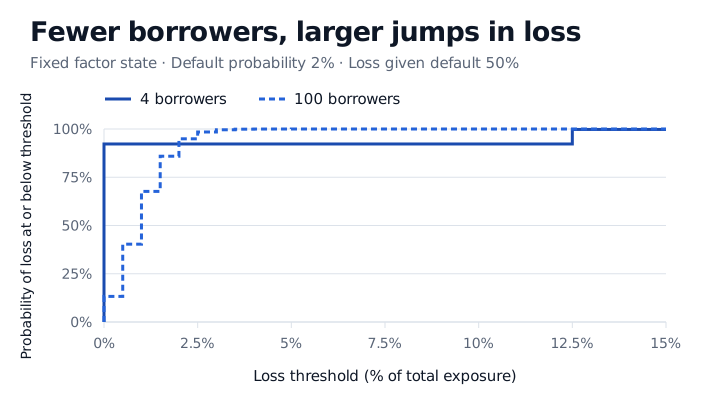
Exact binomial loss distributions for two fictional books at the same factor state. Each curve shows the probability that loss is at or below the amount on the horizontal axis.
With unequal exposures, let be borrower ’s share of total exposure, its fixed loss given default, and its default probability given the common factor value . Conditional independence makes the portfolio loss variance
The squared weights explain why a few large borrowers can matter even in a book with hundreds of small ones. Multiple loans to the same borrower share its default indicator, so add their default-loss amounts before squaring.
From conditional variance to a quantile correction
The asymptotic single-risk-factor (ASRF) model takes the limit as individual exposure shares become small enough for the conditional variance to vanish. Its loss benchmark is the conditional mean , which still moves with the economy. If higher values of mean worse conditions and increases with , the benchmark VaR at confidence is , where is the -quantile of the factor. The SelfMadeQuant lesson on large-portfolio asymptotics and the Basel IRB formula develops this limit (public preview, full lesson for members).
The adjustment approximates the difference between two unconditional loss quantiles, . In a smooth one-factor model, with positive factor density and positive near , the leading correction is
The correction uses how conditional variance, factor density and the slope of the conditional mean behave around the stressed factor value. The four-name example fixes one state and therefore gives only a single value of for each book. A VaR correction can have either sign. When a few borrowers dominate the book, large jumps can make the first-order approximation unreliable. A finite-portfolio calculation can retain each borrower’s loss jump and mix the conditional loss distributions over the factor. Gordy and Marrone, §1, eq. (4), and §4
The adjustment addresses the name-level part of credit concentration risk within the assumed factor model. A book can have many small borrowers in the same industry and still be vulnerable to an industry-wide shock. That calls for modelling the shared driver. In the current Basel Framework, the Pillar 1 corporate IRB formula is applied exposure by exposure, while the Pillar 2 supervisory review chapter calls for banks to assess credit concentrations in their capital adequacy assessment. BCBS research on name and sector concentration, Basel Framework CRE31.4–31.6, Basel Framework SRP32.6–32.13
Sources
- Michael B. Gordy, A Risk-Factor Model Foundation for Ratings-Based Bank Capital Rules, Federal Reserve working paper (2002), §§2 and 4.
- Michael B. Gordy and James Marrone, Granularity Adjustment for Mark-to-Market Credit Risk Models, Federal Reserve working paper (2010), §1, eqs. (3)–(4), and §4.
- Basel Committee Research Task Force, Studies on Credit Risk Concentration, historical research working paper (2006), executive summary.
- Basel Committee, current Basel Framework chapters on IRB risk-weight functions and Pillar 2 credit risk, versions effective January 2023.