The Global Investment Performance Standards (GIPS®) are voluntary ethical standards for calculating and presenting investment performance, maintained by CFA Institute. They help investors compare managers without letting each manager choose whichever accounts, methods and disclosures make its record look best. A return can be arithmetically correct yet represent a misleading selection of experience. The standards address that reporting problem.
The firm makes the claim
For investment firms, compliance applies across the defined firm and requires all applicable requirements, including authoritative guidance and Q&As. It cannot be claimed for a selected strategy, composite or account alone. A composite groups portfolios managed to a similar mandate, objective or strategy; actual, fee-paying, discretionary segregated accounts must belong to at least one. “Discretionary” concerns the ability to implement the strategy, rather than merely having trading authority. These distinctions sit in the Firms standards, especially provisions 1.A.1, 1.A.4 and 3.A.2.
The chapters serve different roles: investment managers use the Firms standards; asset owners that do not market investment services use the Asset Owners standards; independent verifiers follow the Verifiers standards. Asset owners marketing services follow the Firms standards. GIPS compliance does not mean CFA Institute has certified an investment strategy or endorsed its expected returns. CFA Institute’s introduction to the Verifiers standards explains this division of scope.
Two accounts, one uncomfortable month
Consider a fictional composite with two fee-paying discretionary accounts in the same strategy, both eligible for the entire measurement month. There are no external cash flows. The supplied monthly total returns use a consistent fee basis; this example does not calculate or compare gross- and net-of-fees returns.
| Account | Beginning assets, units | Monthly return | Ending assets, units |
|---|---|---|---|
| A | 100 | +2% | 102 |
| B | 300 | −4% | 288 |
| Total | 400 | 390 |
For this time-weighted return composite, beginning-asset weighting is one approach permitted by provision 2.A.36. The other approaches reflect beginning assets plus external flows or use the aggregate method. The handbook explains the alternatives.
Here the weights are 25% and 75%, so
The no-flow aggregate check gives the same result: . Equal-account averaging gives . That answers a different question—what the average account returned—and is not a substitute for the required composite calculation. Keeping only A reports +2%, converting an overall loss into a gain by changing the sample.
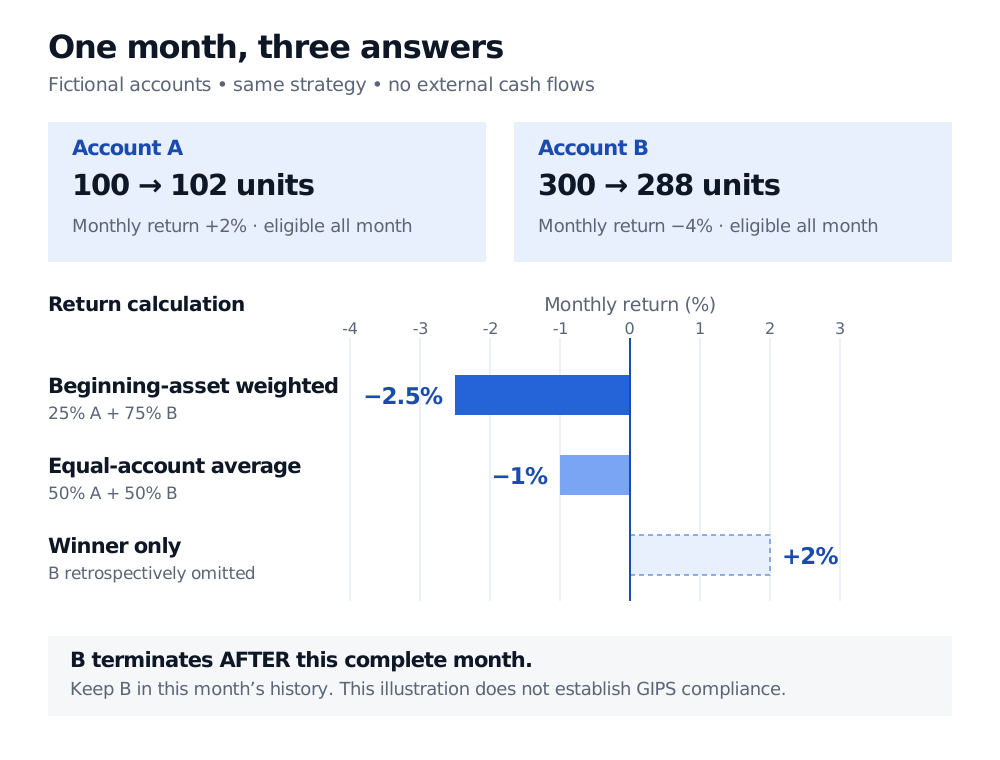
Original fictional no-external-flow example. The two accounts share a strategy and are eligible throughout the complete month. The chart compares weighting and selection choices; it does not establish GIPS compliance.
Suppose B terminates after this complete month, with discretion retained throughout the month. Its −4% belongs in that month’s composite history. Provision 3.A.9 retains terminated portfolios through their last full eligible measurement period; 3.A.8 governs full-period inclusion. Erasing B’s earlier history introduces survivorship bias. If discretion instead ended during the month, the monthly inclusion analysis would change. Consistent policies and the actual loss-of-discretion date matter. See the handbook’s termination discussion.
This arithmetic illustrates two reporting choices. It establishes neither a complete GIPS Report nor firm-wide compliance.
What verification adds
Independent verification is recommended rather than mandatory. It tests whether specified policies and procedures were designed in accordance with GIPS and implemented across the firm. It provides no assurance about a particular composite’s performance, a particular GIPS Report, or the entire compliance claim. A separate performance examination addresses a specified composite or pooled fund. Read the actual scope and periods covered in the reports; “verified strategy” overstates what firm-wide verification does. The Verifiers standards define these boundaries.
A backtest is also different from an actual managed-account history. Simulated returns cannot become actual composite performance by following the weighting formula. Theoretical performance may qualify as clearly labelled supplemental information subject to the applicable requirements, and must not be linked into actual performance history. Provision 2.A.4 and its handbook discussion make that distinction.
Read the operative guidance, too
As checked on 30 October 2026, the official site continues to publish the 2020 Firms edition, effective 1 January 2020, alongside errata, authoritative handbook discussions, Guidance Statements and Q&As. The edition title does not freeze the obligations at 2020. The current Firms directory is the starting point for subsequent guidance; for example, the OCIO guidance applies to relevant reports containing periods ending on or after 31 December 2025. The trade-errors exposure draft remains in progress as of this check and is not a finalized Guidance Statement.
For the related problem of losing funds disappearing from a research sample, read Performance Persistence and Survivorship Bias (public preview; full lesson requires membership).
Sources
- CFA Institute: 2020 GIPS Standards for Firms, introduction, effective date and provisions 1.A.1–1.A.5, 2.A.4, 2.A.36, 3.A.2 and 3.A.8–3.A.9
- CFA Institute: GIPS Standards Handbook for Firms, discussions of 2.A.4, 2.A.36, 3.A.8 and 3.A.9
- CFA Institute: 2020 GIPS Standards for Verifiers, purpose and scope of verification; performance examination
- CFA Institute: current standards, errata, Guidance Statements and Q&A directory for firms
- CFA Institute: Guidance Statement for OCIO Portfolios, effective date
- CFA Institute: Work in Process, draft status as checked 30 October 2026