How financial firms assess gifts and hospitality, and how a vendor's invitation during procurement raises a conflict that needs its own review.
Gifts, Entertainment and Anti-Bribery Rules
Gifts and entertainment rules govern what employees can offer or accept, what needs approval and what must be recorded. Anti-bribery laws prohibit corrupt offers or transfers of value in the circumstances each law covers. For a quant team choosing a market data vendor, the controls protect a decision that can affect data quality, backtest coverage and licensing costs.
A bottle sent to a buyer or a pair of tickets the buyer uses alone is ordinarily treated as a gift under a firm's policy. A meal attended by both firms or a vendor-hosted event is ordinarily assessed as business hospitality. A single invitation can contain both, and the event label can hide who benefits. The host's attendance helps establish the context. The purpose, timing, frequency and value still matter. DOJ and SEC, FCPA Resource Guide, pp. 14–18
A vendor invitation while bids are pending
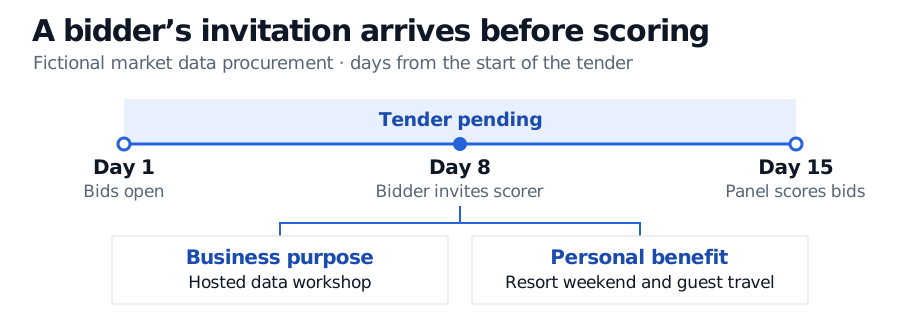
A fictional investment firm opens a tender for a new market data feed on day 1. On day 8, one bidder offers a quant on the selection panel a hands-on workshop and a resort weekend, including travel for a guest. The workshop would let the quant test the bidder's handling of delisted securities. The weekend gives the scorer a personal benefit while the panel's day 15 scoring is still ahead.
In a fictional tender, bids open on day 1. On day 8 a bidder offers a data workshop and a resort weekend with travel for a guest. The invitation reaches a bid scorer before the panel scores on day 15.
The offer arrives seven days before scoring. The same invitation contains a relevant workshop and a personal benefit.
In this firm's fictional policy, benefits from active bidders require written clearance before acceptance. The quant sends the full invitation to compliance. The register records the bidder, recipient, timing, estimated value by component and eventual disposition, including declined offers. Compliance declines the leisure package and has procurement arrange the same technical evaluation for every bidder, with any necessary travel paid by the investment firm.
The panel chair separately decides whether the quant can score the bid or should step aside. That review protects the scoring process from an actual or apparent conflict. An independent reviewer can use the same coverage, data quality and cost criteria across vendors. The timing and the personal benefit explain the escalation. Establishing corrupt intent would require evidence about why the offer was made.
Where U.S. rules apply
Covered gifts from a FINRA member. FINRA, a self-regulatory organisation, applies Rule 3220 to covered gifts given directly or indirectly by a member or associated person in relation to the business of the recipient's employer. Since 30 March 2026 the rule's limit is USD 300 per recipient per year, aggregating covered gifts from the member and its associated persons. The rule has specified exceptions and recordkeeping and supervision requirements. Under the rule, a gift handed out at a business entertainment event generally counts towards the limit. FINRA excludes the cost of the entertainment itself from the value of that gift. The rule governs covered outgoing gifts, while the buyer's policy in the example governs receipt. FINRA Rule 3220 and Supplementary Material, FINRA Regulatory Notice 26-05
A corrupt offer to a foreign official. Change the facts so that the bidder is a covered securities issuer and the scorer is a procurement officer in a foreign ministry. Where the jurisdictional conditions are met, the U.S. Foreign Corrupt Practices Act (FCPA) issuer provision reaches a corrupt offer of anything of value to influence the official's decision or gain an improper advantage to obtain or retain business. A corrupt offer can fall within the statute even if the officer declines it. One statutory affirmative defence covers reasonable, genuine expenses directly tied to activities such as demonstrating a product or performing a contract with a foreign government. The workshop's relevance helps explain expenses directly tied to the demonstration. The guest's resort travel calls for its own assessment. 15 U.S.C. § 78dd-1(a), (c), (f) and (g)
Covered issuers have separate duties to keep accurate books and maintain internal accounting controls. If the bidder pays for a resort stay, booking it as workshop fees would obscure what the money purchased. The Justice Department's June 2025 guidelines direct federal prosecutors' enforcement priorities. The statutory provisions govern the prohibition, defences and issuer accounting duties. 15 U.S.C. § 78m(b)(2), DOJ FCPA enforcement guidelines, June 2025