Remeasurement puts foreign-currency transactions or books into the entity’s functional currency, the currency of its primary economic environment. Translation expresses those functional-currency statements in a different presentation currency (called the reporting currency in US GAAP). For an analyst, the distinction explains why an exchange-rate move can affect earnings on an unpaid invoice and equity on an investment in a foreign operation. IAS 21, paragraphs 8–14, 20–34 and 38–41, FFIEC guidance on ASC 830.
Start by identifying the functional currency of the operation. Under IAS 21, the currencies that mainly influence selling prices and operating costs are primary indicators. Financing and the currency in which operating receipts are retained provide supporting evidence. If the books are in a different currency, remeasure into functional currency first. Then translate if the group presents in another currency. IAS 21, paragraphs 9–14, 34 and 38.
One stronger euro, two accounting results
Both fictional cases use a spot exchange rate of 1.10 USD per EUR initially and 1.20 at period-end.
Remeasure an unpaid payable. A USD-functional buyer acquires equipment for EUR 100 on credit. It initially records equipment and a payable of USD 110 each. The unhedged payable is still open at period-end. Paying the same EUR 100 would now cost USD 120 at the closing rate, so the buyer debits FX loss and credits the payable by USD 10. The loss enters profit or loss before any payment occurs. The equipment uses its historical exchange rate and is carried at USD 110. Assume zero depreciation and impairment for this example.
Translate a foreign operation. Separately, a wholly owned EUR-functional operation has EUR 90 of assets and EUR 20 of liabilities at both dates. Assume zero earnings, distributions, other movements and tax effects. Opening net assets translate to USD 77 and closing net assets to USD 84. The entire difference comes from the rate change applied to opening net assets.
The USD 7 goes to the group’s other comprehensive income (OCI) and accumulates in equity as part of the cumulative translation adjustment (CTA). The operation still has EUR 70 of net assets.
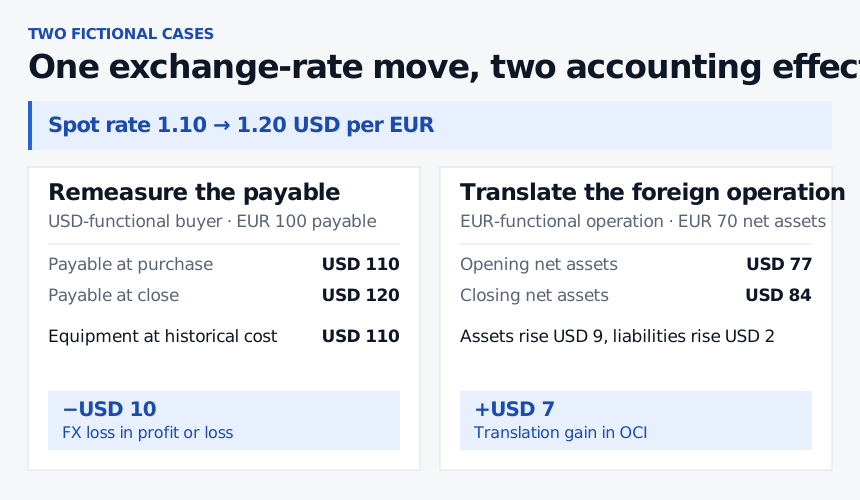
The USD 9 rise in translated assets is partly offset by a USD 2 rise in translated liabilities.
For practice reading quote units and reciprocals, see the SelfMadeQuant FX lesson, available with a free account.
Which rate goes where?
For functional-currency measurement, use the transaction-date spot rate at initial recognition. At period-end, use the closing rate for monetary items such as payables and receivables, which settle for fixed or determinable currency amounts. Historical-cost nonmonetary items such as equipment or inventory use the historical rate. Under IAS 21, a nonmonetary item carried at fair value uses the rate on the valuation date, and its FX component follows the gain or loss into earnings or OCI. IAS 21, paragraphs 20–34, FASB ASC 830-10-45-18.
For presentation-currency translation in the ordinary non-hyperinflationary case, use the closing rate for assets and liabilities, including historical-cost equipment. Use the rates on the recognition dates for income and expenses. A representative average can approximate those rates when it reflects the timing of the underlying activity. Large rate swings or a concentration of transactions at a particular date can make a period average misleading. The resulting translation differences go to OCI. The accumulated amount can enter earnings on a qualifying disposal of the foreign operation. IAS 21, paragraphs 38–41 and 48–49, ASC 830-30-45-3 to 45-5 and 45-12, FFIEC guidance on ASC 830.
When the treatment changes
- Net investment and hedges. Exchange differences on qualifying long-term intragroup monetary items that form part of a net investment can go to consolidated OCI. Under IAS 21, those differences enter profit or loss in the relevant separate or individual statements. Qualifying hedges follow the applicable hedge-accounting rules. IAS 21, paragraphs 15 and 27–33, FASB ASU 2017-12, ASC 220-10-45-10A.
- Hyperinflation. Under IFRS, a hyperinflationary functional currency generally triggers IAS 29 restatement before translation under IAS 21. ASC 830 instead remeasures a foreign entity in a highly inflationary economy as if the reporting currency were its functional currency. Separate IAS 21 amendments for a hyperinflationary presentation currency are effective for annual periods beginning on or after 1 January 2027, with early application permitted. IAS 21, paragraphs 41A–43 and 60O, SEC Financial Reporting Manual, section 6710.2.
- Lack of exchangeability under IFRS. When the currency lacks exchangeability for the relevant purpose at the measurement date, IAS 21 requires an estimated spot rate reflecting an orderly exchange and disclosures about the estimate and its effects. IAS 21, paragraphs 8A–8B, 19A, 57A–57B and Appendix A.
When analysing a filing, read the transaction FX gain or loss in earnings alongside the foreign-currency balances that drove it. Use the CTA roll-forward to explain part of the change in reported equity. To isolate the effect of translation on revenue growth, examine the rates applied to revenue itself.
Sources
- IFRS Foundation, IAS 21 The Effects of Changes in Foreign Exchange Rates
- FASB Accounting Standards Codification, Topic 830 Foreign Currency Matters
- FASB ASU 2019-04, historical rates under ASC 830-10-45-18
- FASB ASU 2017-12, foreign currency items in OCI
- FFIEC, Foreign Currency Transactions and Translation, September 2026 Call Report instructions
- SEC Division of Corporation Finance, Financial Reporting Manual Topic 6