A fee switch is a governance-controlled setting that enables a protocol to capture a share of the fees traders pay. In an automated market maker, the switch can lower fee income for liquidity providers (LPs) without changing the fee paid by traders. Protocol revenue here means the protocol’s share of the swap fees, before expenses or any later use of the assets.
Who gets the same 30 basis points?
Over one measurement period, traders swap a fictional USD 10 million of input value through a liquidity pool with a flat fee of 30 basis points. Hold volume and the trader fee fixed. With the switch off, LPs are allocated all the fees. With it on, the rules allocate one sixth of gross fees to the protocol and the rest to LPs.
The switch allocates 5 bp of input volume to the protocol and 25 bp to LPs. The one sixth applies to the gross fee. This comparison isolates the allocation change. In practice, a lower fee share can change how much liquidity LPs supply, which can change later trading volume.
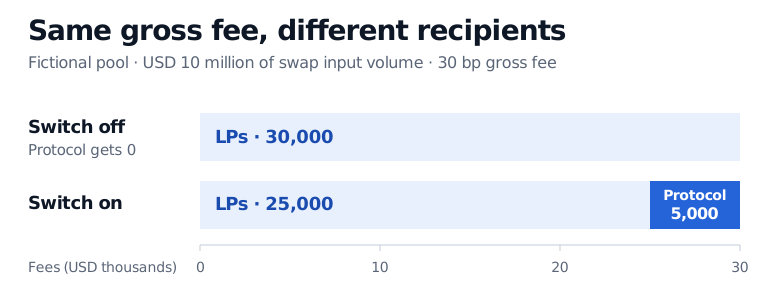
Fictional fee allocation at fixed volume and a fixed swap fee. The shaded amounts show who is allocated the fees.
When does the protocol collect?
Uniswap v2 illustrates why a fee split and a transfer ledger can look different. Swap fees accrue inside the pool reserves. With the switch on, the pair uses growth in the square root of the reserve product to calculate the protocol's claim. When liquidity is added or removed, the pair can mint new LP shares to the designated recipient. Those shares represent a claim on both pool assets. The protocol's share in the example above is measured in USD for comparison, while the v2 contract collects through LP shares. Uniswap v2 whitepaper, §2.4 · Uniswap v2 pair contract
In December 2025, Uniswap governance executed proposal 93, UNIfication, which set the Ethereum mainnet v2 factory's fee recipient to its TokenJar collection contract. The separate Firepit release mechanism allows a caller to burn the required amount of UNI in exchange for specified collected assets. The fee assets go to the recipient chosen in the release call. The burn removes UNI from spendable supply and gives passive holders no right to receive those assets. Executed Uniswap governance proposal 93 · Uniswap Protocol Fees, Firepit Mechanics
To reconcile a dashboard, check which pools and dates it covers, then track fees accrued, assets collected and assets released or distributed as separate measures. A token burn belongs in a supply ledger. A holder payout belongs in a distribution ledger and requires a payout rule. A protocol revenue figure alone tells you neither the cash paid to holders nor the effect on the token price.