An exchange for physical pairs a futures trade with an opposite cash-market trade. Follow both parties’ positions and see how CME handles clearing and records.
Exchange for Physical (EFP) Trades
An exchange for physical (EFP) is a trade negotiated privately outside the exchange order book that pairs the purchase of an exchange-listed futures contract with the simultaneous sale of a corresponding cash-market position. The other party sells the futures and buys the cash position. The package lets a commodity buyer agree the physical purchase and close its futures hedge in one trade. At CME, an EFP is one type of exchange for related position (EFRP), and the cash leg can be a qualifying physical purchase or physical forward contract. CME Rule 538
From a futures hedge to inventory
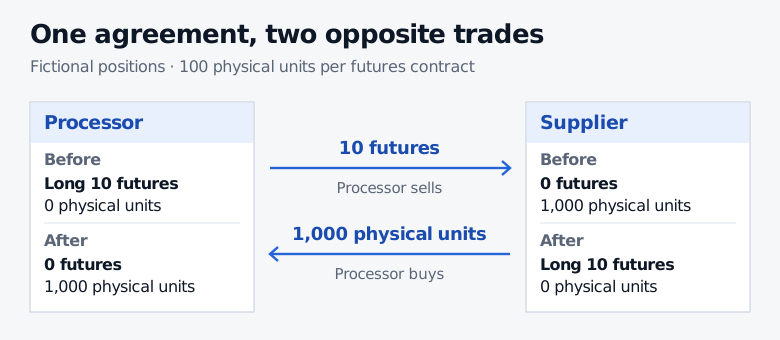
A processor is long 10 futures contracts for a commodity it needs to buy. A supplier holds 1,000 units of that commodity and starts with zero futures. In this fictional contract, each future represents 100 units, so the processor’s hedge covers 10×100=1,000 units.
The processor buys the supplier’s 1,000 units and sells 10 futures in the same contract month as its existing long. The sale closes the processor’s futures position, and the physical purchase puts 1,000 units into inventory once it settles. The supplier sells its 1,000 units and buys the 10 futures, opening a long position from flat. Agreeing both prices as a package fixes the cash–futures spread for the deal without leaving one leg to be priced later. The processor then has the price and storage exposure of holding inventory.
In a fictional EFP, the processor goes from long 10 futures and no stock to zero futures and 1,000 physical units. The supplier goes from zero futures and 1,000 units to long 10 futures and no stock. Each futures contract represents 100 units.
The futures and cash legs move in opposite directions. Positions shown after the futures leg clears and the physical purchase settles.
What CME checks and clears
CME Rule 538 requires a genuine transfer of ownership or a legally binding agreement for the related cash leg. Its size must be approximately equivalent to the futures leg. When the cash leg uses a related product, the rule requires a reasonable degree of price correlation, and an appropriate hedge ratio can establish size equivalence. The agreed prices must be commercially reasonable, and the futures price must use the contract’s applicable price increment. Eligibility also depends on the product. CME Rule 538 and its current advisory
The parties arrange and settle the physical purchase bilaterally. The futures leg is submitted as an EFP for clearing via CME Direct or CME ClearPort, with the date and time the parties agreed the terms. The advisory calls for submission as soon as possible, normally by the end of the business day of execution, subject to the relevant contract’s posting cutoff. Parties retain records of both legs, such as futures trade tickets, cash confirmations, and evidence of payment and title transfer where applicable, and must produce them on request. CME clearing mechanics · CME advisory, FAQs 19–24
For the mechanics of the futures leg, the SelfMadeQuant Futures Mechanics lesson explains contract size and why selling the same contract month offsets a long. The full lesson requires membership.