The Employment Cost Index (ECI) is a quarterly US Bureau of Labor Statistics (BLS) measure of how employers’ hourly labour costs change for a fixed mix of occupations and industries. Total compensation includes wages and salaries plus employer benefit costs. For a macro model, the ECI helps separate rising compensation costs from a shift in employment towards higher-paid jobs. BLS Handbook of Methods overview
What the fixed mix controls for
If lower-paid industries lose jobs while higher-paid industries keep hiring, average hourly earnings can rise even when hourly pay is unchanged in each industry. The monthly US Current Employment Statistics measure of average hourly earnings divides private-sector payroll by paid hours. Changes in the mix of paid hours affect the average, and employer costs such as health insurance and retirement contributions are outside its coverage. BLS Current Employment Statistics concepts
For the main ECI aggregates, BLS groups jobs by ownership sector, industry and occupation. It uses comparable sampled jobs to estimate changes in hourly costs within each group. It then updates each group’s cost bill with employment held fixed between reweightings and adds the bills across groups. This modified Laspeyres design limits the effect of workers moving between those groups. The headline civilian series covers private industry and state and local government within the survey’s scope. Federal employment and agricultural workers are excluded. Some detailed cuts, including union and nonunion series, use weights that can vary within those groups. BLS ECI calculation methods · BLS ECI questions and answers
How benefits can lift total compensation
Suppose a fictional, unchanged set of jobs starts with a total hourly compensation cost indexed to 100. Wages and salaries account for 70 index points and employer benefits for 30. Over one period, wage costs rise 3% and benefit costs rise 5%. The new cost of the same basket is . Relative to the starting cost, total compensation grows 3.6%.
The contributions are 2.1 percentage points from wages and salaries and 1.5 percentage points from benefits. Benefits grew faster, while wages contributed more because they made up more of the starting bill. The 70/30 split is a fictional starting expenditure split. BLS uses matched survey observations and fixed employment counts across job groups, so a permanent 70/30 average of published wage and benefit growth rates cannot reproduce the headline. BLS ECI calculation methods
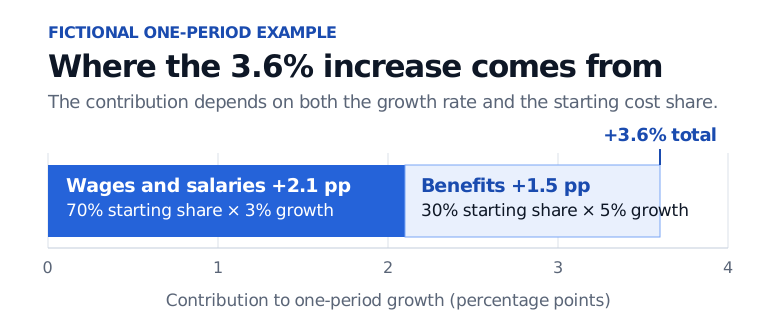
Starting cost shares determine how much each component’s growth contributes to the change in the total.
Use the wages and salaries series for wage inflation and the total compensation series when employer labour costs are the question. BLS counts items such as paid leave, health insurance and nonproduction bonuses under benefits. For real ECI, BLS deflates the nominal index using the Consumer Price Index for All Urban Consumers (CPI-U). Nominal compensation can rise while its value in consumer-price terms falls. Deflating total compensation still leaves benefits in the measure. BLS ECI questions and answers · BLS constant-dollar calculation
Which date goes into a backtest?
The ECI reference pay period contains the 12th of the quarter-ending month. The release date is when the result becomes observable. For example, on 30 October 2026 at 8:30 a.m. ET, BLS reported that civilian total compensation had risen 0.8% over the three months to September, seasonally adjusted, and 3.4% over the twelve months to September, not seasonally adjusted. Both were nominal. The two rates compare different periods and use different seasonal conventions. BLS Handbook of Methods overview · BLS September 2026 release archive
Store the component, population, comparison period, seasonal treatment and release timestamp with the observation. Use the release vintage available at the decision time to avoid look-ahead bias. Historical seasonally adjusted values can be revised. Method changes matter too. In its September 2026 release, BLS announced that the January 2027 release of December 2026 data would introduce 2025 employment weights in place of the 2021 weights and remove workers’ compensation costs from the ECI calculation. BLS September 2026 release archive · BLS reweighting and benefits notice
Sources
- BLS Handbook of Methods — ECI overview
- BLS Handbook of Methods — ECI calculation
- BLS Employment Cost Index questions and answers
- BLS Handbook of Methods — Current Employment Statistics concepts
- BLS Employment Cost Index — September 2026 release archive
- BLS notice on 2025 employment weights and workers’ compensation costs