Dollarization is the use of a foreign currency for domestic payments, pricing, saving or borrowing. Currency substitution is the payments case, where people use foreign money to settle transactions. The term dollarization can also describe the use of a foreign currency other than the US dollar. For credit analysis, the distinction matters because a borrower can earn local currency and owe dollars even when most everyday payments still use local money. World Bank and IMF, Financial Sector Assessment: A Handbook, §3.5.3.
What has moved into dollars?
- Payments. A shop starts accepting dollar cash alongside local money. That is informal currency substitution. A price quoted in dollars and settled in local money shows that the dollar serves as a unit of account, while the local currency still serves as the means of payment.
- Balance sheets. A household holds dollar deposits, or a business takes out a dollar loan. This is financial dollarization. A foreign-currency deposit share measures the denomination of bank deposits and says little by itself about which money people hand over at the till.
- Official currency. In full official dollarization, the jurisdiction adopts foreign currency as legal tender in place of its own currency. A currency peg keeps domestic money and targets its exchange rate. A currency board also keeps domestic money and adds a formal conversion commitment backed by foreign reserves. World Bank and IMF handbook, §3.5.3, Berg and Borensztein, IMF Working Paper 00/50.
When 120 million buys too few dollars
A fictional borrower earns 120 million in local currency, all available on the day a USD 50 million debt payment falls due. The local currency is still in use, before any official conversion to dollars. Assume the borrower can exchange its receipts at the quoted exchange rate, with no hedge, fees or other funds available for the payment. If is the number of local units per US dollar, then
At 2 local units per US dollar, the borrower can buy USD 60 million, covering the payment 1.2 times. At 3, the local currency has depreciated. The same receipts buy USD 40 million and cover the payment 0.8 times, leaving USD 10 million unfunded.
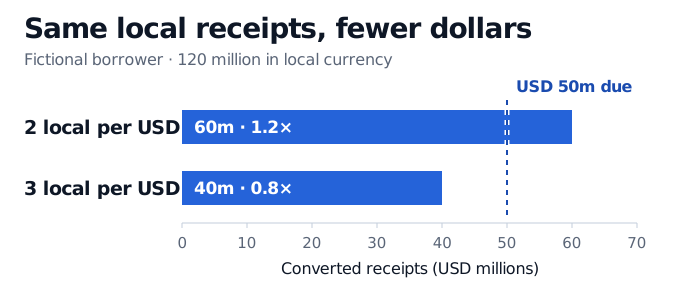
The dashed line marks the same dollar payment in both scenarios. At the weaker exchange rate, the borrower needs another USD 10 million by the due date.
A bank can fund a dollar loan with dollar deposits and have a small direct FX position. If its borrower earns local currency, depreciation can still make the loan harder to repay. The mismatch shows up for the bank as credit risk. In a stress test, check which receipts, hedges and debt payments match by currency and date. The SelfMadeQuant spot FX lesson works through a forward hedge for a foreign-currency payment in Exercise 3. The preview is public and the full exercise requires membership. World Bank and IMF handbook, §3.5.3.
Who can supply dollars in a squeeze?
With partial dollarization, the domestic central bank can still issue local money. Providing emergency dollar liquidity depends on the dollars it can mobilize, for example from usable reserves or borrowing. Full adoption removes the old local-to-dollar exchange rate for cash flows that now settle in dollars. The foreign issuer sets monetary policy for the adopted currency, while the adopting jurisdiction still has to secure dollar liquidity for its banks. A bank run can strain that liquidity even when the bank’s assets and liabilities are denominated in the same currency. World Bank and IMF handbook, §3.5.3, Berg and Borensztein, IMF Working Paper 00/50.
Sources
- World Bank and International Monetary Fund, Financial Sector Assessment: A Handbook, §3.5.3 on forms of dollarization, currency-induced credit risk and dollar liquidity.
- Andrew Berg and Eduardo Borensztein, The Pros and Cons of Full Dollarization, IMF Working Paper 00/50, on currency boards, monetary autonomy and emergency liquidity.