A currency board arrangement is an exchange-rate regime that commits the monetary authority to convert domestic money into an anchor currency at prescribed rates and to fully back the monetary base with foreign reserve assets. For an FX risk model, that rule links conversion pressure to changes in bank settlement balances and, in turn, to domestic funding rates. HKMA, Linked Exchange Rate System FAQ.
When the board buys anchor currency from an eligible counterparty, it receives foreign assets and issues domestic base money in payment. When it sells anchor currency, it receives and extinguishes domestic base money. The conversion itself expands or contracts the base. A conventional currency peg can also involve FX intervention. The currency board adds a backing requirement that constrains base-money issuance. Under full official dollarization, the jurisdiction adopts foreign currency in place of its domestic currency. Under a board, the domestic currency continues to circulate. HKMA, Linked Exchange Rate System FAQ, Berg and Borensztein, The Pros and Cons of Full Dollarization.
The percentage can rise as reserves fall
Suppose a fictional board has 120 million in eligible foreign reserve assets and 100 million in covered domestic monetary-base liabilities. Both stocks are valued in millions of domestic currency units on the same date and valuation basis. Its backing ratio is
An eligible bank then redeems 20 million of its domestic settlement balance for anchor currency at the board’s rate. With no fees, revaluation or other transactions, eligible reserves fall to 100 million and base liabilities fall to 80 million. The ratio rises to 125%. The excess of eligible assets over covered liabilities stays at 20 million. The same cushion now sits over a smaller monetary base.
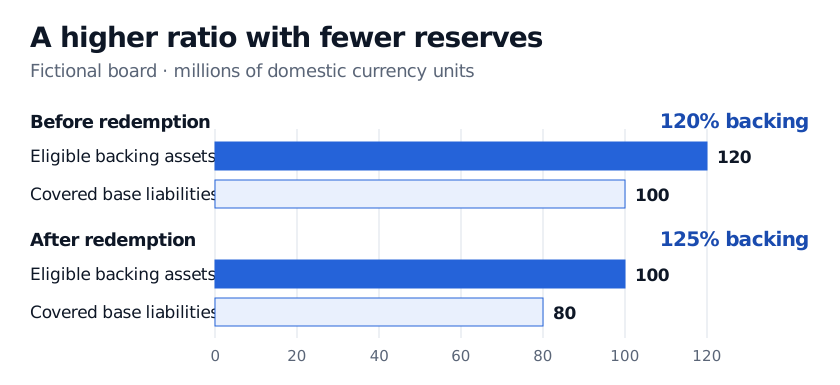
Fictional balance sheet. Matching declines in backing assets and base liabilities leave a 20 million cushion in both snapshots.
The denominator covers the issuer’s specified base liabilities. Customer deposits are claims on commercial banks and sit outside this backing calculation. For a real board, check which foreign-exchange reserves are designated as backing, which liabilities enter the published base and who can convert directly.
Who converts in Hong Kong?
Under Hong Kong’s Linked Exchange Rate System, banks can transact with the Hong Kong Monetary Authority (HKMA) under two Convertibility Undertakings. At the strong-side rate of 7.75 HKD per USD, the HKMA sells HKD for USD. The banks’ combined clearing balance at the HKMA, called the Aggregate Balance, expands and tends to put downward pressure on HKD interbank rates. At the weak-side rate of 7.85 HKD per USD, the HKMA buys HKD for USD. The Aggregate Balance contracts and tends to put upward pressure on HKD interbank rates. These undertakings apply to transactions with banks. A retail customer’s exchange quote comes from their own provider. HKMA, How Does the LERS Work?.
The Aggregate Balance is one part of Hong Kong’s monetary base. The base also includes Certificates of Indebtedness backing banknotes issued by note-issuing banks, government-issued notes and coins in circulation, and Exchange Fund Bills and Notes. The HKMA designates a Backing Portfolio within the Exchange Fund for the base. It sets 105% and 112.5% as the lower and upper backing-ratio triggers for transfers into or out of that portfolio. Those thresholds govern the backing portfolio. The 120% worked ratio above belongs to the fictional board. HKMA, Components of the Monetary Base, HKMA, Portfolio Segregation.
Sources
- HKMA, Linked Exchange Rate System FAQ, questions B1–B3 on interbank rates, the backing rule and discretionary operations.
- HKMA, How Does the LERS Work?, conversion rates and the automatic adjustment mechanism.
- HKMA, Components of the Monetary Base, the four published components.
- HKMA, Portfolio Segregation, designated backing assets and transfer triggers.
- Andrew Berg and Eduardo Borensztein, The Pros and Cons of Full Dollarization, Section I and Section II.E on currency boards and full dollarization.