A direct listing brings a company's shares onto a stock exchange with initial sales through the exchange's auction, rather than through the pre-trading sale and distribution used in a traditional firm-commitment initial public offering. It can provide liquidity for existing shareholders, raise new company capital, or do both, depending on the listing route. For quant work, the distinction determines who receives the cash, whether shares outstanding increase, and which price could actually have been traded. The SEC describes the auction-versus-pre-opening-sale distinction in its December 2020 NYSE approval order.
This article concerns US equity direct listings. The operative rule examples below are for Nasdaq Global Select, checked 31 October 2026; NYSE sources supply separately dated context. The label alone does not specify another venue's eligibility or auction rules.
Follow the cash before counting the shares
A secondary direct listing lets existing shareholders sell previously issued shares. The issuer receives no proceeds from those shareholders' sales. NYSE calls its resale route a Selling Shareholder Direct Floor Listing; Nasdaq describes the corresponding Global Select route in IM-5315-1. A primary direct listing includes shares sold by the company in the opening auction. Nasdaq calls that a Direct Listing with a Capital Raise, under IM-5315-2, and permits issuer sales alone or alongside selling shareholders. Nasdaq's current listing rules, SEC's 2020 NYSE order.
Consider two separate fictional scenarios, each starting with 100 million shares outstanding. Assume every specified sale executes at USD 10 per share, ignore fees and taxes, and assume no other share issues, conversions or cancellations. These are cash-flow illustrations, not demonstrations that a company qualifies for listing.
| What happens in the auction? | Secondary only | Primary only |
|---|---|---|
| Existing shares sold | 5 million | None |
| Newly issued shares sold | None | 10 million |
| Cash paid by buyers | USD 50 million | USD 100 million |
| Gross proceeds to selling shareholders | USD 50 million | Zero |
| Gross proceeds to company | Zero | USD 100 million |
| Shares outstanding after sale | 100 million | 110 million |
In the secondary case, the same shares change owners. In the primary case, the company issues additional claims and receives additional cash:
Buyer payments equal recipient proceeds in each column. Do not call the secondary sale's USD 50 million a company capital raise, or add its 5 million transferred shares to the outstanding count. Conversely, “direct listings never issue new shares” would erase the primary route.
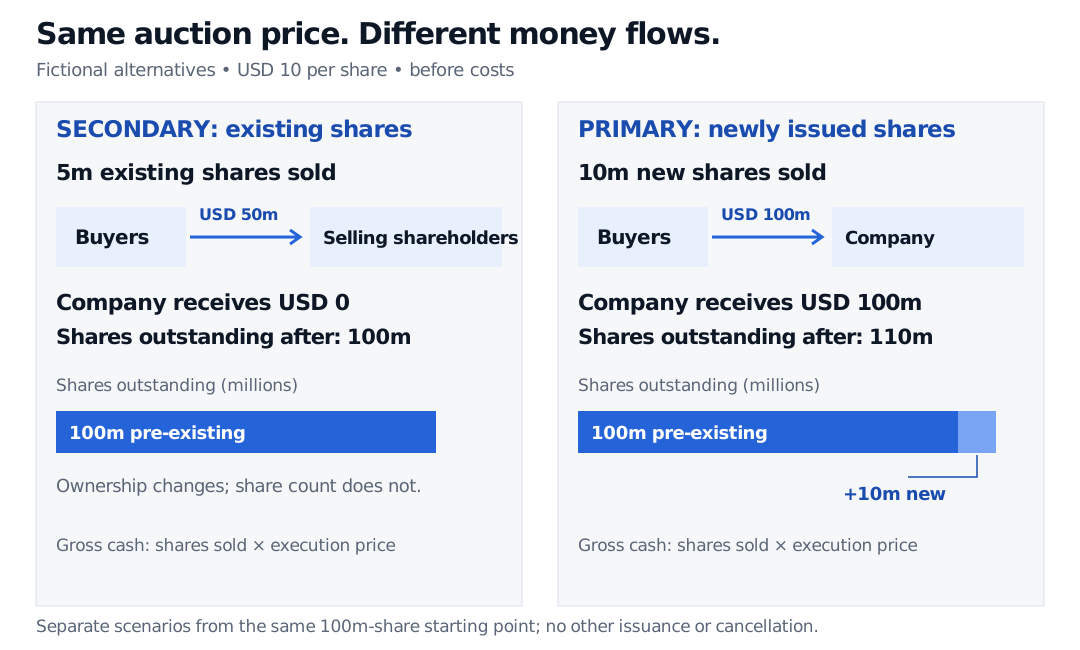
Original fictional cash-flow and share-count comparison. Both scenarios start with 100 million shares; bars share the same scale in millions of shares. Proceeds are before costs.
Issuance reduces a nonparticipating holder's percentage ownership, but this is not by itself proof of an equal percentage loss in wealth: the issuer also acquires cash. Our primary scenario specifies proceeds and share count, not a valuation model for the business after the raise.
A reference price is not a purchase opportunity
An initial reference price provides a starting point for price discovery. It is not a promise that an investor can buy or sell there. In its 6 October 2020 account of secondary direct listings, NYSE describes setting an initial reference price with the financial advisor, followed by DMM price indications as orders accumulate; the eventual opening price comes from submitted supply and demand. This is a dated description of those NYSE openings, not a universal algorithm. NYSE: Opening and Trading Direct Listings.
Nasdaq's Current Reference Price is an order-based auction indication, distinct from an earlier listing reference value. Its direct listings initially trade through the Halt Cross in Rule 4753, with release conditions in Rule 4120(b)(4)(C). These are special procedures for the listing's opening auction. Nasdaq Equity 4.
Suppose an illustrative secondary listing has an initial reference value of USD 8, but opens at USD 10. The opening is 25% above that reference, since . This is a comparison between two numbers, not a 25% return available to an auction buyer. Someone filled at USD 10 and still marking the shares at USD 10 has zero price return before costs. A backtest needs an attainable fill price and quantity, not an assumed purchase at the reference value.
“Direct” does not remove intermediaries or restrictions
The useful distinction is how the shares first sell. It does not imply the absence of every underwriting or advisory role. Current Nasdaq IM-5315-2 requires an underwriter for the company's primary sales and requires that underwriter to be identified in the effective registration statement. This is an operative listing requirement, not merely an outstanding proposal. The current rule includes an amendment dated 3 August 2026, operative 14 August 2026. Nasdaq 5300 Series.
NYSE's history also cautions against relying on an old “no underwriters” summary: the SEC's 15 December 2022 approval, Release 34-96514, added a retained-and-named underwriter requirement for Primary Direct Floor Listings. The same order discusses the possibility of lock-up arrangements. A direct-listing label therefore does not prove that all insider shares are immediately saleable or that lockups are absent; the issuer's disclosed arrangements matter. SEC's NYSE approval order.
Financial advisors also have explicit functions. Nasdaq Rule 4120(b)(4)(C)(iii) provides for a broker-dealer financial advisor in the non-IPO initial-pricing process. For a capital-raise direct listing, 4120(b)(4)(C)(iv) imposes special release and pricing conditions, and ordinary customer market orders cannot participate in that cross. The issuer's special Company Direct Listing Order must execute in full. An auction can therefore remain unlaunched when conditions fail; there is no guaranteed reference-price execution. Nasdaq Equity 4, Rules 4120 and 4702(b)(16).
To analyse a specific listing, identify the seller, the number of new shares, the relevant prospectus restrictions, and the venue's current auction procedure before interpreting its debut return. For the broader distinction between ownership claims and changes to share count, Equities, Indices and Corporate Actions develops rights issues, splits and equity-return adjustments. Its preview is public; the full lesson requires membership.
Sources
- Nasdaq, 5300 Series, IM-5315-1 and IM-5315-2: secondary and capital-raise routes, named-underwriter requirement and current amendment history. Checked 31 October 2026.
- Nasdaq, Equity 4, 4120(b)(4)(C)(iii)–(iv), 4702(b)(16) and 4753: financial advisor, capital-raise release conditions, issuer order and Halt Cross. Checked 31 October 2026.
- SEC, Release 34-90768, 22 December 2020, pp. 5–7: traditional firm-commitment offering versus direct-listing sales and the two NYSE routes. Historical approval, subsequently amended.
- NYSE, Opening and Trading Direct Listings, 6 October 2020, “Direct Listings” and “Price Discovery Process”: historical NYSE reference-price and auction sequence.
- SEC, Release 34-96514, 15 December 2022, pp. 10–12 and 30–34: approved NYSE named-underwriter requirement and discussion of possible lock-ups.