DenseNet is a convolutional neural network architecture in which each layer inside a dense block receives the feature maps of every earlier layer in that block, together with the block input. It combines them by concatenating channels. For a quant researcher evaluating image-like alternative data, the practical question is how earlier representations remain available as deeper features are learned. DenseNet makes that reuse explicit. The original definition is in Huang et al., §3.
The growing feature bank
Write for the block input and for the new features produced by layer . Its transformation is
Here is a learned transformation; concatenation simply puts the earlier maps alongside one another on the channel axis. In the basic paper architecture, the transformation uses batch normalisation, ReLU and convolution. The maps within a block have matching spatial dimensions.
The growth rate is the number of new channels each layer produces. With input channels and such layers, layer consumes channels, while the concatenated block output contains channels. These are feature counts, not parameter counts. Huang et al., §3 gives the architecture and growth-rate convention.
Consider an illustrative block that starts with 3 channels, has 3 layers, and adds 2 channels per layer. Keep spatial resolution fixed and omit transitions inside this example.
| Layer | Channels consumed | New channels produced | Channels retained after concatenation |
|---|---|---|---|
| 1 | 3 | 2 | 5 |
| 2 | 5 | 2 | 7 |
| 3 | 7 | 2 | 9 |
Layer 3 sees the original three channels, the two produced by layer 1, and the two produced by layer 2. It produces two more. The whole block therefore returns 9 channels, even though the last learned transformation produces only two. A shape audit that records only each transformation's output would miss the retained channels.
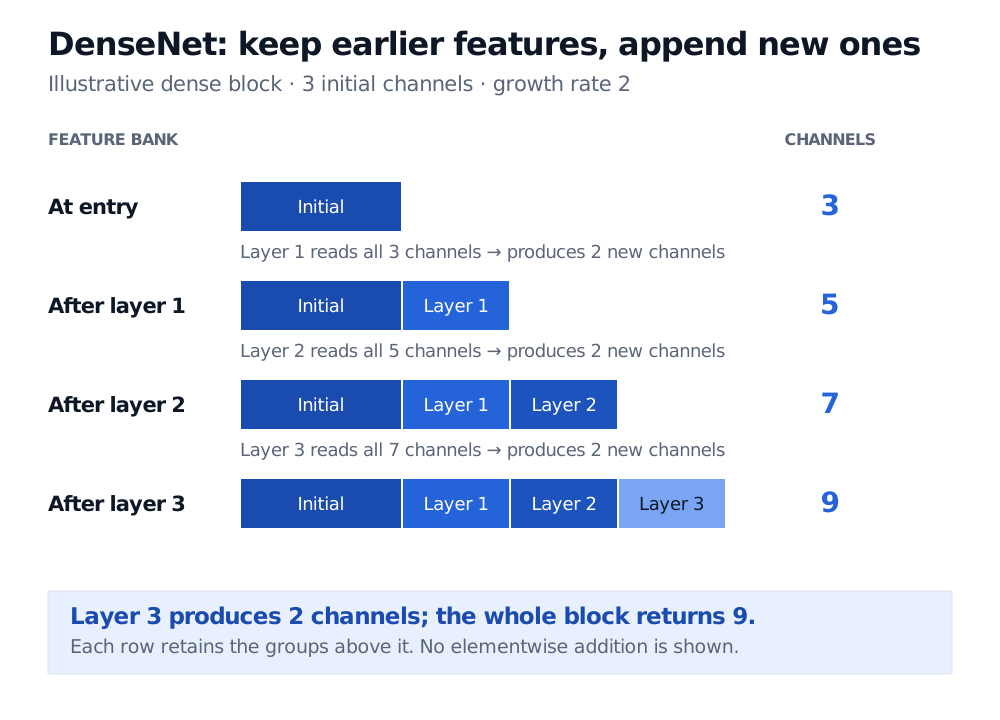
Original shape-accounting diagram. Each horizontal group represents channels, not learned values or a measured contribution to prediction.
Concatenation changes what is preserved
A residual network uses elementwise addition to merge a shortcut with a transformed branch. DenseNet keeps the earlier feature maps as separate channels instead. The distinction is developed in Dive into Deep Learning, §8.7.1. Having access to a feature does not mean the fitted model must use it strongly, or that each new channel carries independent information.
Growth is local to a dense block. Transition layers between blocks can change resolution and compress channels; bottleneck convolutions inside a layer can reduce the width processed by a subsequent convolution. Neither operation changes concatenation into addition. Dive into Deep Learning, §§8.7.2–8.7.3 illustrates channel growth and the separate transition operation.
For research, the diagram is a representation audit, not a forecast result. It contains no fitted weights, targets or return observations. It cannot establish predictive skill, profitability, or a universal speed or memory advantage over another architecture. A financial application still needs its own data design and out-of-sample evaluation.
For the underlying shape arithmetic and residual comparison, see CNN Building Blocks: Receptive Fields and Residual Design Patterns (public preview; full lesson requires membership).
Sources
- Huang, Liu, van der Maaten and Weinberger, Densely Connected Convolutional Networks, §3 for connectivity, growth rate, bottlenecks and compression; §5 for the feature-reuse analysis. CVPR 2017 paper; linked author revision dated 28 January 2018.
- Zhang, Lipton, Li and Smola, Dive into Deep Learning, §§8.7.1–8.7.3, for the addition/concatenation comparison and dense-block/transition shapes.