Delisting removes a class of securities from a stock exchange. Deregistration ends a class’s registration under a particular provision of the U.S. Securities Exchange Act of 1934. Going dark is the informal term for a company ceasing to be an SEC reporting issuer through termination of registration or suspension of the applicable reporting duties. Shareholders can retain their shares through that change. A stock can drop out of an exchange-listed research universe while its issuer’s filings still supply new fundamental data. SEC Form 25 · SEC Form 15
What changes on Form 25
Rule 12d2-2 uses Form 25 for removal from a national securities exchange and withdrawal of the class’s Section 12(b) registration, as applicable. Either the exchange or the issuer can file under the corresponding procedure. On the ordinary timetable, delisting takes effect 10 days after filing and withdrawal of Section 12(b) registration takes effect after 90 days. The SEC can shorten the registration period or postpone effectiveness under the rule. The exchange can also suspend trading before formal delisting, so the last trading date is a separate observation. Rule 12d2-2 · Rule 12d2-1
The Section 13(a) filing duty based solely on that Section 12(b) registration generally pauses at effective delisting, even if the registration itself ends later. A later postponement of withdrawal can trigger catch-up reports. Reporting can also be required under Section 12(g) or Section 15(d), or because another class of the issuer’s securities independently triggers a filing obligation. Rule 12d2-2(d)(5)–(7) · SEC Form 15
When Form 15 matters
- Section 12(g) can require registration of a class of equity securities outside an exchange listing. An eligible issuer can certify termination on Form 15 under Rule 12g-4. The corresponding Section 13(a) reporting duty is suspended upon filing the certification, with registration terminating on a later timetable under the rule. Withdrawal or denial of the certification can require catch-up reports. Rule 12g-4
- Section 15(d) can create a reporting duty through an effective Securities Act registration statement. Rule 12h-3 allows suspension through Form 15 where its conditions are met, including filing history, holder criteria where applicable, and restrictions tied to the offering’s registration statement. Where Section 15(d) itself suspends the duty for a fiscal year, Rule 15d-6 governs the Form 15 notice. Exchange Act Section 15(d) · Rule 12h-3 · Rule 15d-6
One stock, three stages
Fictional Aldermere’s common shares start out exchange-listed, with the issuer filing SEC reports. When the delisting takes effect, Aldermere keeps filing under Rule 12d2-2(d)(7) because the Section 15(d) reporting duty from an earlier registered offering applies in this case. Later, assume that duty is validly suspended and every other potential filing basis is absent. Aldermere has now gone dark.
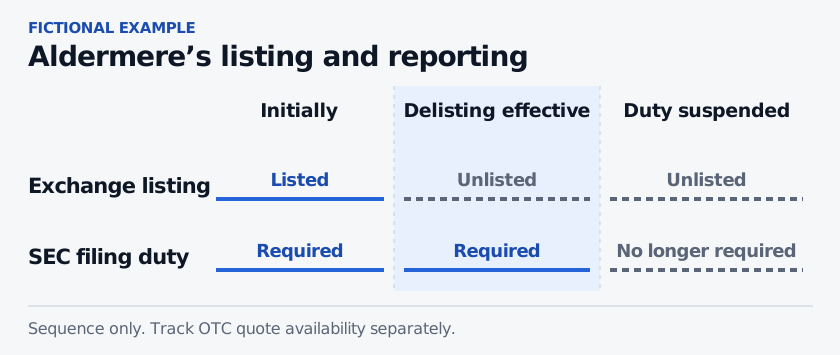
Two effective events in the fictional Aldermere case. Stage widths show sequence only.
Aldermere’s shares could be quoted over the counter after delisting. Actual quote availability depends on market participants and separate quotation requirements, including information review under Rule 15c2-11 where applicable. For a simulated exit, check whether a quote was available and whether its price and size support an executable trade. SEC Rule 15c2-11 · FINRA Rule 6432
For a historical backtest, store listing, reporting status and quote availability as distinct records. Capture when changes became public as well as when they took effect. Keep the stock in the historical universe for dates on which it met the strategy’s rules to avoid survivorship bias. An existing holding still needs an economic outcome, such as documented sale proceeds, a distribution or a continuing claim. The Corporate Actions and Survivorship lesson works through that accounting, with a public preview and full lesson for members.