CycleGAN learns unpaired translations using adversarial and cycle-consistency losses. Two perfect finite solutions show why reversibility does not identify economic counterfactuals.
CycleGAN
CycleGAN is an unpaired translation method that learns two opposing mappings using adversarial losses and a round-trip consistency penalty. For a quant experimenting with translating financial observations between domains, the critical distinction is between producing plausible target-domain data and establishing what the same economic observation would have become.
Originally developed for images, it can learn from separate collections such as summer and winter scenes without a matched photograph of each scene in both seasons. It combines generative adversarial networks with a reconstruction constraint. Zhu et al., Introduction and §3
What the cycle constrains
Write the forward translator as G:X→Y and the reverse translator as F:Y→X. Two discriminators compare translated samples with real observations in their respective destination domains. The cycle penalty is
Training combines both adversarial terms with λLcyc, where λ controls the reconstruction penalty. The paper's implementation uses least-squares adversarial losses. A low cycle penalty encourages recovery of the input; it does not directly compare a translation with its correct paired output, because that output is unavailable. Zhu et al., §§3–4
Two perfect cycles, incompatible answers
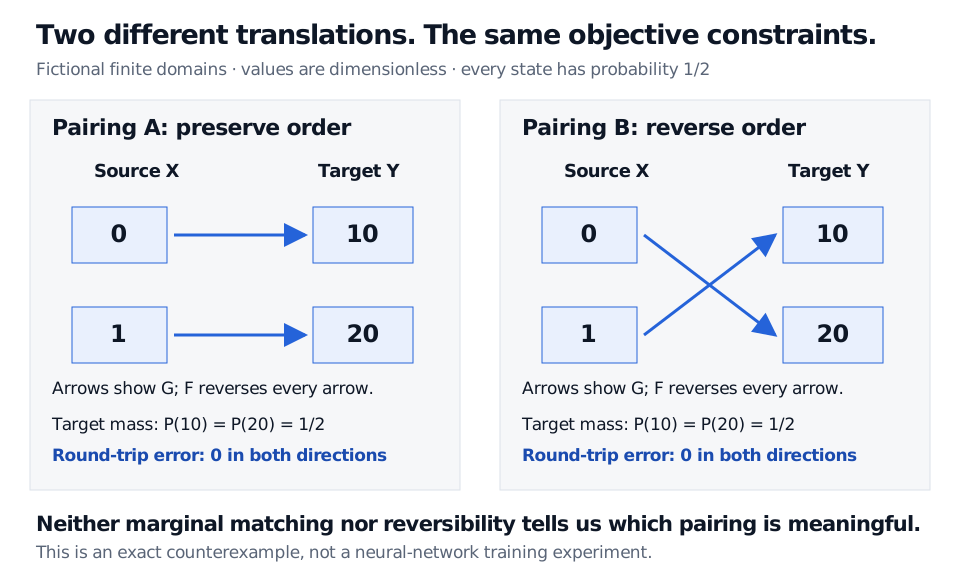
Consider fictional, dimensionless domains: a source variable is uniform on {0,1} and a target variable is uniform on {10,20}. There are no observed pairs.
Candidate
Forward mapping
Reverse mapping
A
G(0)=10, G(1)=20
F(10)=0, F(20)=1
B
G(0)=20, G(1)=10
F(20)=0, F(10)=1
For either candidate, the translated target values have probabilities P(G(X)=10)=P(G(X)=20)=1/2. The reverse translator likewise matches the source distribution. Thus both reproduce the same marginal distributions.
Both also recover every original value. Under A, the source cycle starting at zero is 0→10→0; under B it is 0→20→0. The other source state and both target states return exactly too. Each candidate has cycle loss zero.
Two fictional uniform source states 0 and 1 map either to 10 and 20 respectively or to 20 and 10. Both target states retain probability one half, and both inverse mappings give zero round-trip error.
Two exact solutions disagree on every pairing. Matching domain distributions and recovering inputs do not determine economic meaning.
This is an identifiability counterexample: the constraints admit incompatible answers to “which target belongs to this source?” It is an exact finite construction, not a claim about neural-network convergence. Zero cycle loss also does not mean zero adversarial loss; the example establishes exact distribution matching, without assigning a numerical value to a GAN training objective.
Translating a market is not identifying its counterfactual
Suppose, as a proposed research task, one collection contains calm-market observations and another contains stressed-market observations. An unpaired translator could associate source observations with plausible stressed observations while its reverse translator learns to undo those associations. The finite example shows why those properties alone cannot establish a counterfactual outcome for a particular portfolio or date.
That conclusion is an economic interpretation of the counterexample, not an empirical finance result from the image paper. A counterfactual needs a specified intervention and assumptions connecting it to outcomes. A useful financial translation also needs independent checks on what it must preserve: instrument identity, contractual cash flows, available information, and relevant cross-asset or temporal relationships. Matching a chosen feature distribution does not enforce these requirements automatically.
The authors themselves describe semantic label permutations and warn that plausible generated content can differ from ground truth. Additional semantic supervision can help; it supplies information beyond reversibility. CycleGAN project page, interpretation and failure cases
Use cycle consistency as a structural constraint and evaluate the translated output against the actual task. When exploring domain adaptation, test the downstream model on untouched target-domain observations. When proposing stress scenarios, test economic constraints separately and make the scenario assumptions explicit. An inverse mapping is evidence of recoverability, not evidence that an economic intervention has been identified.