A covered bond is a bond issued by a bank or other eligible credit institution. Investors have a claim on the issuer and a priority claim on a legally segregated cover pool, often made up of mortgages. This dual recourse gives a credit analyst two sources of payment to assess. A housing downturn can weaken both at once if the bank and the pool are exposed to the same borrowers or regions. Reserve Bank of Australia, Covered Bonds in Australia.
Who pays if the bank fails?
The issuing bank owes the scheduled interest and principal while the bond performs. Ring-fencing keeps the designated cover assets available for the priority claim if the bank gets into trouble. Ordinary creditors cannot share those assets ahead of that claim. The governing law and issue documents specify how investors gain access to the pool. Directive (EU) 2019/2162, Articles 4 and 12.
For bonds subject to the EU directive's rules as implemented in national law, Article 4 provides for a priority claim on cover assets in issuer insolvency or resolution. If the pool falls short in insolvency, the unpaid balance is a claim on the issuer's estate. It generally ranks alongside ordinary unsecured claims, with a limited national option for specialised mortgage credit institutions. Total claims are capped at the bond's payment obligations. Article 5 bars automatic acceleration solely because the issuer enters insolvency or resolution. The bond can remain payable on its contractual schedule, so the timing of pool cashflows matters. Directive (EU) 2019/2162, Articles 4–5.
The same mortgages can support two different structures
In a typical covered-bond structure, the bank funds loans that remain on its consolidated balance sheet. A separate vehicle can hold legal rights to cover assets for the benefit of bondholders without changing who owes the bond payments. In Australia, the pool assets are held by a special purpose vehicle. APRA treats qualifying cover assets as if the issuing bank held them directly for prudential purposes. Reserve Bank of Australia, Covered Bonds in Australia and APRA, APS 121.
In a true-sale securitisation, the originator sells the mortgages to a vehicle that issues mortgage-backed securities. Those investors are paid from the vehicle's mortgage collections and any contracted support, with no general claim on the originator for a payment shortfall. The originator can still service the loans or retain some exposure. The identity of the entity that owes the debt is the distinction to track when both structures contain similar mortgages. Reserve Bank of Australia, Structure of a Residential Mortgage Securitisation.
What does 10% overcollateralisation measure?
A fictional programme has AUD 100 million of outstanding bond principal and AUD 110 million of eligible cover assets. Both amounts are measured on a nominal basis at the same date. For this principal-only comparison, overcollateralisation is the surplus of eligible assets over outstanding principal, divided by outstanding principal.
If the eligible cover value later falls to AUD 98 million with principal still at AUD 100 million, the simple coverage ratio falls from 110% to 98%. The cover value is now AUD 2 million below bond principal. A drop in the amount counted can reflect a change in eligibility as well as asset deterioration. Actual recovery depends on what the assets pay, when that cash arrives, other claims or expenses charged to the pool and what the investor can recover from the issuer's estate.
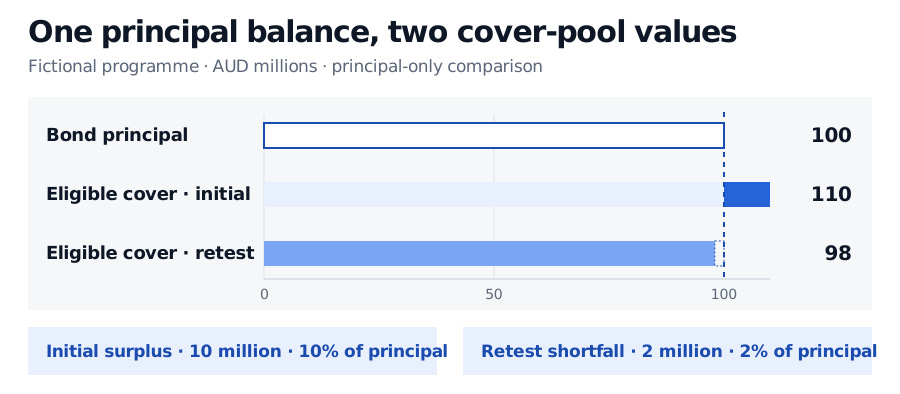
The dashed line marks unchanged outstanding principal. Both cover-pool values use the same measurement basis.
Read the programme's coverage test before comparing reported figures. Australia's Banking Act 1959 generally sets the cover-pool minimum at 103% of the secured bonds' face value under section 31A. The section provides for a different percentage by regulation and an exception where compliance would conflict with an APRA direction. In the EU, Article 15 of Directive (EU) 2019/2162 specifies a nominal principal comparison subject to its calculation rules and requires coverage of liabilities including interest, eligible hedges and expected wind-down costs. The applicable legal and contractual tests determine which values count and how much excess cover the issuer must maintain. Australian Banking Act 1959, section 31A and Directive (EU) 2019/2162, Articles 14–15.
Sources
- EUR-Lex, Directive (EU) 2019/2162, consolidated 9 January 2024. Articles 4–5, 12 and 14–15 cover claim priority, acceleration, segregation, disclosures and coverage.
- Australian Federal Register of Legislation, Banking Act 1959, compilation of 31 March 2026. Division 3A covers the Australian structure, including the pool maintenance rules in section 31A.
- APRA, APS 121 Covered Bonds, effective 1 January 2023. Cover-pool documentation, prudential treatment and default provisions.
- Reserve Bank of Australia, Covered Bonds in Australia, September 2017 and Asset Securitisation in Australia, September 2004. Historical explanations of the two funding structures.