The Consolidated Audit Trail (CAT) is the US regulatory system for collecting and linking order-event information across securities markets so regulators can reconstruct how orders were handled. It connects an order's receipt or origination, routing, execution, modification and cancellation. For a quant working on order reconciliation or regulatory reporting, the crucial distinction is between messages about an order and shares actually traded. CAT overview.
CAT is a specific cross-market audit trail established under SEC Rule 613 and the CAT NMS Plan. Its eligible-security scope includes NMS securities and OTC equity securities. An exchange and a broker can report their own handling of the same order. CAT NMS Plan, definitions and §§6.3–6.4.
Follow the order, rather than add the messages
Consider a fictional client instruction to buy 1,000 shares. Broker A receives it and routes all 1,000 shares to Exchange X. The exchange executes 400 shares. The remaining 600 shares are then successfully cancelled. Assume one route, no replacement order, no other fill and no later correction.
| Stage | What happened | Shares still open |
|---|---|---|
| Receipt | Broker A receives the 1,000-share buy | 1,000 |
| Route and receipt | A sends all 1,000 shares to X; X receives the order | 1,000 |
| Execution | X fills 400 shares | 600 |
| Effective cancellation | The remaining 600 shares are cancelled | 0 |
The final reconciliation is
Only 400 shares executed. Routing 1,000 shares did not buy another 1,000, and an acknowledgement of receipt or acceptance did not establish a trade. The route and the receiving side's record describe a handoff within the same lifecycle. Summing quantities across event categories would mix instructions, handoffs and outcomes.
A cancellation request would not justify the final zero on its own. A fill can occur while a cancellation is in flight. Here the cancellation is stipulated to have become effective for all 600 remaining shares. A real reconciliation must resolve the actual fills, cancellation outcome and any corrections.
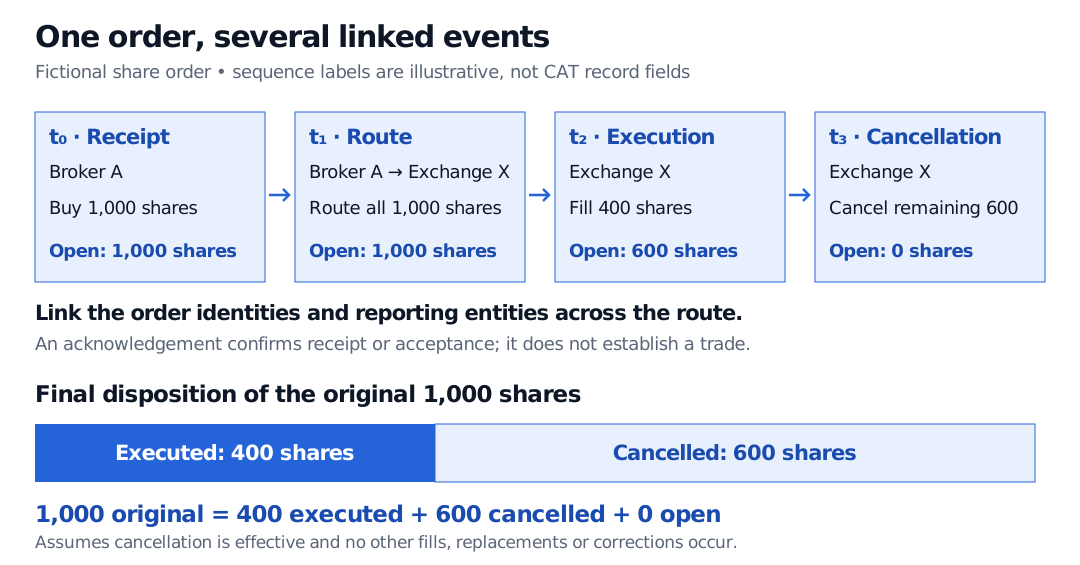
Fictional lifecycle, with quantity measured in shares. The final bar partitions the original order; routing and acknowledgement do not create extra traded shares. Cancellation is assumed effective, with no intervening fill or replacement.
What makes separate reports one lifecycle?
The sending and receiving systems need not use the same local order identifier. CAT's linkage architecture connects identifiers across the reports. Timestamps place events in time; reporting-entity identities show who originated, routed, received or executed the order. These pieces work together: a timestamp alone is not a reliable join key, and two similar-sized orders are not necessarily the same order. The illustration's sequence labels are teaching labels, not an actual CAT message schema. CAT NMS Plan, §§6.3–6.4 and Appendix C's sequencing discussion.
The Plan Participants are the participating self-regulatory organisations, including exchanges and FINRA. Their applicable rules impose reporting obligations on Industry Members. FINRA CAT, as Plan Processor, operates the system for the Participants; it is distinct from both the reporting broker and the regulators using the data. The SEC and authorised SRO regulatory users use CAT for oversight. SEC concept release, §§II.A and III.B.
A lifecycle join is therefore also a data-quality problem. Missing route links, mistaken identities or an unincorporated correction can change the reconstruction. The lesson Observation, Event and Availability Timestamps develops the difference between an event's time and the time a system can use its record. The full lesson requires membership; a public preview is available.
Regulatory reconstruction has its own clock
CAT supports surveillance, investigations, enforcement and market analysis. It is not the public consolidated tape, which disseminates market trade and quotation information, and it is not an instantaneous broker risk-control service. Public prints do not reveal the complete routed-order history, while CAT access is restricted to authorised regulatory use. SEC privacy order, introduction; SEC concept release, §III.B.
Recording, submission, validation and linkage are separate steps. The September 2026 Plan specifies corrected linked data availability at T+6, with separate interim-linkage arrangements. This is a processing timetable after the transaction date, not instantaneous publication of each event. CAT NMS Plan, Appendix D §§6.1–6.2.
The original personal-data design is not the current rulebook
Status checked 31 October 2026. CAT requirements have changed materially:
- On 10 February 2025, the SEC granted relief from reporting names, addresses and years of birth for natural persons reported using transformed SSNs or ITINs. This was targeted relief, not removal of order reporting. 2025 privacy order, §III.
- On 13 January 2026, the SEC approved amendments codifying and expanding privacy relief, eliminating specified personal-information reporting requirements and providing for removal of previously reported customer information. The order describes a phased implementation; approval is not proof that every historical copy was already deleted. CAIS approval, §§III.B and implementation discussion.
- Operational changes remained scheduled: FINRA CAT's 22 October 2026 newsletter lists Reference Database Phase 1B removal and rejection of fields relating to names, addresses and birth years, among others, for 7 December 2026 production. October update, “Reference Database Releases”.
- The 27 March 2026 cost amendment approved further changes to interim linkage, retention and processing, including permission to delete CAT data older than three years. An original-design retention or processing description can therefore be obsolete. This does not erase firms' separate books-and-records obligations. Cost savings approval, §§III.A–B.
Removing personal fields does not make linked trading activity public or remove the need for confidentiality and security. Regulators can seek identifying information through other regulatory channels. The SEC's 16 April 2026 concept release also opened a broader review of CAT design, governance, funding and privacy; a request for comment is not itself a replacement rule. CAIS approval; Concept release, summary.
Sources
- FINRA CAT overview: order lifecycle and handling broker-dealers.
- CAT NMS Plan, consolidated as of 3 September 2026: eligible securities, reporting roles, lifecycle information and staged data availability.
- SEC privacy exemptive relief, 10 February 2025: the scope and rationale of the targeted exemption.
- SEC CAIS amendment approval, 13 January 2026: broader privacy changes and phased implementation.
- SEC cost savings amendment approval, 27 March 2026: interim linkage and retention changes, with separate firm recordkeeping obligations.
- SEC concept release, 16 April 2026: regulatory purpose, system governance and review questions.
- FINRA CAT October 2026 update: scheduled Reference Database Phase 1B production changes.