A price reporting agency (PRA) gathers market evidence and publishes an assessed price for a specified physical commodity. The assessment estimates market value for a defined grade, location, quantity and delivery window at a specified time or over a stated period. A physical supply contract can use that number to set the invoice price even if the buyer and seller never trade a cargo at the assessment level. The same series may also be an input to derivative settlement. IOSCO, Principles for Oil Price Reporting Agencies
Which observations describe the same market?
Two cargoes can both be crude oil and carry different prices because they load at different ports or have different sulphur content. The PRA first defines the market it wants to measure. Its methodology governs which trades and quotes can enter, when they count and whether an observation with different terms can be normalised to the reference specification. A freight adjustment can put a delivered cargo on a comparable loading-port basis. A quality adjustment can account for an eligible grade’s premium or discount. The assessment is only as interpretable as the specification and evidence behind it. Platts Assessments Methodology Guide, Part III
Platts Dated Brent (PCAAS00) illustrates why timing matters. Its October 2026 benchmark statement specifies a 16:30 London time assessment for a standard 700,000-barrel cargo on a North Sea free-on-board basis. Platts’ Market on Close process considers verified trades and firm bids and offers. Competitive, verifiable bids and offers still open at the close can take precedence over earlier trades because the market may have moved. Editors apply judgement under the published methodology when screening information, normalising observations and deciding where to assess value. Platts Dated Brent Benchmark Statement, 26 October 2026
The August 2026 product specification gives a concrete location adjustment. Platts converts eligible WTI Midland cargo indications delivered to Rotterdam to a North Sea FOB-equivalent value so it can compare them with other eligible grades for loading ten days forward to month-ahead. A raw Rotterdam delivery price includes different shipping terms from a North Sea loading price. Platts Europe and Africa Crude Oil Specifications, North Sea section
Thin or selectively reported trade data can leave a PRA with an incomplete view of the market. IOSCO’s October 2012 oil PRA principles call for published methods that explain how evidence is prioritised, what happens when transaction data are scarce and how assessors exercise judgement. The principles address oil assessments referenced in regulated derivatives. IOSCO, Principles for Oil Price Reporting Agencies, §§1.1–1.4
One fictional benchmark and its invoice
Suppose a fictional commodity benchmark admits only verified trades for a single grade, port and delivery window from 14:00 inclusive up to the 16:00 local close. Its rule explicitly volume-weights the eligible trades. Two trades qualify, 20 units at USD 100 per unit and 10 units at USD 102 per unit. The rule gives
The first trade has twice the weight of the second. Now suppose a firm bid at USD 101.50 and a firm offer at USD 102.50 are open at 16:00 for the same terms. The trade-only rule still gives USD 100.67. The closing quotes indicate a higher range of trading interest. A methodology that targets value at the close can use that evidence. The quotes alone leave open where a close-based method would assess value.
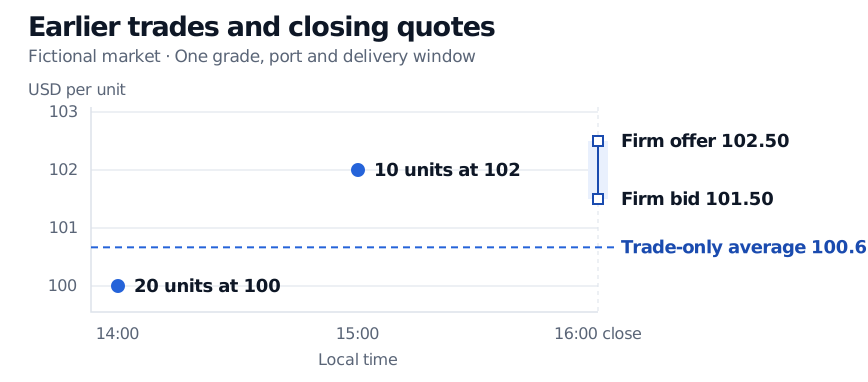
The dashed line weights earlier trades by quantity. The closing quotes show later trading interest and carry zero weight under the fictional trade-only rule.
A separate 30-unit supply contract names this benchmark and fixing day and adds an agreed differential of USD 1.50 per unit. Using the unrounded benchmark, the commodity charge is before other charges. The contract fixes how the differential enters the invoice. The methodology fixes how the benchmark is determined.
One number, different uses
A derivative applies its own settlement rules to the assessment. The ICE Dated Brent future, for example, uses the daily midpoint of Platts’ Dated Brent high and low quotations, averaged over the contract’s determination period, to calculate its final cash settlement. Its exchange trading price and the individual daily physical assessments are separate observations. ICE Futures Europe, Dated Brent Future specifications
In a backtest, store when the assessment first became available to the strategy as well as the time it describes. A same-day signal formed before the feed delivered the assessment would introduce look-ahead bias, and a later correction belongs to a later data vintage. Use the assessment as a reference for contract pricing or valuation. Simulate execution from separate evidence about accessible quotes, size and terms. A local physical price can also move differently from the assessed series or a futures hedge because the grade, delivery point or dates differ. That mismatch creates basis risk. Platts Assessments Methodology Guide, Parts III and V
Sources
- S&P Global Energy, Platts Assessments Methodology Guide, June 2026
- S&P Global Energy, Europe and Africa Crude Oil Specifications Guide, August 2026
- Platts Benchmark B.V., Dated Brent Benchmark Statement, 26 October 2026
- IOSCO, Principles for Oil Price Reporting Agencies, October 2012
- ICE Futures Europe, Dated Brent Future