A central-bank swap line is an agreement that lets two central banks temporarily exchange currencies and reverse the exchange on an agreed date. A U.S. dollar liquidity line lets a foreign central bank obtain dollars from the Federal Reserve and lend them to eligible institutions in its own jurisdiction. That gives banks facing funding liquidity risk another way to meet dollar payments when private funding is hard to renew. Federal Reserve Board, Central bank liquidity swaps
One exchange rate for both principal payments
Consider a fictional seven-day draw. On settlement day, the Fed sends USD 100 million to the foreign central bank and receives 150 million units of that central bank's currency. The two parties agree to reverse those same principal amounts seven calendar days later. The principal exchange rate is 1.50 foreign currency units per USD in both directions. Even if the market rate moves before maturity, the scheduled principal payments stay fixed.
Assume a simple annual rate of 5% for this example, with an Actual/360 day count. The interest uses seven actual days over a 360-day year:
At maturity, the foreign central bank pays USD 100,097,222.22 in total and the Fed returns the 150 million foreign currency units. The extra dollars are interest. In an ordinary FX swap, funding costs are typically reflected in the difference between the near and far exchange rates. In the New York Fed's published dollar–euro agreement with the ECB, both principal legs use the same exchange rate and the ECB pays a separate dollar fee. The agreement generally uses Actual/360 and specifies that the parties agree on the rate for each transaction. New York Fed–ECB U.S. Dollar Swap Agreement, §§4–5
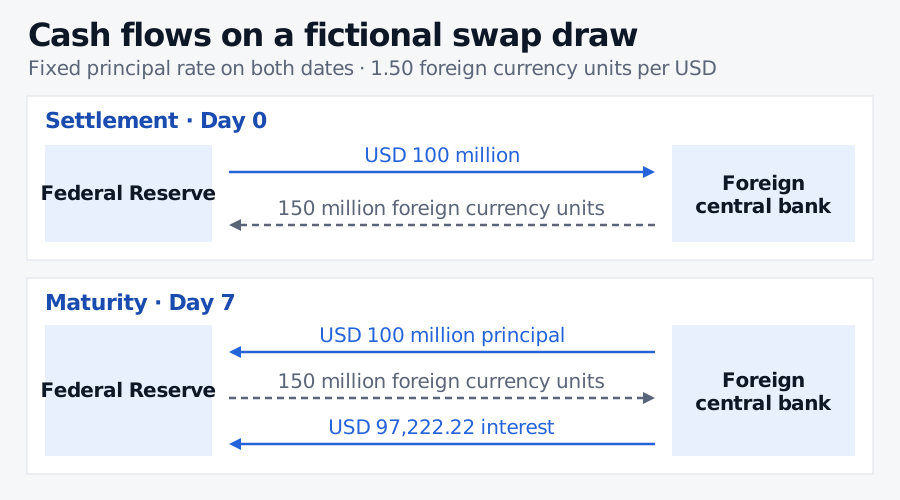
The two principals reverse at the original exchange rate. The drawing central bank pays dollar interest at maturity.
Follow the obligation to repay
The Fed takes counterparty credit risk on the foreign central bank under the swap. That central bank sets the terms of its own dollar loans, including eligibility and acceptable collateral, and bears the credit risk of those loans. If a local institution fails to repay, the central bank still owes the Fed under the swap. Fixing the exchange rate protects the scheduled principal payments from currency moves when the parties perform. Federal Reserve Board, Swap Lines FAQs
Read a draw separately from the line
A standing line is available funding capacity under an agreement. A draw is a particular transaction with an amount, settlement date and maturity date. To see when dollars actually went out or came due, read the operations results by settlement and maturity, along with the amount drawn. The New York Fed also flags small transactions used to test operational readiness. Those test draws have a different purpose from an operation responding to funding stress. New York Fed, Central Bank Swap Arrangements · Central Bank Liquidity Swap Operations