CCP recovery is action by a central counterparty under its recovery plan and rulebook to restore viability and keep critical clearing services running. CCP resolution is intervention by a public authority using powers under applicable law to protect those services and financial stability. For a clearing member, both can change the cash it must pay or the amounts it expects to receive precisely when its own funding is under stress. CPMI–IOSCO recovery guidance · FSB Key Attributes, FMI annex
A member defaults and the loss exceeds the ordinary resources
A default waterfall specifies the order in which designated resources absorb a member-default loss. Those resources can include the defaulter’s initial margin and default-fund contribution, dedicated CCP capital and pooled contributions from surviving members. The CCP’s own contribution, often called its skin in the game, gives its owners a direct stake in controlling clearing risk. Its size and place in the sequence affect that incentive. The order and the boundary between ordinary default management and recovery depend on the clearing service’s rules. RBA on CCP risk controls and incentives · CPMI–IOSCO recovery guidance, §4.2
Suppose a fictional clearing service incurs a default loss of 120 million units and uses all 100 million units of ordinary loss-absorbing resources stipulated for this example. Its unallocated loss, in millions, is
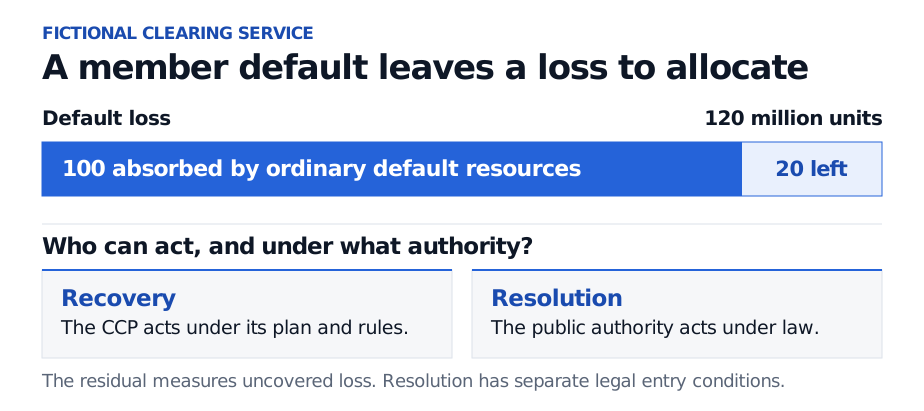
The bar shows how much loss remains after the example’s ordinary resources are used. The two panels distinguish who can act and where their powers come from.
Covering the loss and keeping clearing open
- Allocate the loss. A CCP may call for extra contributions under its rules. Where permitted, it can also reduce the variation margin gains it pays to members with net gains while continuing to collect in full from surviving members with net losses. A gain haircut reduces a cash outflow by allocating loss to recipients.
- Fund settlement on time. A CCP can have enough loss-absorbing resources on paper while still being short of usable cash in the right currency by the payment deadline. A repayable liquidity facility can bridge that timing gap. The underlying loss still needs to be allocated.
- Restore the clearing service. A member default can leave the CCP with unmatched market exposure. An auction can transfer the defaulter’s positions and restore offsetting obligations. The CCP may also need to replenish depleted buffers for subsequent stress.
A non-default loss can arise even when every clearing member pays. A cyber theft or a loss on invested collateral can threaten the CCP’s viability. Which capital, insurance or contractual arrangements can absorb the loss depends on its cause and the rules that apply. A member-default waterfall answers a different question. CPMI–IOSCO recovery guidance, §§4.2–4.6
The SelfMadeQuant lesson Margin and Collateral traces ordinary variation-margin payments and shows how a margin call restores a buffer while the trading loss remains. The public preview is open and the full lesson requires membership.
When a public authority can intervene
The 20 million units measure the uncovered loss in this example. Resolution has a separate legal test, and an authority can sometimes intervene before the CCP has exhausted its recovery tools. In the UK, for example, the Bank of England acts under Schedule 11 of the Financial Services and Markets Act 2023. The conditions include failure or likely failure, whether remedial action could work without endangering financial stability, whether intervention is necessary in the public interest, and how well winding up would serve the resolution objectives. If the conditions are met, a transfer to a temporary bridge CCP can keep critical clearing services available while a longer-term solution is arranged. FSB Key Attributes, FMI annex §§4.3–4.4 and 4.13 · HM Treasury’s CCP resolution code
For a clearing member’s stress test, the practical split is between loss borne and cash due by each deadline. An assessment can add to both. A cut to expected variation-margin receipts can strain funding even without a new cash call, especially when a member still owes on an offsetting position elsewhere. CPMI–IOSCO recovery guidance, §§4.2.17–4.2.23 and 4.3
Sources
- CPMI–IOSCO, Recovery of financial market infrastructures, revised July 2017. Recovery responsibility, planning, loss allocation, liquidity, replenishment and matched-book tools.
- FSB, Key Attributes of Effective Resolution Regimes for Financial Institutions, revised April 2024. FMI annex on resolution entry, powers and continuity of critical functions.
- HM Treasury, Central Counterparties Special Resolution Regime Code of Practice, January 2024. UK resolution objectives, entry conditions and bridge CCPs.
- Reserve Bank of Australia, Skin in the Game, June 2015. How default-waterfall contributions affect incentives.