Rule 10b-18 is a voluntary U.S. safe harbour for eligible open-market share buybacks of an issuer’s own common stock. It provides the issuer and its affiliated purchasers limited protection from market-manipulation liability based solely on how, when, at what price and in what volume they buy. A buyback authorisation sets the programme’s size. For an issuer seeking the safe harbour, the four conditions help explain how much of that authorisation can translate into demand on any given day. 17 CFR § 240.10b-18, Preliminary Note 1 and paragraph (b).
Four conditions apply to the same trading day
- Manner. Solicited repurchases generally come from or go through one broker or dealer per day. The issuer and its affiliated purchasers share that broker or dealer for those purchases.
- Timing. The issuer must avoid the opening regular-way purchase reported in the consolidated system. The restriction before each scheduled primary-session close applies in both the security’s principal market and the market of execution. It lasts 10 minutes if dollar ADTV is at least USD 1 million and public float is worth at least USD 150 million, and 30 minutes otherwise. A separate provision covers qualifying after-hours purchases.
- Price. For a stock with quotes and trades in the consolidated system, the ceiling at execution is the higher of the highest independent bid and the latest independent trade price. The reference can change between order entry and the fill.
- Volume. Under the ordinary test, the total number of shares bought that day by or for the issuer and its affiliated purchasers can be at most 25% of the security’s average daily trading volume (ADTV).
Missing one condition puts all of that day’s otherwise eligible repurchases outside the safe harbour. Rule 10b-18(d) says this alone creates no presumption of manipulation. The protection also excludes purchases that form part of a scheme to evade federal securities laws. 17 CFR § 240.10b-18, Preliminary Note 1 and paragraphs (b) and (d).
Which trading days count toward ADTV?
For the volume condition, ADTV averages the reported share volume over the four full calendar weeks before the week of the purchase. A midweek repurchase uses the same lookback as one on Monday of that week. Earlier days in the purchase week stay outside the denominator. SEC staff guidance counts an open trading day with zero volume in the average and leaves out a market holiday. 17 CFR § 240.10b-18(a)(1), SEC staff FAQ, questions 21 and 39.
Suppose a fictional U.S. common stock trades 80 million eligible shares over 20 trading days in the lookback. Assume the ordinary volume condition applies and the lookback contains no purchases made under the weekly block exception. ADTV is 4 million shares per day, so the daily total under the ordinary volume condition is at most
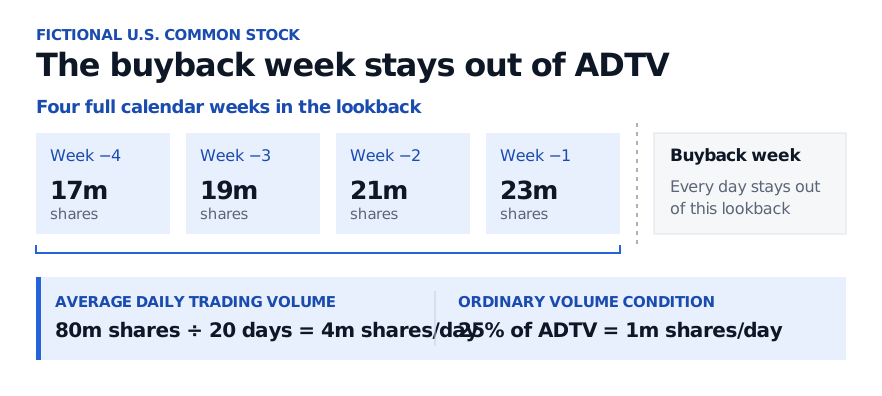
Every purchase day in the same calendar week uses the same four-week lookback. The daily volume test is applied separately to each day.
That ceiling covers volume alone. Available liquidity at eligible prices and times can leave the issuer with far fewer fills. An execution participation rate instead compares fills with market activity over the execution window. The TWAP, VWAP and Participation Algorithms lesson (public preview, full lesson for members) shows how that denominator affects scheduling and order completion.
When the ordinary calculation changes
The rule has a once-per-week alternative for a qualifying block. It replaces the ordinary volume test for that day, with no other Rule 10b-18 purchases that day, and the block is excluded from the four-week ADTV calculation. The other safe harbour conditions still apply. The rule excludes certain tender-offer purchases and repurchases during specified merger-related periods, with exceptions for some merger transactions. A privately negotiated accelerated share repurchase also falls outside this open-market safe harbour. 17 CFR § 240.10b-18(a)(5), (a)(13) and (b)(4), SEC staff FAQ, question 13.
Rule 10b5-1 sets out affirmative defences for trading alleged to be based on material nonpublic information, including qualifying prearranged plans. A buyback under such a plan is still evaluated separately under Rule 10b-18 if the issuer seeks the execution safe harbour. 17 CFR § 240.10b5-1(b) and (c), 17 CFR § 240.10b-18, Preliminary Note 1.
Sources
- 17 CFR § 240.10b-18, issuer repurchases. Operative rule text checked on 8 November 2026.
- SEC Division of Trading and Markets, Rule 10b-18 staff FAQ. Staff guidance last updated in December 2016.
- 17 CFR § 240.10b5-1, trading on material nonpublic information. Operative rule text checked on 8 November 2026.