Trace how a loss of net worth can turn into weaker spending, and distinguish active debt repayment from a contraction in credit supply.
Balance Sheet Recessions and Deleveraging
A balance sheet recession is a downturn in which widespread efforts by households or businesses to repair their balance sheets weaken aggregate demand. Deleveraging means reducing leverage, often by paying down debt or borrowing less than is being repaid. In Richard Koo’s account, borrowers can prioritise debt reduction even at low rates. A demand forecast that expects lower rates to revive spending through new borrowing can then overstate the recovery. Koo, The World in Balance Sheet Recession, pp. 19–22
The house loses value first. The repayment comes later.
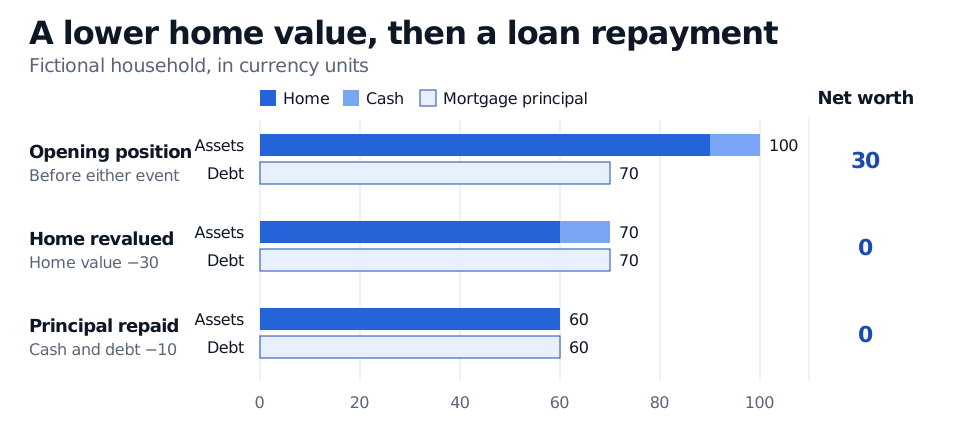
Take a fictional household with a home worth 90, cash of 10 and a mortgage balance of 70. All amounts are in the same currency units. Its net worth is 100−70=30. If the home is revalued at 60, assets fall to 70 and net worth falls to 70−70=0. The mortgage principal stays at 70. The household still has its 10 in cash.
Now suppose it uses that cash to repay 10 of principal. Holding the home value fixed and ignoring interest, fees and all other flows, assets and debt both fall to 60, so net worth stays at 60−60=0. The household owes less and has less liquid cash. Debt still equals 100% of marked assets, so the smaller debt balance leaves this leverage ratio unchanged. If it instead builds up cash from new income by cutting consumption, the saving builds net worth before that cash is used to repay principal.
Fictional household assets, debt and net worth start at 100, 70 and 30. A 30 loss in home value leaves 70, 70 and 0. A 10 cash repayment leaves 60, 60 and 0.
The lower home valuation erases the net-worth cushion. The later repayment reduces debt and cash by the same amount.
When debt repair weakens demand
When many households cut consumption or firms postpone investment to free up cash for repayment, businesses receive less revenue from those buyers. Aggregate demand falls if spending elsewhere, including by other borrowers, the government or overseas buyers, fails to make up the difference. The household’s balance sheet tells you what happened to its wealth and debt. The recession mechanism depends on how much borrowers reduce spending and how much other buyers spend in response. Koo, pp. 21–23
Two feedback loops can deepen the downturn. In Fisher’s debt-deflation mechanism, a fall in the general price level raises the purchasing power of each unit of fixed nominal debt still outstanding, so the real burden can rise even as borrowers repay principal. If the heavier burden prompts further spending cuts, they can put more downward pressure on prices. In the financial accelerator, lower borrower net worth can raise the cost of external finance and depress investment, further weakening activity and cash flows. A fall in home prices can damage net worth before any broad deflation occurs. Fisher, paragraphs 29–33 · Bernanke, Gertler and Gilchrist, §§3–4
What falling debt can tell you
Outstanding debt can fall because borrowers repay faster, because fewer loans are originated or because balances are extinguished after default. John Krainer’s study of U.S. consumers after the housing bust found larger declines in nonmortgage debt among borrowers with lower credit scores, including among borrowers who stayed current on their mortgages. He interpreted this as evidence that tighter lending likely also mattered, while recognising that different borrowing demand could contribute to the pattern. Krainer, Consumer Debt and the Economic Recovery, figures 2–4 and conclusion
A macro stress test can model the two channels separately. Track new originations, principal repayments and debt extinguished after default alongside consumption and business investment. Applications, approvals and lending standards can help distinguish borrowers choosing to borrow less from lenders offering less credit. Falling balances and weak spending together are consistent with both channels.