Automatic stabilizers are existing tax and benefit rules that cushion swings in household income and spending as the economy moves through the business cycle. In a downturn, taxable incomes can shrink and more workers can qualify for unemployment benefits. Tax receipts fall and benefit payments rise under the same rules, which can widen the fiscal deficit. A cyclically adjusted balance estimates what the budget balance would be with the economy at potential, holding policy fixed. For a sovereign budget forecast, the distinction separates receipts lost to a downturn from receipts lost to a newly enacted tax cut. Congressional Budget Office, “Background” and “Budget Deficits Without Automatic Stabilizers”.
A tax bill that falls on its own
In a fictional economy, households pay a flat 25% tax on all income. With no transfers, their disposable income is pre-tax income less tax. Suppose the annual pre-tax income of households falls from 1,000 at potential to 900 in the downturn. Tax falls from 250 to 225, and disposable income falls from 750 to 675. Of the 100-unit income loss, households bear 75 and the budget absorbs 25 through lower receipts. The tax law stays the same.
With annual government expenditure fixed at 250 and no other revenue, a balanced budget at potential becomes a deficit of 25 in the downturn. A newly legislated rate cut would be a discretionary fiscal policy decision even if its initial cost were also 25. The tax example measures the immediate income cushion. The effect on GDP would depend on how households and firms respond, which is the separate question addressed by a fiscal multiplier.
What each adjustment removes
The headline balance is the recorded revenue minus recorded expenditure. Use the surplus-positive convention throughout, so a negative number is a deficit. In the decomposition set out in the IMF technical note on structural balances, the cyclical balance is the estimated signed contribution of the business cycle. Subtract it from the headline balance to get the cyclically adjusted balance. In the downturn above, the contribution is negative, so removing it raises the balance. IMF technical note, section II.A.
Now suppose the government also authorises a one-time emergency infrastructure repair costing 10 in the same downturn. Assume it qualifies as a one-off in the IMF note's framework and has no feedback on taxable incomes or other outlays. The three balances differ:
- Headline. Receipts of 225 less total spending of 260 give .
- Cyclically adjusted. Restore the 25 of cyclical revenue while retaining the repair. The balance is .
- Structural. Also remove the repair outlay. With no other transitory adjustments in this example, the balance is .
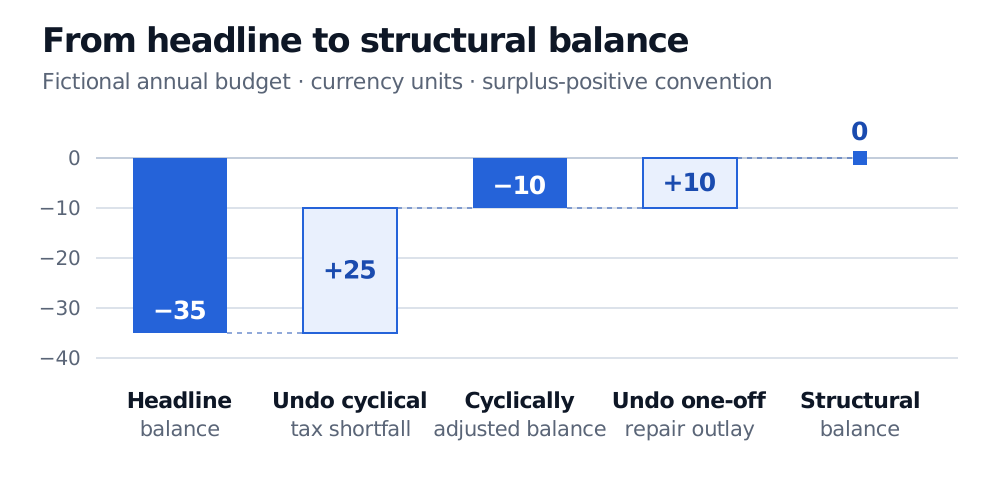
Fictional annual balances in currency units. The solid marks show balances. The outlined steps undo negative contributions to the headline balance.
In the IMF note's framework, structural adjustments can also remove other temporary influences, such as exceptional commodity-price revenue that the output cycle fails to capture. What qualifies depends on the framework and the fiscal item. A one-off can still be a discretionary decision, as the repair shows. The IMF's Fiscal Monitor also reports a cyclically adjusted primary balance, which separately excludes net interest payments. When comparing series, match the type of balance and check whether the figures use actual GDP or potential GDP as the denominator. IMF technical note, figure 1 and appendix I. IMF Fiscal Monitor, April 2026 glossary and table A4.
When the estimate changes
In the toy economy the full 100-unit income loss was assumed cyclical. In real data, potential output is estimated. An analyst needs an output gap, which measures actual output relative to estimated potential. The adjustment also uses elasticities that describe how strongly revenues and some outlays respond to the cycle. For example, a slump concentrated in corporate profits can affect receipts differently from one concentrated in household spending. The US Congressional Budget Office's 2022 report uses both the output gap and the gap between actual and noncyclical unemployment to estimate federal revenue and outlay responses. IMF technical note, section II.B. CBO, “Background”.
If potential output is revised down toward actual output in a downturn, a model with unchanged positive budget sensitivity will generally attribute less of the shortfall to the cycle. The adjusted balance can then worsen even if the headline figures stay put. In historical analysis, use the release vintage available on the decision date. To measure a particular policy change, compare the measure with an unchanged-policy baseline. A change in the adjusted balance can also reflect demographics or shifts in the mix of taxable incomes and spending that the cyclical model leaves in the residual. IMF fiscal rules primer, “Cyclically-Adjusted Balance Rules”. CBO, “Budget Deficits Without Automatic Stabilizers”.
Sources
- Congressional Budget Office — Automatic Stabilizers in the Federal Budget, October 2022
- Bornhorst and colleagues — When and How to Adjust Beyond the Business Cycle? A Guide to Structural Fiscal Balances, IMF technical note, April 2011
- IMF — Fiscal Monitor, April 2026
- IMF — Fiscal Policy: How to Select Fiscal Rules, A Primer, March 2018