An auditor’s opinion is the independent auditor’s conclusion on whether the financial statements comply, in all material respects, with the applicable reporting framework. An unmodified opinion reflects reasonable assurance about the statements as a whole. A going-concern disclosure addresses whether the business can keep operating. A material weakness identifies a serious deficiency in the controls that produce financial reports. For a quant, these are separate fields that change how you interpret financial statement data. Either warning can accompany an unmodified financial statement opinion. AUASB ASA 700, paragraphs 10–17 and 38 · PCAOB AS 2201, paragraphs .02–.03 and .90–.92
What did the auditor establish?
Australia’s ASA 705 makes two judgments central to a modified opinion. First, did the auditor establish a misstatement, or is there too little reliable evidence to determine whether one exists? Second, how far do the effects, or possible effects, reach? Pervasive effects can extend across the report, affect a substantial share of it even if confined to one item, or involve disclosure essential to understanding the report. AUASB ASA 705, paragraphs 5–10
Consider four versions of an audit at a fictional equipment group. Assume each case is assessed independently, the auditor issues a report, and the auditor has already judged materiality and pervasiveness.
- Qualified, established misstatement. Audit evidence shows that one small division failed to write down obsolete inventory. Management leaves the material error uncorrected, and the effects are confined.
- Qualified, evidence gap. The auditor cannot verify inventory at one site, even through alternative procedures. Any undetected errors there could be material, with effects confined to that part of the report.
- Adverse. Audit evidence shows that the group omitted a major subsidiary it was required to consolidate. The uncorrected omission materially distorts the statements throughout.
- Disclaimer. A records failure affects the group’s core operations. Alternative procedures cannot provide enough evidence about revenue, inventory and receivables, and undetected errors could be both material and pervasive. The auditor declines to express an opinion.
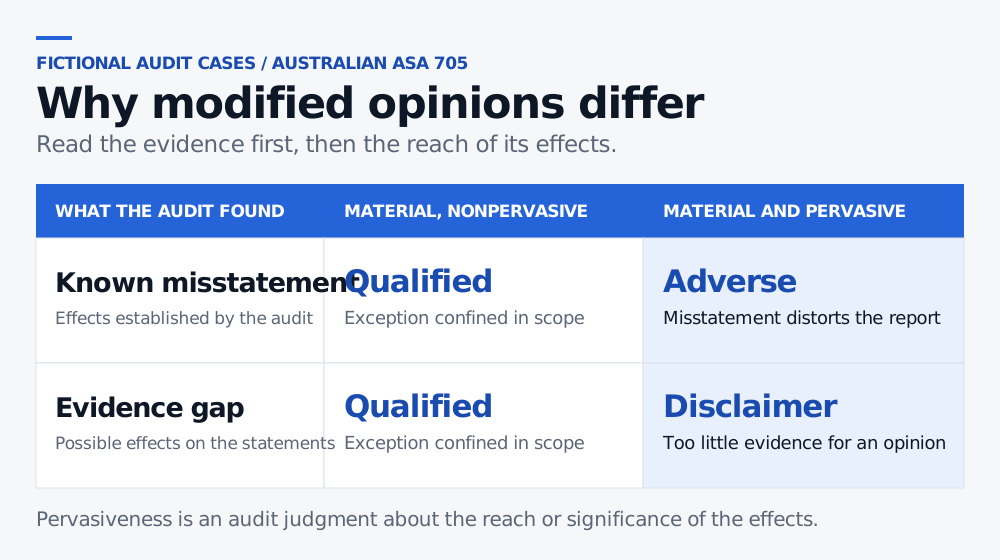
Fictional audit cases under ASA 705. The rows distinguish effects established by the audit from possible effects the auditor could not resolve.
If both reports say Qualified Opinion, read the basis section and the exact wording of the opinion. The wording distinguishes the effects of an identified error from the possible effects of missing evidence. An adverse opinion gives a conclusion about the report. A disclaimer leaves the reader without an audit opinion on it. AUASB ASA 705, paragraphs 16–24 and A1
An unmodified opinion can come with a going-concern warning
The going-concern basis assumes the entity will continue operating for the foreseeable future and will realise assets and settle liabilities in the ordinary course of business. Management assesses whether that basis is appropriate. The auditor evaluates management’s assessment and gathers evidence. If a major debt maturity depends on refinancing, that can involve assessing the reliability of the cash flow forecast and looking for evidence that management’s funding plans are feasible. AUASB ASA 570, paragraphs 2–7, 12–18 and A16–A20
The Australian ASA 570 compilation for periods beginning from 1 January 2023 through 14 December 2026 sets out these outcomes, assuming the revised standard was not adopted early.
- Appropriate basis, adequately disclosed material uncertainty. The opinion is unmodified if no other matter requires modification. The auditor’s report includes a distinct Material Uncertainty Related to Going Concern section pointing to the relevant note. The section flags the uncertainty even when the financial statements fairly report it.
- Appropriate basis, inadequately disclosed material uncertainty. The auditor gives a qualified or adverse opinion depending on pervasiveness and explains the omitted or inadequate disclosure in the basis section.
- Inappropriate use of the going-concern basis. If management uses that basis anyway, the auditor gives an adverse opinion.
- Insufficient evidence to conclude. An evidence gap about going concern may lead to qualification or disclaimer, depending on the possible effects.
A generic Emphasis of Matter paragraph draws attention to something already properly presented or disclosed. When ASA 701 requires a Key Audit Matters section, that section points readers to the dedicated going-concern or basis section for matters reported there. AUASB ASA 570, paragraphs 19–24 and A35 · ASA 706, paragraphs 7–9 · ASA 701, paragraph 15
The revised Australian ASA 570 and the international ISA 570 (Revised 2024) apply to periods beginning on or after 15 December 2026. Australia permits early adoption with the related amendments. Under the revised Australian rules, when the auditor concludes that the basis is appropriate and identifies no material uncertainty, the report includes a separate Going Concern section, subject to the exception for disclaimers. The material-uncertainty section also cross-refers to the basis section when inadequate disclosure causes a qualified or adverse opinion. Read the conclusion inside the section and use the standard applicable to the reporting period. Revised ASA 570, operative date and paragraphs 34–38 · AUASB early adoption policy · IAASB effective date
Material weakness is about the reporting controls
In a US integrated audit under PCAOB AS 2201, a material weakness is a control deficiency, or combination of deficiencies, that creates a reasonable possibility of a material error in annual or interim financial statements escaping timely prevention or detection. For example, suppose no effective review catches substantial manual revenue entries, but substantive audit work establishes that the issued statements are fairly presented. The auditor can issue an adverse opinion on internal control over financial reporting and an unqualified opinion on the financial statements in the same audit. PCAOB AS 2201, paragraphs .02–.03, .62–.69, .90–.92 and .A7
Keep the three signals separate in a dataset
Capture the financial statement opinion and its basis, the going-concern conclusion and the note it references, and the controls conclusion where one is reported. An unmodified opinion can accompany a material going-concern uncertainty. In a credit model, the statements can supply starting balances while the disclosed refinancing risk informs a separate stress scenario. The report identifies a source of risk. A default probability requires a separate estimate.
In an event study, use the first public disclosure that actually contains the signal. In a replay of a trading process, allow for when the document was received and parsed. The period end, the report’s signature date and the time the market could first see the conclusion can all differ. The SelfMadeQuant lesson on Observation, Event and Availability Timestamps works through these distinctions. The preview is public, and the full lesson is available to members.
Sources
- AUASB ASA 700, Forming an Opinion and Reporting on a Financial Report
- AUASB ASA 705, Modifications to the Opinion in the Independent Auditor’s Report
- AUASB ASA 570, March 2023 compilation and May 2025 revision
- AUASB recently issued standards and early adoption policy and IAASB ISA 570 (Revised 2024)
- AUASB ASA 701, Communicating Key Audit Matters and ASA 706, Emphasis of Matter and Other Matter Paragraphs
- PCAOB AS 2201, An Audit of Internal Control Over Financial Reporting That Is Integrated with An Audit of Financial Statements